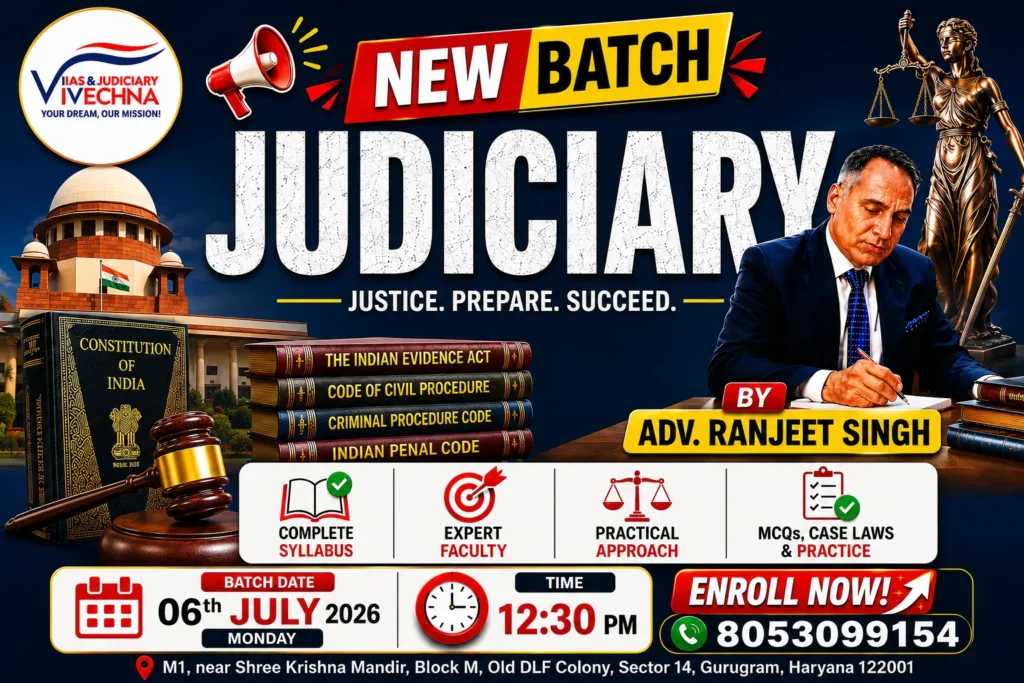
Every year, thousands of law graduates dream of wearing the black robe and delivering justice from the bench. Yet only a handful convert that dream into a reality — because judicial services exams demand more than just knowledge of bare acts; they demand structured guidance, disciplined practice, and mentorship from people who have walked the path before. That is exactly the gap Vivechna IAS & Judiciary Academy aims to fill with its brand-new Judiciary Batch 2026, launching on 6th July 2026 (Monday) at 12:30 PM from its Gurugram campus.
If you are a law graduate, final-year LLB student, or a working professional preparing for PCS-J, Civil Judge, or Judicial Services exams, this new batch is designed to take you from foundational concepts to exam-ready answer writing under the mentorship of Adv. Ranjeet Singh and a team of experienced faculty members.
In this article, we cover everything you need to know — from the batch details and admission process to a complete roadmap of the Judiciary Examination in India, including eligibility, exam pattern, syllabus, preparation strategy, and career prospects after clearing the exam.
Judiciary Batch 2026: Key Details at a Glance
Detail | Information |
Batch Name | New Judiciary Batch – “Justice. Prepare. Succeed.” |
Batch Start Date | 6th July 2026 (Monday) |
Timing | 12:30 PM |
Faculty Adv. | Ranjeet Singh and expert panel |
Institute | Vivechna IAS & Judiciary Academy |
Address | M1, near Shree Krishna Mandir, Block M, Old DLF Colony, Sector 14, Gurugram, Haryana 122001 |
Contact | +91 8053099154 |
Course Coverage | Complete syllabus, expert faculty, practical approach, MCQs, case laws & practice |
Whether you are just starting your judiciary preparation or looking to switch to a more result-oriented judiciary coaching in Gurgaon, this batch is built to give you a genuine head start for the 2026–27 exam cycle.
Why “Justice. Prepare. Succeed.” Is More Than Just a Tagline
The tagline of the new batch — Justice. Prepare. Succeed. — is a deliberate reflection of the three-stage journey every judiciary aspirant must undertake:
- Justice represents the constitutional ideal every judicial officer is sworn to uphold — the very reason lakhs of aspirants choose this career path over any other.
- Prepare reflects the rigorous, disciplined, and structured preparation required to crack one of India’s toughest legal examinations, covering everything from the Constitution of India to the Indian Penal Code, Criminal Procedure Code, Code of Civil Procedure, and the Indian Evidence Act.
- Succeed is the outcome Vivechna IAS & Judiciary Academy promises to work toward with every student — through mentorship, test series, and personalised feedback.
This philosophy underlines the entire teaching methodology of the academy, and the new batch commencing on 6th July 2026 is structured around exactly this three-stage approach.
What Is the Judiciary Exam in India?
The Judiciary Exam, often referred to as the PCS-J (Provincial Civil Services – Judicial) exam or Civil Judge exam, is a state-level competitive examination conducted by various State Public Service Commissions and High Courts to recruit Civil Judges (Junior Division) and, in some states, judicial magistrates.
Unlike UPSC or HPSC exams, judiciary exams are conducted independently by each state — for example, Delhi Judicial Service, UP Judiciary (UPPCS-J), Haryana Civil Judge Exam, Rajasthan Judicial Service, MP Judiciary, and more. Each state has its own notification, syllabus nuances, and local law components, though the core structure remains largely similar across India.
Clearing the judiciary exam allows a law graduate to be directly appointed as a Civil Judge, entering the judicial services at an entry-level position with a defined promotional hierarchy leading up to the District Judge cadre and, eventually, potential elevation to the High Court.
Eligibility Criteria for Judiciary Exams
While specific eligibility conditions vary slightly by state, the general requirements are:
- Educational Qualification: A Bachelor’s degree in Law (LLB) from a recognised university. Some states allow final-year students to apply provisionally.
- Age Limit: Typically between 21–35 years, with relaxations for reserved categories (SC/ST/OBC/PwD) as per state rules.
- Bar Enrollment: Some states require candidates to be enrolled as advocates with the Bar Council, while others (like Delhi Judicial Service) do not mandate prior practice.
- Nationality: Must be an Indian
- Domicile: Several states require a domicile certificate of that particular state, though a few states have relaxed this requirement following judicial pronouncements.
Because eligibility rules differ meaningfully between states, aspirants are strongly advised to check the latest official notification for their target state before applying.
Selection Process for Judiciary Exams
The judiciary examination follows a three-stage selection process, similar in structure to UPSC but with a heavier emphasis on law:
1. Preliminary Examination
The Prelims is an objective-type screening test, usually consisting of General Knowledge, English/Hindi language, and Law-related MCQs covering the Constitution, IPC, CrPC, CPC, Evidence Act, and local/state-specific laws. This stage is only qualifying in most states — marks are not usually added to the final merit, except in a few states.
2. Mains Examination
The Mains is a descriptive, subjective examination consisting of multiple papers, typically including:
- General Knowledge / Current Affairs
- Language papers (English and Hindi/regional language, including translation and essay)
- Civil Law – I and II (CPC, Transfer of Property Act, Contract Act, Hindu Law, Muslim Law, etc.)
- Criminal Law (IPC, CrPC, Evidence Act)
- Judgment/Award Writing
This stage tests not just legal knowledge, but the candidate’s ability to apply law to facts and write structured, well-reasoned answers — a skill that requires focused answer writing practice.
3. Interview / Viva Voce
Candidates who clear the Mains are called for a personality test / viva voce, conducted by a panel usually comprising sitting or retired judges. This stage assesses legal aptitude, presence of mind, communication skills, and suitability for judicial office. A well-prepared mock interview program can make a significant difference at this stage.
The final merit list is typically prepared by combining Mains and Interview marks (Prelims being qualifying only, in most states).
Judiciary Exam Pattern: An Overview
While the exact pattern differs across states, a typical judiciary exam pattern looks like this:
Prelims:
- Objective/MCQ-based
- 100–150 questions
- Negative marking usually applicable
- Duration: 2 hours
Mains:
- 4–6 descriptive papers
- Each paper carries 100–200 marks
- Total duration per paper: 3 hours
- Includes law papers, language papers, and judgment writing
Interview:
- Usually 50–100 marks
- Conducted by a board of judges/legal experts
Understanding the exact weightage and pattern of your target state is essential, and Vivechna’s Judiciary Exams coaching program provides state-specific pattern analysis as part of the curriculum
Detailed Judiciary Syllabus: Subject-Wise Breakdown
Constitutional Law
Constitutional Law forms the backbone of the judiciary syllabus. Key areas include:
- Fundamental Rights and Directive Principles
- Basic Structure Doctrine
- Union and State legislative relations
- Powers of the President, Governor, and Judiciary
- Writ jurisdiction (Articles 32 and 226)
- Constitutional Amendments and landmark judgments
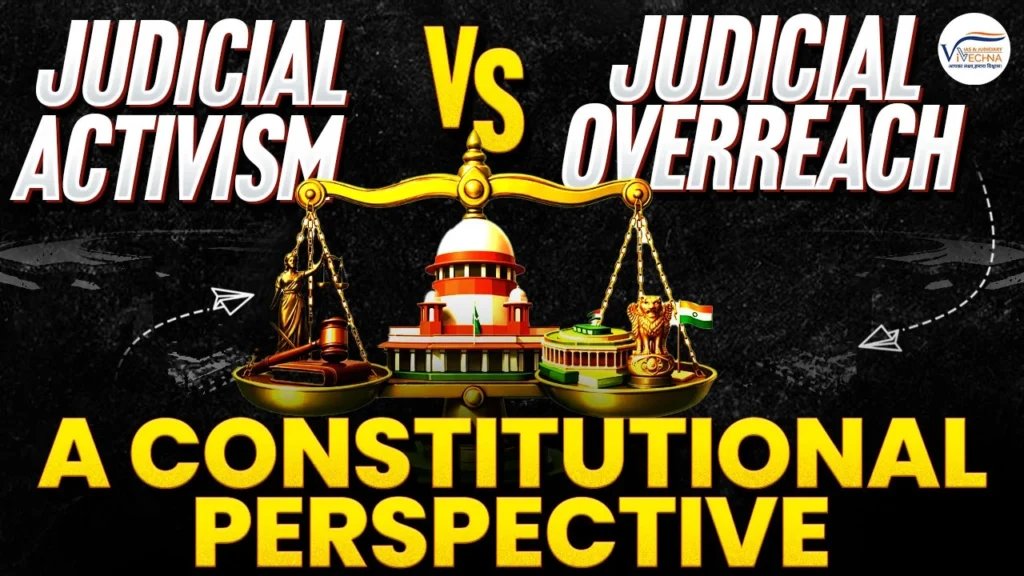
A strong grip on constitutional law is essential not only for the written exams but also for the interview stage, where questions on judicial activism, separation of powers, and constitutional morality are common. Aspirants can also read our detailed piece on Judicial Activism vs Judicial Overreach for deeper conceptual clarity, along with our analysis of the Role of Judiciary in India.
Civil Law
Civil Law papers typically test the candidate’s understanding of:
- Code of Civil Procedure (CPC), 1908 — pleadings, jurisdiction, appeals, execution
- Indian Contract Act, 1872
- Transfer of Property Act, 1882
- Hindu Law and Muslim Law (personal laws)
- Specific Relief Act
- Law of Torts
Civil law questions in the Mains often involve drafting of pleadings, framing of issues, and practical problem-solving based on hypothetical case facts.
Criminal Law
Criminal Law is one of the highest-weightage sections and includes:
- Indian Penal Code (IPC) / Bharatiya Nyaya Sanhita (BNS)
- Code of Criminal Procedure (CrPC) / Bharatiya Nagarik Suraksha Sanhita (BNSS)
- Indian Evidence Act / Bharatiya Sakshya Adhiniyam (BSA)
- Juvenile Justice Act, POCSO Act, and other special criminal statutes
With the recent transition from the IPC, CrPC, and Evidence Act to the new BNS, BNSS, and BSA framework, aspirants must be thoroughly updated on the new provisions. Our dedicated resource on the Judiciary Batch for Bharatiya Sakshya Adhiniyam (BSA) is a good starting point for this transition.
Procedural Laws
Beyond substantive law, judiciary exams place significant emphasis on procedural mastery:
- Civil and criminal procedure (CPC, CrPC/BNSS)
- Limitation Act
- Court fees and suit valuation
- Rules of pleading and drafting
Procedural law questions test practical application — how a judge would actually handle a case from filing to final order — making case-based practice indispensable.
Language Papers
Most states require candidates to clear language papers in English and Hindi (or the relevant regional language), which typically test:
- Essay writing
- Précis writing
- Translation (English to Hindi and vice versa)
- Grammar and comprehension
Translation, in particular, is often underestimated but heavily scored. Our detailed guide on
Translation for Judiciary Exams offers proven tips to strengthen this section.
Current Legal Developments
Judiciary exams — especially the interview stage — frequently test awareness of:
- Recent Supreme Court and High Court judgments
- Constitutional amendments and new legislation
- Legal reforms such as the BNS, BNSS, and BSA
- Landmark rulings on criminal procedure, property rights, and constitutional law
Staying updated through daily legal news analysis, such as Vivechna’s coverage of rulings on CrPC Section 156(3) and property rights disputes, ensures aspirants are never caught off guard in interviews or current-affairs-based questions.
Answer Writing Strategy for Judiciary Mains
Answer writing is the single biggest differentiator between candidates who clear the Mains and those who don’t. A strong answer should:
- Start with the relevant legal provision — cite the exact section/article before explaining it.
- Apply the law to the facts — especially in problem-based questions, show step-by-step legal reasoning.
- Cite case laws wherever relevant, briefly and
- Structure the answer — introduction, legal analysis, application, and
- Practice judgment writing separately, as it follows a distinct structural format (facts, issues, arguments, reasoning, and final order).
For a deeper, topic-wise strategy, refer to our detailed guide on Judiciary Mains Answer Writing.
Preparation Tips for Judiciary Aspirants
- Master the bare acts first — before moving to commentaries or case laws, ensure a strong hold on the exact wording of statutes. Our guide on mastering bare acts for judiciary exams offers proven strategies for this.
- Make short, revisable notes for each Act, rather than relying solely on bulky
- Practice previous year papers state-wise to understand recurring question
- Attempt regular mock tests to build speed and accuracy for the objective Prelims
- Dedicate fixed hours to answer writing every week, not just before the Mains
- Stay updated on current legal developments, especially new codifications like BNS, BNSS, and BSA.
Common Mistakes Judiciary Aspirants Should Avoid
- Ignoring bare acts in favour of shortcut notes or coaching handouts
- Ignoring language papers, assuming law papers alone will carry them
- Ignoring local/state-specific laws and rules, which often carry dedicated Mains
- Neglecting answer writing practice until the last few months before
- Not revising previous attempts’ question papers, missing recurring
- Poor time management during the exam, leading to incomplete papers despite good
- Skipping interview preparation, assuming the written exam is the only
Time Management Techniques for Judiciary Preparation
Given the vast syllabus, structured time management is critical:
- Create a subject-wise weekly timetable, allotting fixed slots for civil law, criminal law, constitutional law, and language practice.
- Follow the Pomodoro technique or timed study blocks to maintain focus during long study sessions.
- Allocate separate time for revision, not just first reading — most aspirants under-allocate time for revision cycles.
- Simulate exam conditions during mock tests to build stamina for 3-hour descriptive
- Balance current affairs and static law preparation so that neither is neglected closer to the exam.
For an in-depth roadmap, see our detailed article on Time Management for Judiciary Exam. Preparation
Career Opportunities After Qualifying the Judiciary Exam
Clearing the judiciary exam opens a respected and stable career path, including:
- Civil Judge (Junior Division): The entry-level judicial post, with a defined promotional
- Promotion to Senior Judicial roles: Over time, judicial officers can be promoted to Civil Judge (Senior Division), Chief Judicial Magistrate, District Judge, and beyond.
- Elevation to the High Court: Exceptional judicial officers may, after significant experience, be considered for elevation to the High Court bench.
- Job security and social prestige: Judicial service offers one of the most respected and secure career paths available to law graduates in India, along with attractive pay scales, allowances, and government benefits.
If you are also weighing judiciary against other career paths, our comparative guides — IAS vs Judiciary: Which Career Is Better? and Can You Prepare for IAS and Judiciary Together? , can help you make an informed decision.
Why Choose Vivechna IAS & Judiciary Academy for Judiciary Preparation?
With multiple coaching institutes claiming to be the “best judiciary coaching,” here’s what genuinely sets Vivechna IAS & Judiciary Academy apart for the 2026 batch:
1. Experienced and Result-Oriented Faculty
The new batch is led by Adv. Ranjeet Singh, supported by a panel of experienced faculty members, many of whom bring courtroom and mentoring experience directly relevant to judicial services preparation.
2. Complete and Structured Syllabus Coverage
As highlighted in the batch promotion itself, the program promises complete syllabus coverage, ensuring no topic — from Constitutional Law to Local Acts — is left out. Explore the full Judiciary Exams coaching program for detailed course structure.
3. Practical Approach with MCQs, Case Laws & Practice
Rather than relying purely on rote learning, the curriculum integrates MCQ practice, case law analysis, and applied problem-solving, mirroring the actual demands of the Prelims and Mains exams.
4. Dedicated Answer Writing and Test Series
Regular answer writing sessions and a full-length test series help students benchmark their preparation, identify weak areas, and build exam-day stamina well before the actual exam.
5. Mock Interview Program
For those progressing to the final stage, Vivechna’s mock interview program, conducted with retired judges and legal experts, prepares candidates for the pressure and nuance of the judicial viva voce.
6. Personalised Mentorship
With small batch sizes and a dedicated mentorship programme, students receive individual attention and tailored feedback — a critical factor for cracking a subjective, writing-heavy exam like the judiciary Mains.
7. Coverage of Other State Judiciary Exams
Beyond the core program, Vivechna also supports aspirants preparing for other state judiciary and HPSC/HCS exams, along with UPSC preparation for those exploring both civil services and judicial services as career options.
8. Central, Accessible Location
Located at M1, near Shree Krishna Mandir, Block M, Old DLF Colony, Sector 14, Gurugram, Haryana 122001, the academy is easily accessible for aspirants based in Gurgaon, Delhi NCR, and surrounding regions looking for reliable judiciary coaching in Gurgaon.
Frequently Asked Questions (FAQs)
Q1. When is the new Judiciary Batch 2026 starting at Vivechna IAS & Judiciary Academy? The new Judiciary Batch begins on 6th July 2026 (Monday) at 12:30 PM at the Gurugram campus.
Q2. Who is teaching the new Judiciary Batch? The batch is led by Adv. Ranjeet Singh, along with a team of experienced faculty specialising in Constitutional, Civil, and Criminal Law.
Q3. What does the Judiciary Batch curriculum cover? The program covers the complete judiciary syllabus — Constitutional Law, Civil Law, Criminal Law, Procedural Laws, and Language papers — along with MCQ practice, case law discussions, and answer writing sessions.
Q4. Is this batch suitable for beginners? Yes. The batch is designed to take aspirants from foundational legal concepts through to advanced Mains-level answer writing and interview preparation, making it suitable for both beginners and those re-attempting the exam.
Q5. Where is Vivechna IAS & Judiciary Academy located? The academy is located at M1, near Shree Krishna Mandir, Block M, Old DLF Colony, Sector 14, Gurugram, Haryana 122001.
Q6. How can I enroll in the new Judiciary Batch? You can enroll by calling +91 8053099154
or by visiting the Contact Us page on the Vivechna IAS website to book a seat or demo class.
Q7. Does Vivechna provide a test series and mock interviews for judiciary aspirants? Yes, the program includes a dedicated judiciary test series, regular answer writing practice, and a mock interview program conducted with experienced legal mentors ahead of the final viva voce stage.
Q8. Does Vivechna also offer coaching for UPSC and HPSC alongside Judiciary? Yes, Vivechna IAS & Judiciary Academy is a multi-exam institute offering dedicated coaching for UPSC Civil Services, HPSC/HCS, CLAT, and Judicial Services, allowing students to explore combined preparation strategies where relevant.
Enroll Now — Seats Are Limited!
The judiciary exam rewards those who prepare early, consistently, and under the right guidance. With the new Judiciary Batch starting 6th July 2026 at 12:30 PM, this is the right moment to begin — or restart — your journey toward becoming a Civil Judge.
📞 Call now to enroll: +91 8053099154 📍 Visit us at: M1, near Shree Krishna Mandir, Block M, Old DLF Colony, Sector 14, Gurugram, Haryana 122001
Justice. Prepare. Succeed. Your journey to the bench starts here — with Vivechna IAS & Judiciary Academy.