Judiciary Batch for Bharatiya Sakshya Adhiniyam (BSA): Build a Strong Foundation for Judicial Services Success
India's legal system is in the midst of a historic transformation. With the enactment of the Bharatiya Sakshya Adhiniyam (BSA), the Indian Evidence Act, 1872 — a colonial-era legislation that governed evidentiary procedures for over 150 years — has been formally replaced. For every serious Judiciary aspirant, this change is not merely academic. It is a shift that directly affects what will be tested, how deeply, and in what format across state-level Judicial Services Examinations.
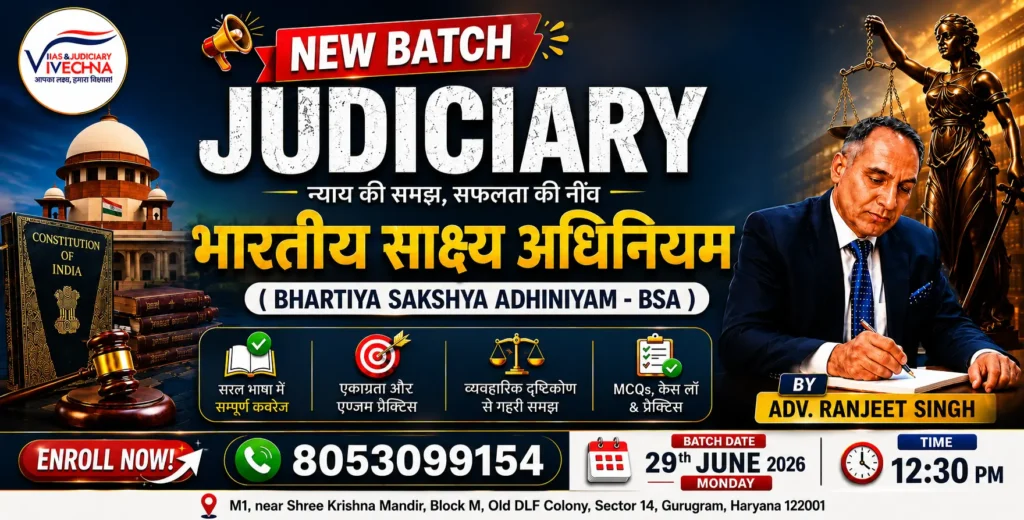
To help candidates navigate this transition with clarity and confidence, Vivechna IAS & Judiciary Academy, Gurugram has launched a dedicated Judiciary Batch on Bharatiya Sakshya Adhiniyam, conducted under the expert guidance of Advocate Ranjeet Singh. The course is structured to take students from foundational understanding through to advanced examination-level mastery — covering conceptual clarity, statutory provisions, MCQ practice, case law analysis, and mains answer writing.
Why Bharatiya Sakshya Adhiniyam Is Critical for Judiciary Examinations
Evidence law is not one subject among many in Judicial Services preparation — it is foundational. Every civil and criminal matter before a court ultimately depends on the admissibility, relevancy, and evaluation of evidence. A Judicial Officer who does not have a firm command over evidence law cannot adjudicate effectively.
The Bharatiya Sakshya Adhiniyam (BSA) is now the governing statute for this entire domain. Judiciary examination authorities across states have already begun incorporating its provisions, and this emphasis is expected to deepen in future examination cycles.
Whether you are preparing for:
- Haryana Judiciary
- Delhi Judiciary
- Rajasthan Judiciary
- Punjab Judiciary
- Uttar Pradesh Judiciary
- Bihar Judiciary
- Madhya Pradesh Judiciary
- Any other State Judicial Services Examination
A thorough, updated understanding of the Bharatiya Sakshya Adhiniyam is essential for both the Preliminary and Mains stages of all Judicial Services Examinations.
What the Bharatiya Sakshya Adhiniyam Changes — and Why It Matters
The BSA modernises India's evidence law framework in several significant ways while retaining many of its foundational principles.
● Simplifying evidentiary procedures for more efficient trial management
● Formally recognising electronic and digital evidence within the legal framework
● Strengthening transparency in judicial proceedings
● Aligning evidentiary processes with contemporary technology
For Judiciary aspirants, these changes matter enormously. The provisions on electronic evidence, digital records, and digital authentication are entirely new areas that were either absent or inadequately addressed in the old Indian Evidence Act. Examination authorities are expected to test these provisions heavily in coming years, and candidates who understand them deeply will carry a meaningful advantage.
About the Judiciary Batch at Vivechna IAS & Judiciary Academy
A structured, analytical and examination-focused approach to mastering Bharatiya Sakshya Adhiniyam for Judicial Services Examinations.
Program Philosophy
The BSA Judiciary Batch has been designed from the ground up for aspirants preparing for Judicial Services Examinations. The approach is analytical and examination-oriented, not encyclopaedic.
Rather than attempting to cover everything superficially, the course builds genuine understanding of every major area of evidence law as tested in competitive examinations.
Complete Coverage in Accessible Language
Legal provisions are inherently dense, and many Judiciary aspirants struggle to translate statutory language into practical understanding. This course addresses that challenge directly.
- The meaning and purpose of each provision
- Important legal definitions and terminology
- Core evidentiary principles and rationale
- Practical courtroom applications
- Judicial interpretation through landmark case laws
Examination-Oriented Preparation
This ensures students are not just knowledgeable, but fully examination-ready.
Practical Legal Understanding
Evidence law cannot be mastered through theory alone. The batch integrates real-life courtroom scenarios, case-based discussions, and application-driven learning.
This strengthens both conceptual clarity and retention, while preparing candidates for increasingly application-based Judiciary examinations.
MCQ and Case Law Practice
Key Topics Covered in the BSA Course
Comprehensive coverage of all major areas of the Bharatiya Sakshya Adhiniyam relevant to Judicial Services Examinations.
Introduction to Evidence Law
Students begin with the conceptual foundations: meaning and purpose of evidence, scope of evidence law, and the distinction between relevancy and admissibility. This foundation ensures deeper understanding rather than rote memorisation.
Relevancy of Facts
One of the most frequently tested areas in Judiciary exams. It includes relevant facts, facts in issue, admissions, confessions, and statements of persons who cannot be called as witnesses.
Admissions and Confessions
Covers types of admissions, evidentiary value, judicial vs extra-judicial confessions, confessions before police officers, and legal principles governing retraction.
Dying Declaration
A crucial criminal law concept covering admissibility, conditions for validity, and judicial interpretation of evidentiary weight.
Documentary Evidence
Covers primary and secondary evidence, public and private documents, and rules governing proof, production, and admissibility.
Electronic and Digital Evidence
One of the most important additions in the BSA. Covers electronic records, digital communications, authentication, and admissibility requirements for modern digital evidence.
Expert Opinion
Includes medical, handwriting, fingerprint, and digital forensic experts, along with judicial standards for evaluating expert testimony.
Witnesses and Examination
Covers competency of witnesses, examination-in-chief, cross-examination, re-examination, and hostile witness treatment.
Burden of Proof
Explains legal and evidential burden, presumptions, shifting of burden, and judicial interpretation in civil and criminal trials.
Presumptions under Evidence Law
One of the most MCQ-intensive areas of the BSA. Covers categories of presumptions, conditions, and their application in examination questions.
Mains Answer Writing for Evidence Law
Structured training to develop clarity, precision, and legal reasoning for Judiciary Mains Examination.
Introduction
Identifying the legal issue and framing the context of the question.
Relevant Provision
Citing the applicable section(s) of the Bharatiya Sakshya Adhiniyam.
Legal Principle
Explaining the governing rule or doctrine clearly and concisely.
Judicial Interpretation
Incorporating relevant case laws and judicial reasoning.
Application
Applying the legal principle to the facts of the question.
Conclusion
Providing a clear, structured, and reasoned final outcome.
Comprehensive Revision Strategy
A structured, repeatable framework designed to ensure long-term retention and exam readiness.
First Revision
Conceptual review — important definitions, core principles, and foundational structure of the Bharatiya Sakshya Adhiniyam.
Second Revision
Section mapping, case law consolidation, exceptions, and special provisions for deeper conceptual reinforcement.
Third Revision
MCQ practice, mock tests, application-based questions, and examination-ready short notes for final revision.
Common Challenges in BSA Preparation — and How the Course Addresses Them
Understanding difficulties in evidence law is the first step toward mastering it effectively.
Understanding Legal Terminology
Terms like admissibility, relevancy, presumption, estoppel, and burden of proof often confuse students without proper context. The course simplifies every term using plain language and real-life illustrations before introducing formal legal definitions.
Moving Beyond Memorisation
Many aspirants rely on rote learning of provisions, which weakens performance in application-based questions. The course focuses on conceptual clarity and logical understanding of why provisions exist, not just what they state.
Applying Law to Facts
Judiciary examinations increasingly test legal reasoning rather than memory. Students are trained through problem-solving exercises, hypothetical scenarios, and case-based discussions to build structured analytical thinking.
About the Faculty: Advocate Ranjeet Singh
Expert-led guidance designed to simplify complex legal concepts and align preparation with Judiciary examination standards.
● Simplified and structured explanation of legal concepts
● Examination-oriented teaching focused on high-yield topics
● Practical legal insights drawn from courtroom experience
● Detailed case law analysis with examination relevance
● Personalised guidance and structured doubt-resolution sessions
● Strategic preparation techniques for Prelims and Mains stages
2026 Judiciary Examination Preparation Roadmap
A structured phase-wise strategy to guide aspirants from foundation to final examination readiness.
Foundation Building (Month 1)
Focus on the Constitution of India, basic concepts of BSA, legal terminology, and important definitions. The objective is to build strong conceptual clarity before advanced topics.
Core Law Subjects (Month 2–3)
Comprehensive study of Bharatiya Nyaya Sanhita, Bharatiya Nagarik Suraksha Sanhita, Bharatiya Sakshya Adhiniyam, CPC, and Contract Act with conceptual depth.
Practice and Application (Month 4–5)
Case laws, problem-based questions, MCQ practice, and previous year paper analysis to shift focus from knowledge to application.
Revision and Mock Tests (Month 6)
Full-length mock tests, answer writing practice, revision strategy, and final examination readiness under timed conditions.
Who Should Join This Course?
The BSA Judiciary Batch is designed for anyone seriously preparing for Judicial Services Examinations, regardless of their current stage.
● Judiciary aspirants at any stage of preparation
● LLB students and final-year law graduates
● Law graduates preparing for State Judicial Services
● APO (Assistant Prosecution Officer) aspirants
● Legal professionals strengthening evidence law foundation
● Beginners with no prior exposure to evidence law
Career Opportunities After Clearing Judiciary Examinations
A respected and impactful career path in India’s judicial system with long-term stability and institutional growth.
● Professional stability and secure government service
● Structured promotions through judicial hierarchy
● Strong financial security and benefits
● High institutional respect and social recognition
● Direct role in delivering justice to society
● Ideal career path for law graduates seeking courtroom authority
Why Students Prefer Vivechna IAS & Judiciary Academy
A trusted destination for structured, exam-focused Judiciary preparation in Gurugram.
● Expert faculty with subject-specific depth and examination experience
● Updated curriculum with complete BSA and recent legal developments
● Small batch sizes ensuring individual attention
● Personal mentorship throughout the preparation journey
● Comprehensive, examination-aligned study material
● Regular test series: sectional & full-length mock tests
● Practical legal teaching based on real courtroom scenarios
● Affordable fee structure without compromising quality
Frequently Asked Questions
Common queries about the Bharatiya Sakshya Adhiniyam Judiciary Batch
Is the Bharatiya Sakshya Adhiniyam important for Judiciary Examinations?
Yes — it is one of the most important and consistently tested subjects in both Preliminary and Mains stages of all major Judicial Services Examinations.
Does the course cover case laws?
Yes. Important Supreme Court and High Court judgments are discussed in detail, with clear explanation of their ratio decidendi and examination relevance.
Are MCQs included?
Yes. Students receive extensive MCQ practice including daily questions, topic-wise tests, and full-length mock examinations.
Is the course suitable for beginners?
Absolutely. The course starts from foundational concepts and builds progressively toward advanced examination-level material.
Who teaches the course?
The batch is conducted under the guidance of Advocate Ranjeet Singh, with a teaching methodology centred on conceptual clarity, practical understanding, and examination-oriented preparation.
Is electronic evidence covered in the course?
Yes. Electronic and digital evidence is covered in depth, including electronic records, digital signatures, admissibility requirements, and the BSA's framework for cyber evidence — areas expected to receive significant examination attention in coming years.
Join the Judiciary Batch — Batch Details
Structured, expert-led preparation for mastering Bharatiya Sakshya Adhiniyam with examination-focused clarity.
📅 Batch Start Date: 29 June 2026
🕧 Class Timing: 12:30 PM
👨⚖️ Faculty: Advocate Ranjeet Singh
📍 Address: M1, Near Shree Krishna Mandir, Block M, Old DLF Colony, Sector 14, Gurugram, Haryana – 122001
📞 Admission Helpline: 8053099154