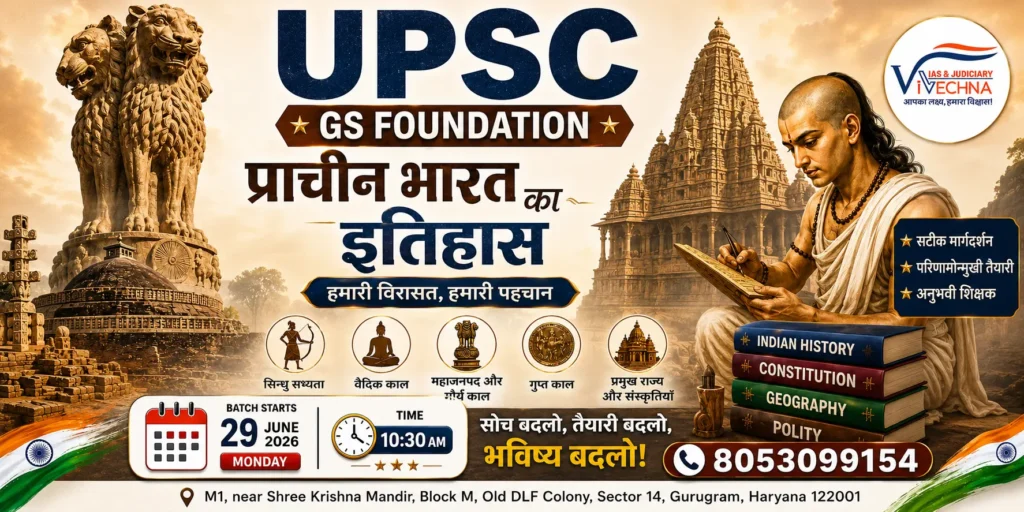
Ancient Indian History is not merely a chapter in a textbook. It is the story of one of the world’s oldest and most sophisticated civilisations — a narrative that stretches from the carefully planned cities of the Indus Valley to the intellectual and artistic brilliance of the Gupta Age, spanning thousands of years of political evolution, cultural achievement, and philosophical inquiry. For UPSC aspirants, understanding this history deeply is not optional. It is foundational.
Ancient Indian History forms a significant and consistently tested component of General Studies Paper I. Questions from this domain appear regularly in both UPSC Prelims and Mains, and the subject’s reach extends further — into the Essay paper, Ethics preparation, and the personality interview. A candidate who has genuinely understood India’s ancient past is better equipped not just to answer history questions but to engage with questions about governance, society, culture, and civilisational values at every stage of the examination.
At Vivechna IAS & Judiciary Academy, Gurugram, the newly launched UPSC GS Foundation Course on Ancient Indian History is designed to build exactly this kind of genuine, analytical understanding — from foundational concepts through to examination-ready mastery.
Why Ancient Indian History Matters for UPSC
UPSC has, over successive years, demonstrated a consistent and deepening interest in Ancient Indian History — particularly in areas that go beyond simple factual recall. Recent examination trends show increasing emphasis on cultural heritage, archaeological discoveries, religious and philosophical movements, ancient science and technology, and the connections between ancient governance models and contemporary administrative thought.
Topics that recur with regularity across UPSC Prelims and Mains include the Indus Valley Civilisation, the Vedic period, the Mahajanapadas, Buddhism and Jainism, the Mauryan Empire, the Gupta Age, ancient art and architecture, literary traditions, and India’s scientific heritage. A candidate who approaches these areas with conceptual clarity and analytical depth will consistently outperform one who relies on memorisation of dates and dynasties.
Beyond General Studies Paper I, Ancient Indian History directly supports preparation in several other areas. The Essay paper regularly features themes of cultural continuity, civilisational values, and India’s intellectual traditions — all of which are enriched by a serious engagement with ancient history. Ethics preparation benefits from familiarity with philosophical traditions rooted in Buddhist, Jain, and Vedic thought. And the UPSC interview rewards candidates who can speak about India’s history and heritage with genuine understanding rather than rehearsed facts.
The UPSC GS Foundation Course at Vivechna IAS & Judiciary Academy provides comprehensive, examination-aligned coverage of every major topic in Ancient Indian History. The approach throughout is conceptual and analytical — building understanding rather than encouraging memorisation.
The Indus Valley Civilisation represents one of the most remarkable achievements in early human history, and UPSC examiners have consistently drawn on it for both factual and analytical questions. The course covers urban planning and town administration, trade networks and commercial practices, social and religious life, and the significance of major archaeological sites including Harappa, Mohenjo-Daro, Dholavira, and Lothal.
Equal attention is given to recent archaeological discoveries, which UPSC has increasingly incorporated into examination questions. Students also engage with the interpretive questions that surround the civilisation — what its decline tells us, how it compares with other ancient cultures, and what its legacy means for understanding early Indian society.
The Vedic period represents a major civilisational transition in Indian history, and understanding it requires more than memorising the names of texts. The course examines the Early and Later Vedic periods in depth — covering the evolution of political institutions, economic developments, the transformation of social structure, and the development of religious practice. Special attention is given to comparative analysis between the Indus Civilisation and Vedic Culture, an area that UPSC has tested in both direct and analytical question formats.
The emergence of the sixteen Mahajanapadas marks one of the most significant political transformations in ancient India — the shift from tribal organisation to territorial kingdoms and republics. The course explores this transition in detail: the political evolution of early states, the growth of urban centres, the economic changes that accompanied them, and the relationship between this period and the religious movements that emerged alongside it. These topics appear frequently in both Prelims and Mains.
This is among the most heavily tested areas in UPSC’s treatment of Ancient Indian History, and the course treats it with corresponding depth. Students engage with the life and teachings of Gautama Buddha and Mahavira, the philosophical principles of both traditions, the spread of these religions across India and beyond, the major councils and the emergence of sectarian divisions, and the lasting contributions of Buddhist and Jain thought to Indian culture, art, architecture, and ethics.
The overlap between this section and Ethics preparation is significant. The moral philosophy of Buddhism — the nature of suffering, the path to liberation, the principles of right conduct — connects directly with GS Paper IV themes. Students are taught to recognise and develop these connections.
The Mauryan Empire represents the first major political unification of the Indian subcontinent, and its significance for UPSC preparation extends well beyond political history. The course covers the reigns of Chandragupta Maurya, Bindusara, and Emperor Ashoka; the administrative
and governance structure of the empire; the Arthashastra and its remarkable insights into statecraft and economic management; the Ashokan edicts and their significance for understanding both governance and the spread of Buddhism; and the Mauryan Empire’s external relations.
Students are specifically trained to connect ancient governance models with contemporary administrative concepts — an analytical skill that pays dividends in both Mains answers and interview discussions.
The Gupta period is frequently referred to as India’s Golden Age, and UPSC question setters return to it regularly — drawn by the richness of its achievements in literature, science, art, and governance. The course covers the political history of the Gupta rulers, their administrative system, the economic prosperity of the period, and the remarkable scientific advancements that emerged during this era — including the contributions of Aryabhata in mathematics and astronomy. Classical Sanskrit literature, Gupta-period art and architecture, and the cultural exchanges with other civilisations of the time are all examined in depth.
UPSC’s treatment of culture and heritage is among its most expansive and frequently tested domains, and the course devotes substantial attention to it. Topics covered include the development of Indian philosophical traditions, the major ancient educational institutions (Takshashila, Nalanda, Vikramashila, Vallabhi), the evolution of Indian literature from Vedic texts through Sangam poetry, and the extraordinary scientific achievements of ancient India in mathematics, astronomy, medicine, and metallurgy.
Students learn about the concept of zero and the decimal system, the contributions of Aryabhata and Brahmagupta, the medical traditions of Ayurveda as codified in the Charaka Samhita and Sushruta Samhita, and remarkable feats of ancient technology such as the Iron Pillar of Delhi. These topics are increasingly prominent in UPSC’s examination questions as the syllabus places growing emphasis on India’s scientific heritage.
Art and architecture form one of the most visually and analytically rich areas of UPSC’s Ancient Indian History syllabus, and the course addresses it comprehensively. Buddhist architecture — stupas, chaityas, viharas, and rock-cut caves — is studied alongside the development of temple architecture across the Nagara, Dravida, and Vesara styles. The major schools of sculpture — Gandhara, Mathura, and Amaravati — are examined with attention to their distinctive characteristics and historical context. The cave paintings of Ajanta and the rock-cut monuments of Ellora receive detailed treatment.
Visual learning methods, including illustrations and comparative presentations, are used throughout this section to support retention and facilitate the kind of recognition that UPSC questions often require.
Ancient India produced some of the world’s most significant literary works, and understanding these texts is essential for both Prelims and Mains preparation. The course covers Vedic literature in depth — the four Vedas, the Brahmanas, the Aranyakas, and the Upanishads — examining both their content and their significance as sources of historical and philosophical knowledge. Buddhist literature, including the Tripitaka and its three Pitakas, is studied alongside
Jain canonical texts and the contributions of Jain philosophical traditions. Sangam literature and its importance as a source for the history of South India is also covered
Teaching Methodology
At Vivechna IAS & Judiciary Academy, the course is built on a clear pedagogical conviction: that genuine understanding is more valuable than memorised content, and that analytical thinking — not factual recall — is what UPSC ultimately rewards. Classroom instruction is structured, contextual, and consistently examination-oriented. Faculty members do not simply present information; they explain why it matters, how it connects with other topics, and how it is likely to appear in examination questions. Students are taught to analyse historical developments critically — to understand causes, consequences, and patterns rather than isolated facts. The integrated approach of the course connects Ancient Indian History with Indian Culture, Art and Architecture, Ethics and Philosophy, Governance, Essay preparation, and broader General Studies themes. This interdisciplinary perspective helps students develop the multi-dimensional understanding that UPSC examinations consistently reward.
Preparation Strategy for Ancient Indian History
A structured, phase-wise approach to Ancient Indian History preparation yields consistently better results than unorganised reading or topic-jumping.
Phase 1
Concept Building: Begin with the foundational civilisations and movements — the Indus Valley Civilisation, the Vedic Age, the religious movements of Buddhism and Jainism, and the Mahajanapadas. The focus here is on understanding historical developments and their significance, not on memorising details. NCERT textbooks provide the appropriate starting point; RS Sharma's Ancient India offers the analytical depth required for Mains
Phase 2
Advanced Learning: Move to the great empires — Mauryan and Gupta — and to the rich domain of ancient culture, art, and architecture. At this stage, the emphasis shifts toward analytical understanding: the significance of governance models, the reasons for cultural flourishing, the connections between political stability and intellectual achievement.
Phase 3
Revision and Practice: Revise systematically — important dynasties, religious movements, cultural and literary developments, architectural traditions. Attempt previous year questions and mock tests regularly. Identify and address gaps in both factual knowledge and analytical depth. Answer-writing practice becomes the central activity at this stage
Common Mistakes in Ancient Indian History Preparation
Understanding what not to do is as important as knowing what to do. Several patterns of error recur consistently among UPSC aspirants preparing Ancient Indian History.
Rote memorisation without understanding
UPSC increasingly tests conceptual and analytical questions, not just factual recall. A student who has memorised every ruler of the Gupta dynasty but cannot explain the significance of the period will underperform relative to one who understands it deeply.
Neglecting cultural, philosophical, and artistic dimensions
Many aspirants focus narrowly on political history — dynasties, battles, and rulers — while giving insufficient attention to religion, philosophy, literature, art, and architecture. These areas contribute substantially to both Prelims and Mains questions and deserve equal preparation time.
Inadequate revision
Ancient Indian History contains a substantial volume of information. Without regular, structured revision, even well-learned material fades. Building revision into the preparation schedule from the beginning — not treating it as an afterthought — is essential.
Insufficient MCQ practice
The Prelims requires the ability to identify correct answers rapidly and confidently, often through the elimination of plausible alternatives. This skill is developed through regular practice, not through reading alone.
Poor answer presentation in Mains
Correct content that is poorly presented does not fetch high marks. UPSC Mains answers benefit from clear structure — introductions that frame the issue, logical development of the argument, use of headings, timelines, and diagrams where appropriate, and conclusions that synthesise rather than merely repeat. Answer-writing practice, with expert feedback, is the only way to develop this skill.
Answer Writing for Ancient Indian History
Many students who are genuinely knowledgeable about Ancient Indian History underperform in UPSC Mains because they have not developed the ability to convert their knowledge into well-structured written answers. The course addresses this directly. Students are trained in the full architecture of a strong Mains answer: an introduction that situates the question historically, analytical development that goes beyond description, appropriate use of visual aids such as flowcharts, timelines, and maps, and a conclusion that connects the historical discussion to contemporary relevance. Regular writing practice, combined with detailed faculty feedback, progressively improves both the quality of answers and the speed with which they can be produced under examination conditions.
Assessment and Evaluation
A structured evaluation system ensures that preparation improves continuously rather than plateauing. The programme includes weekly topic-wise tests, monthly revision assessments, full-length UPSC-pattern mock examinations, Prelims-oriented MCQ practice sessions, Mains answer-writing evaluations, and detailed performance analysis reports. This systematic approach allows students to identify strengths and weaknesses early, correct errors before they become habits, and build the examination confidence that comes from consistent, measurable progress.
Who Should Join This Course?
The UPSC GS Foundation Course on Ancient Indian History is designed for a wide range of aspirants:
- Students at the beginning of their UPSC preparation journey who want to build a strong, well-structured foundation
- College students planning their Civil Services preparation while completing their degrees
- Working professionals preparing for UPSC alongside professional commitments
- State PCS aspirants for whom Ancient Indian History forms a significant component of the syllabus
- CAPF and other competitive examination candidates with General Studies components
- Candidates who have appeared in previous UPSC attempts and wish to strengthen their General Studies foundation
The course accommodates learners from all educational backgrounds. No prior specialist knowledge of history is required.
Batch Details
📅 Batch Start Date: 29 June 2026
🕥 Class Timing: 10:30 AM
📍 Address: Vivechna IAS & Judiciary Academy, M1, Near Shree Krishna Mandir, Block M, Old DLF Colony, Sector 14, Gurugram, Haryana
📞 Admission Helpline: 8053099154
Conclusion
Ancient Indian History is the foundation of understanding India’s civilisational identity. From the sophisticated urban planning of the Indus Valley Civilisation to the philosophical depth of Buddhism and Jainism, from the administrative genius of the Mauryan Empire to the cultural and intellectual brilliance of the Gupta Age, every chapter of this history offers insights that are genuinely relevant to both UPSC preparation and to the broader understanding of contemporary India.
The UPSC GS Foundation Course at Vivechna IAS & Judiciary Academy is designed to help aspirants build the conceptual clarity, analytical thinking, and answer-writing competence that this examination demands. Through structured teaching, comprehensive study material, regular assessments, and personalised mentorship, students gain both the knowledge and the confidence to perform at their best.
Whether you are starting your UPSC journey or reinforcing a General Studies foundation that needs to be stronger, a serious engagement with Ancient Indian History is among the most valuable investments you can make in your Civil Services preparation.