Scaling India's Orange Economy
This analysis is based on “Unleash anime spirits: India must tap the fast-growing global animation market as part of its orange economy push” (Economic Times, 19/06/2026). The article argues that India must leverage the global animation and AVGC sectors to transition from a low-wage back-end service provider into an intellectual property powerhouse capable of capturing high-value commercial revenues.
Syllabus Relevance
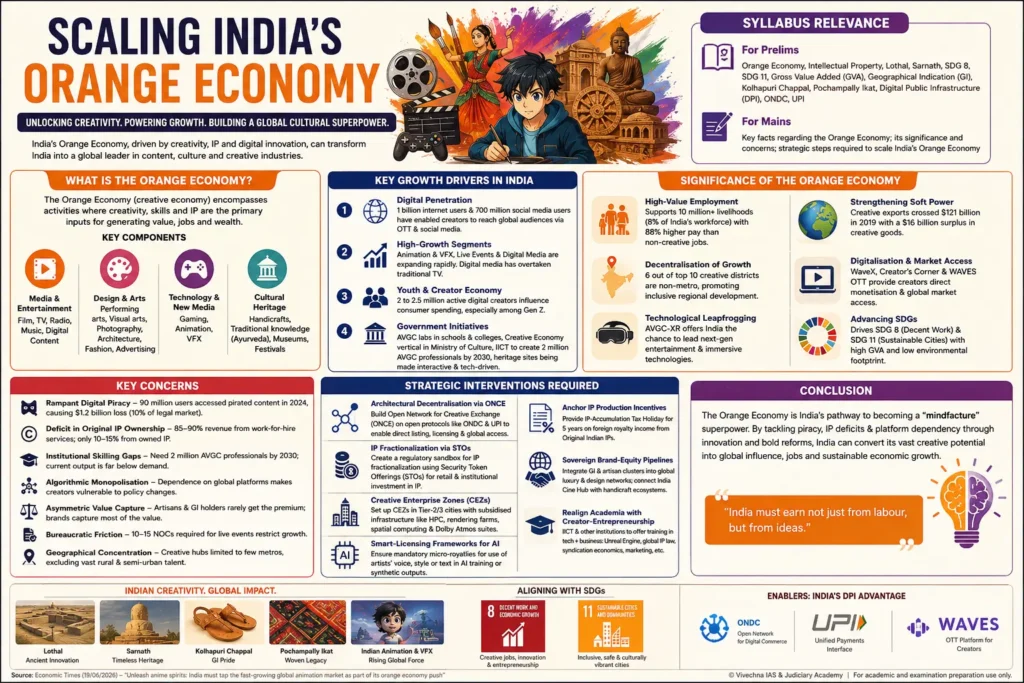
For Prelims: Orange Economy, Intellectual Property, Lothal, Sarnath, SDG 8, SDG 11, Gross Value Added (GVA), Geographical Indication (GI), Kolhapuri Chappal, Pochampally Ikat, Digital Public Infrastructure (DPI), ONDC, UPI
For Mains: Key facts regarding the Orange Economy; its significance and concerns; strategic steps required to scale India’s Orange Economy
Introduction
India’s Orange Economy is emerging as a structural pillar of the country’s transition toward a knowledge-driven economic order, propelled by deepening digital penetration and a wave of youth-led content creation. Yet the sector is constrained by severe bottlenecks — rampant digital piracy, an original Intellectual Property (IP) deficit, and the heavy clustering of creative capital in a handful of metropolitan cities. To scale globally and sustainably, India must pursue bold interventions including open-protocol creative networks and spatially distributed Creative Enterprise Zones.
What is the Orange Economy and Its Status in India?
Concept
The Orange Economy — also called the creative economy — refers to economic activities where individual creativity, skill, and intellectual property (IP) are the primary inputs for generating value, employment, and wealth. It is rapidly becoming a defining feature of India’s transition from a service-based economy to a knowledge-driven “mindfacture” superpower.
Key Components
The Orange Economy encompasses industries where human imagination is the core “raw material”:
Sector | Examples |
Media & Entertainment | Film, television, radio, music, digital content |
Design & Arts | Performing arts, visual arts, photography, architecture, fashion, advertising |
Technology & New Media | Gaming, animation, VFX |
Cultural Heritage | Handicrafts, traditional knowledge (e.g., Ayurveda), museums, festivals |
Key Growth Drivers in India
- Digital Penetration India’s 1 billion internet users and 700 million social media users have democratized content creation, enabling creators to reach global audiences directly via OTT platforms and social media — bypassing traditional gatekeepers entirely.
- High-Growth Segments Sectors like Animation & VFX and Live Events are witnessing rapid expansion. Notably, digital media has overtaken traditional television as the dominant entertainment segment in India.
- Youth and Creator Economy India has between 2 to 2.5 million active digital creators whose content significantly shapes consumer spending, particularly among Gen Z (born 1997–2012).
- Government Initiatives
- Union Budget 2026–27 has prioritised the sector by proposing AVGC Content Creator Labs in 15,000 secondary schools and 500 colleges.
- The Ministry of Culture has established a dedicated Creative Economy vertical to provide market linkages and promote cultural exports.
- The Indian Institute of Creative Technology (IICT), Mumbai aims to bridge the projected demand for 2 million AVGC professionals by 2030.
- Historic sites like Lothal, Sarnath, and Leh Palace are being transformed into interactive, tech-driven heritage destinations.
What is the Significance of the Orange Economy for India?
- High-Value Employment Generation
- The creative economy supports over 10 million direct and indirect livelihoods — approximately 8% of India’s total workforce.
- Creative occupations pay roughly 88% higher than non-creative roles, providing high-productivity alternatives for India’s youth beyond the low-wage trap of traditional manufacturing.
- Decentralisation of Economic Growth
Creative wealth is not confined to large cities. Of the top 10 creative districts in India, 6 are non-metros — including Badgam (J&K), Panipat (Haryana), Imphal (Manipur), Sant Ravi Das Nagar (UP), Thane (Maharashtra), and Tirupur (Tamil Nadu). This indicates the depth and diversity of India’s creative talent and fosters inclusive regional development without necessitating mass migration to urban centres.
- Technological Leapfrogging via AVGC-XR
The AVGC-XR (Animation, Visual Effects, Gaming, Comics — Extended Reality) sector offers India a strategic opportunity to bypass traditional industrial stages and emerge as a global leader in next-generation entertainment and immersive technologies. By leveraging its young demographic, expanding digital infrastructure, and rich creative talent pool, India can position itself as a key architect of the global metaverse and extended reality economy.
- Strengthening Cultural Soft Power
India’s Orange Economy is a vital instrument of economic diplomacy. According to the Export-Import Bank of India (Exim Bank), India’s creative goods and services exports crossed $121 billion in 2019 — with a $16 billion trade surplus in creative goods — driven by design (87.5%) and traditional crafts (9%).
- Digitalisation and Market Access
- The Ministry of Information & Broadcasting (MIB) operationalised WaveX — India’s premier national media-tech startup accelerator — in partnership with the National Film Development Corporation (NFDC).
- Anchored by institutions like T-Hub Hyderabad and FITT, IIT Delhi, WaveX is expanding a network of 10 institutional innovation hubs nationwide.
- Prasar Bharati’s ‘Creator’s Corner’ and the WAVES OTT platform grant micro-influencers direct, secure monetisation pathways and access to international export markets.
- Advancing Sustainable Development Goals (SDGs)
Formalising India’s creative infrastructure acts as a structural multiplier for:
- SDG 8 — Decent Work and Economic Growth
- SDG 11 — Sustainable Cities and Communities
The Government’s ₹1 Lakh Crore Urban Challenge Fund (2025–26 to 2030–31) prioritises reform-linked, climate-resilient city infrastructure while preserving local craft clusters and historical zones. Critically, the Orange Economy generates substantial Gross Value Added (GVA) without the heavy ecological or carbon footprints typical of traditional industries.
What are the Key Concerns Facing the Orange Economy in India?
- Rampant Digital Piracy and Revenue Leakage
The expansion of high-speed internet has shifted piracy from physical bootlegs to sophisticated online streaming, IPTV, and peer-to-peer distribution networks, crippling legitimate monetisation.
- In 2024, approximately 90 million users accessed pirated video content, causing $1.2 billion in revenue loss — equivalent to 10% of the legal video industry.
- If unaddressed, piracy is projected to reach 158 million users by 2029, driving cumulative losses to $2.4 billion.
- Deficit in Original IP Ownership
India functions primarily as a back-end outsourced service provider rather than a creator of original IP. Indian studios earn basic service wages while foreign studios capture the compounding, long-term financial value from merchandise, sequels, and global licensing.
- In the Animation, VFX, and Post-production (AVP) segment, 85–90% of revenues come from work-for-hire services; owned IP monetisation accounts for just 10–15%.
- Major international franchises (e.g., Marvel Cinematic Universe) routinely contract rotoscoping, VFX, and 3D modelling to clusters in Hyderabad, Bengaluru, and Pune — yet the multi-billion-dollar downstream licensing revenues remain entirely with western studios.
- Institutional Skilling Gaps and Supply Deficit
The creative industries are evolving into highly technology-driven domains requiring interdisciplinary mastery across coding, narrative design, real-time rendering, and spatial computing. Current formal education is not producing industry-ready professionals at the required scale.
Meeting the target of 2 million AVGC professionals by 2030 requires an annual workforce increment approximately ten times the current output from accredited programmes.
- Algorithmic Monopolisation and Platform Dependency
India’s 2 to 2.5 million active digital creators influence over 30% of consumer choices, driving $350–400 billion in annual spending. Despite this economic power, they remain structurally vulnerable to the algorithmic decisions of a handful of global tech platforms — Alphabet, Meta, ByteDance. A single policy change by a foreign platform can instantly wipe out the financial viability of localized vernacular media startups.
- Asymmetric Value Capture in Traditional Crafts
India’s traditional crafts, handlooms, and Geographical Indication (GI) products represent an underappreciated layer of the Orange Economy. However, the financial premiums generated by these assets rarely reach grassroots artisans — international luxury brands and upstream aggregators routinely capture the brand equity premium.
The Prada–Kolhapuri chappal controversy starkly illustrated the vulnerability of traditional Indian cultural IP to global appropriation without fair trade reciprocity.
- Bureaucratic Friction for Live and Experiential Economies
Executing live cultural events — concerts, performing arts, theatre, festivals — requires navigating 10 to 15 overlapping No-Objection Certificates (NOCs) spanning municipal bodies, fire safety, police, traffic, noise pollution enforcement, and copyright compliance agencies. This severely constrains the experiential segment’s potential as a driver of urban services and domestic tourism.
- Geographical Concentration of Creative Capital
Creative infrastructure, investment, and studio networks are overwhelmingly concentrated in Bengaluru, Hyderabad, Mumbai, Pune, Chennai, and Delhi-NCR. This spatial polarisation isolates vast reserves of rural and semi-urban talent from formal monetisation channels, deepening regional inequality in human development.
What Strategic Interventions are Required?
- Architectural Decentralisation via ONCE
Adapt India’s successful Digital Public Infrastructure (DPI) model to establish open, equitable transactional pathways for independent creative practitioners.
- Implement the Open Network for Creative Exchange (ONCE) — a unified, open-protocol network built on interoperable architecture similar to ONDC and UPI.
- ONCE would allow musicians, authors, visual designers, and folk artists to directly register, list, and license their works without platform intermediary friction.
- This creates a “Sovereign Media Stack” offering transparent algorithmic discoverability and direct access to domestic and international consumer bases.
- IP Fractionalization via Regulated Security Token Offerings (STOs)
- Establish an “IP Fractionalization Framework” under a dedicated regulatory sandbox managed by SEBI and the Ministry of Culture’s Creative Economy vertical.
- High-potential cinematic universes, gaming titles, or performing arts franchises can be divided into secure digital asset fractions, allowing retail and institutional investors to acquire micro-equity in individual IPs.
- This creates a liquid market for “Patient Creative Capital” powered by automated smart-contract royalty distributions.
- Spatial “Creative Enterprise Zones” (CEZs) in Tier-2/3 Cities
- Set up dedicated Creative Enterprise Zones (CEZs) in secondary growth corridors — Indore, Guwahati, Kochi, Thiruvananthapuram — mirroring the successful Software Technology Parks of India (STPI) model.
- These zones should feature state-subsidised shared infrastructure: High-Performance Computing (HPC) Cloud Rendering Farms, advanced spatial computing setups, and Dolby Atmos audio suites.
- This enables localised cultural expressions to be upscaled into globally competitive digital products.
- “Smart-Licensing Frameworks” for Generative AI
- Codify a distinct “Right to Creative Persona and Style Protection” within standard IP statutes.
- Introduce mandatory Smart-Licensing Agreements requiring technology developers to pay automated micro-royalties whenever an artist’s voice, visual style, or registered literary text is used in AI model training or commercial synthetic outputs — ensuring clear economic reciprocity.
- “Anchor IP Production” Tax Incentives
- Restructure corporate tax frameworks to introduce an “IP-Accumulation Tax Holiday.”
- Domestic creative entities that conceptualise, register, and retain Original Indian IP Rights receive complete exemptions on foreign royalty inflows for an initial five-year window, incentivising studios to build long-term global merchandise and licensing pipelines.
- Sovereign “Brand-Equity Pipelines” for Heritage Assets
- Formulate structured institutional trade channels that embed GI-tagged artisan clusters — such as Pochampally Ikat weavers and Jaipur Blue Pottery — directly into international luxury retail networks and global design calendars.
- Integrate the India Cine Hub portal with regional handicraft ecosystems so that foreign film tourism and cultural experiences directly monetise localised export demand for authentic Indian products.
- Realigning Academia with “Creator-Entrepreneurship”
- Position the Indian Institute of Creative Technologies (IICT) network to deliver specialised “Creative Venture Design” training.
- Upgraded curricula should integrate advanced technical workflows (Unreal Engine, Blender) with core commercial proficiencies — including international syndication economics, global IP litigation, copyright asset valuation, and algorithmic marketing — preparing professionals for leadership roles in the global creative marketplace.
Conclusion
The Orange Economy signals India’s decisive shift from a service-oriented hub to a “mindfacture” superpower. By mitigating structural challenges like piracy and the IP ownership deficit through innovative models such as ONCE and IP fractionalization, India can harness its extraordinary youth demographic to consolidate its standing as a global creative and cultural powerhouse — one that earns not just from labour, but from ideas.
Vivechna Mains Question
- Discuss the potential of the Orange Economy as a driver for inclusive growth and employment generation in India, citing relevant examples. (GS Paper 3 — Growth & Development / Government Policies & Interventions)
Frequently Asked Questions (FAQs)
Q1. What is the Orange Economy? The Orange Economy, or creative economy, is an economic model where value, jobs, and wealth are generated through individual creativity, skill, and intellectual property.
Q2. How significant is the Orange Economy for India’s employment? It supports over 10 million livelihoods (approximately 8% of India’s workforce), with creative occupations paying 88% higher wages than non-creative roles.
Q3. What is the projected demand for AVGC professionals in India by 2030? The Economic Survey 2025–26 projects a human capital demand of nearly 2 million AVGC professionals by 2030.