🎗️ Supreme Court Directs States to Declare Cancer a Notifiable Disease | UPSC Prelims Facts
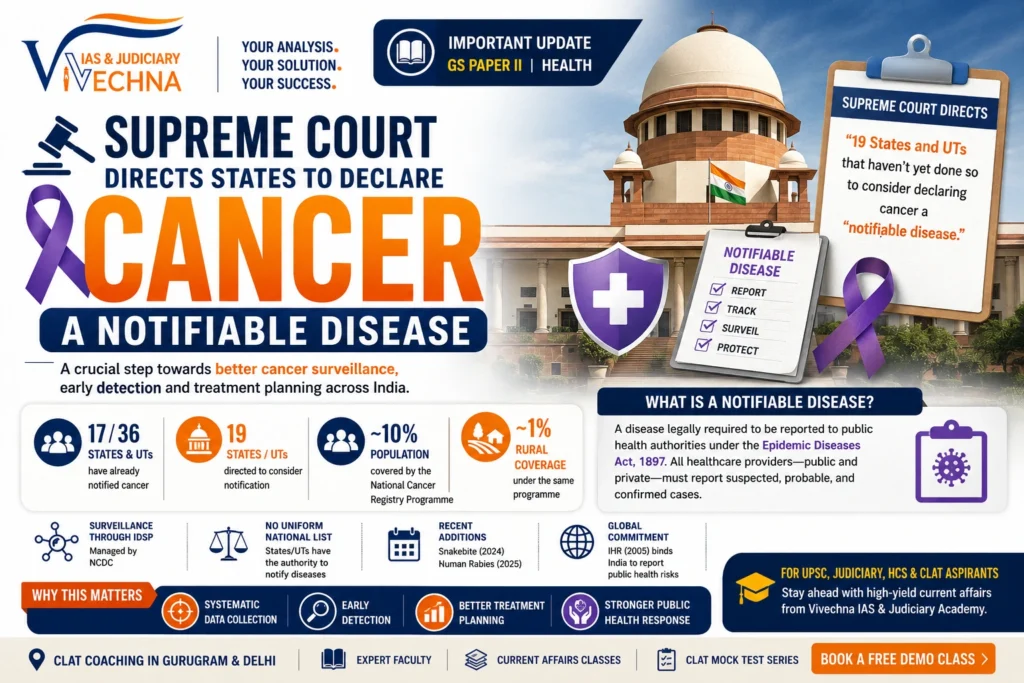
The Supreme Court has directed the 19 States and Union Territories that haven't yet done so to consider declaring cancer a "notifiable disease." The order came on a Public Interest Litigation flagging major gaps in India's cancer-data coverage — the ICMR's National Cancer Registry Programme reportedly covers only around 10% of India's population, with rural coverage as low as 1%. At Vivechna IAS & Judiciary Academy, we break down this compact but high-yield Prelims fact along with the broader concept of notifiable diseases.
📋 What Does "Notifiable Disease" Mean?
Notifiable diseases are legally mandated to be reported to public health authorities under laws like the Epidemic Diseases Act, 1897. Once notified, all healthcare providers — public and private, hospitals, and individual practitioners — become legally obligated to report suspected, probable, and confirmed cases to designated authorities. The primary surveillance framework is the Integrated Disease Surveillance Programme (IDSP), managed by the National Centre for Disease Control (NCDC).
🦠 Commonly Notified Diseases
Tuberculosis, Dengue, Malaria, Cholera, Hepatitis, Measles, Leptospirosis, and Polio feature on most state lists; COVID-19 was universally notifiable during the pandemic.
🐍 Recent Additions
Snakebite was newly notified in 2024, and human rabies in 2025 — showing the list keeps evolving with emerging public-health priorities.
🗺️ Decentralised System
India has no single, uniform national list — the authority to notify a disease rests primarily with state/UT governments, creating variation across states.
🌍 Global Commitment
The International Health Regulations (2005) under the WHO legally bind member countries to inform WHO of public-health risks with international implications.
📌 Why This Matters
Declaring cancer notifiable would make case reporting mandatory nationwide, helping build systematic data, strengthen surveillance, promote early detection, and improve treatment planning — directly relevant for GS Paper II's health-governance and welfare-scheme themes at Vivechna IAS's UPSC Civil Services programme.
✅ Exam Tip
Remember the legal anchor: notifiable-disease reporting traces back to the Epidemic Diseases Act, 1897 — one of India's oldest public-health statutes, later supplemented by the Disaster Management Act, 2005 during COVID-19.
🎯 Key Takeaways
- The Supreme Court directed 19 States/UTs to consider notifying cancer; 17 of 36 States/UTs have already done so.
- The National Cancer Registry Programme covers only ~10% of India's population (just ~1% in rural areas).
- Notifiable-disease law traces to the Epidemic Diseases Act, 1897; surveillance runs through the IDSP under the NCDC.
- India has no single uniform national list of notifiable diseases — states/UTs decide individually.
- Snakebite (2024) and human rabies (2025) are recent additions to various state notifiable-disease lists.
📚 Exam Relevance for UPSC, Judiciary, HCS & CLAT Aspirants
| Exam | Relevance |
|---|---|
| UPSC Prelims | Notifiable disease definition, IDSP/NCDC, Epidemic Diseases Act 1897, IHR 2005. |
| UPSC Mains (GS-II) | Health governance, PIL-driven judicial directions, and gaps in public-health data systems. |
| Judiciary Exams | PIL jurisprudence and statutory public-health law frameworks. |
| HCS / State PCS | State-specific notifiable-disease lists and health-department current affairs. |
| CLAT / Law Entrance | Current-affairs MCQs on Supreme Court directions and public-health legislation. |
📍 CLAT Preparation 2027 — For Aspirants in Gurugram & Delhi NCR
Rapid-fire health and governance current affairs like this are exactly what CLAT's GK section tests. If you're searching for CLAT coaching in Gurugram or the best CLAT institute in Gurgaon, Vivechna IAS & Judiciary Academy runs focused CLAT preparation 2027 batches with daily current-affairs coverage of exactly this kind. This is why CLAT aspirants in Sector 14 Gurugram choose Vivechna IAS — with CLAT coaching near HUDA City Centre and best law entrance coaching near MG Road Gurugram, backed by structured CLAT study material and a full CLAT mock test series, plus CLAT coaching in Delhi and Judiciary coaching in Gurugram.
🖊️ Practice Question (For Self-Assessment)
Consider the following statements regarding notifiable diseases in India:
- India has a single, uniform national list of notifiable diseases applicable to all states.
- The Integrated Disease Surveillance Programme is managed by the National Centre for Disease Control.
- Once a disease is notified, reporting by private healthcare providers becomes legally mandatory.
Which of the statements given above is/are correct?
(a) 2 and 3 only (b) 1 and 2 only (c) 1 and 3 only (d) 1, 2 and 3
Answer: (a) — The authority to notify a disease rests with individual state/UT governments, so no single uniform national list exists; Statement 1 is incorrect.
❓ Frequently Asked Questions (FAQs)
Why has the Supreme Court directed states to notify cancer?
What is a notifiable disease?
Which body manages disease surveillance in India?
Which is the best CLAT coaching in Gurugram?
Does Vivechna IAS provide CLAT mock tests?
🏁 Conclusion
Making cancer a notifiable disease across all States and UTs would be a meaningful step toward closing India's cancer-data gap, enabling far better surveillance, early detection, and treatment planning. For UPSC, Judiciary, HCS, and CLAT aspirants, this is a compact but exam-relevant health-governance fact worth retaining — the kind of high-yield current-affairs nugget Vivechna IAS & Judiciary Academy covers daily in its Prelims-focused current-affairs sessions.
Preparing for UPSC, Judiciary, HCS or CLAT 2027 in Gurugram or Delhi NCR?
Join Vivechna IAS & Judiciary Academy's daily current-affairs sessions and CLAT mock test series — trusted by aspirants across Sector 14 Gurugram, HUDA City Centre, MG Road, and Delhi NCR.
Book a Free Demo Class →