💵 Government Approves Polymer Banknotes for Field Trials | UPSC Economy Notes
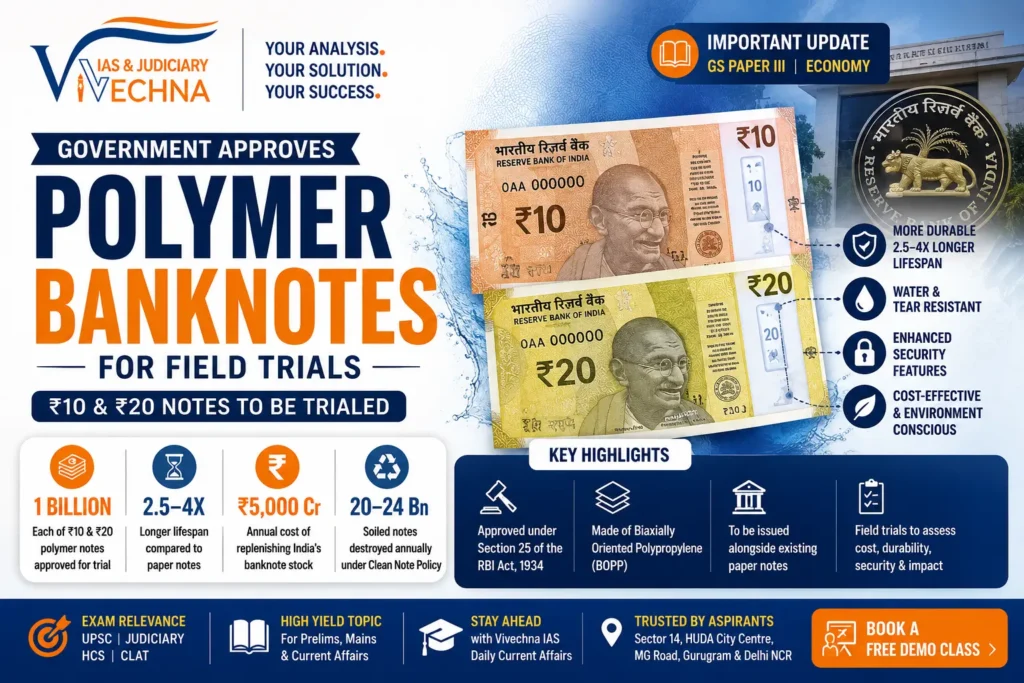
The Government has approved an RBI proposal, made under Section 25 of the Reserve Bank of India Act, 1934, to introduce one billion pieces each of ₹10 and ₹20 polymer banknotes for field trials. This marks India's most concrete step yet toward polymer currency — a durability-driven reform aimed at cutting the Reserve Bank's massive annual note-replacement bill. At Vivechna IAS & Judiciary Academy, we cover this compact but exam-relevant Economy/Fiscal Policy update.
🧾 What Are Polymer Banknotes?
Polymer banknotes are made from biaxially oriented polypropylene (BOPP) — a plastic substrate — unlike India's traditional cotton-pulp paper currency. They will be issued alongside existing paper notes rather than replacing them immediately, with field trials assessing cost, durability, security, environmental impact, and suitability for India's climatic conditions before any decision on regular issuance.
✅ Advantages
- More durable, water-resistant, and tear-resistant than paper notes.
- Transparent windows and embedded security elements make counterfeiting harder.
- Lasts 2.5–4 times longer, reducing replacement frequency.
- Particularly useful for low-denomination notes (₹10, ₹20) that deteriorate fastest due to high circulation.
⚠️ Considerations Being Tested
- Cost of production versus long-term savings.
- Environmental impact of a plastic-based currency substrate.
- Suitability for India's varied climatic conditions (heat, humidity).
- Security-feature performance at scale.
📌 Why This Matters
India spends nearly ₹5,000 crore annually replenishing and maintaining its banknote stock, destroying 20–24 billion soiled notes a year under the RBI's Clean Note Policy. Polymer notes for high-circulation, fast-deteriorating denominations like ₹10 and ₹20 could meaningfully cut this lifecycle cost — a relevant example for GS Paper III's monetary and fiscal policy themes at Vivechna IAS's UPSC Civil Services programme.
✅ Exam Tip
Note the legal basis carefully: the approval is under Section 25 of the RBI Act, 1934, which deals with the design, form, and material of banknotes — a precise, Prelims-testable detail.
🎯 Key Takeaways
- Approved under Section 25 of the RBI Act, 1934 — one billion pieces each of ₹10 and ₹20 polymer notes for field trials.
- Made from biaxially oriented polypropylene (BOPP), not cotton-pulp paper.
- Will circulate alongside paper notes, not replace them immediately.
- Lasts 2.5–4 times longer than paper notes, reducing replacement costs.
- India spends ~₹5,000 crore/year on note replenishment under the RBI's Clean Note Policy.
📚 Exam Relevance for UPSC, Judiciary, HCS & CLAT Aspirants
| Exam | Relevance |
|---|---|
| UPSC Prelims | Section 25 of the RBI Act, 1934, BOPP material, and Clean Note Policy facts. |
| UPSC Mains (GS-III) | Currency management, monetary policy administration, and cost-efficiency in public systems. |
| Judiciary Exams | Statutory powers under the RBI Act relevant to central-bank regulatory questions. |
| HCS / State PCS | General Studies current-affairs sections on banking and currency reforms. |
| CLAT / Law Entrance | Current-affairs MCQs on RBI powers and monetary-policy legislation. |
📍 CLAT Preparation 2027 — For Aspirants in Gurugram & Delhi NCR
Economy and banking current affairs like this are regular CLAT GK-section material. If you're looking for CLAT coaching in Gurugram or the best CLAT institute in Gurgaon, Vivechna IAS & Judiciary Academy's CLAT preparation 2027 batches cover exactly this kind of daily current-affairs update. This is why CLAT aspirants in Sector 14 Gurugram choose Vivechna IAS — with CLAT coaching near HUDA City Centre and best law entrance coaching near MG Road Gurugram, backed by structured CLAT study material and a full CLAT mock test series, plus CLAT coaching in Delhi and Judiciary coaching in Gurugram.
🖊️ Practice Question (For Self-Assessment)
Consider the following statements regarding India's proposed polymer banknotes:
- They will immediately replace all existing paper-substrate ₹10 and ₹20 notes.
- They are made from biaxially oriented polypropylene (BOPP).
- The proposal was approved under Section 25 of the Reserve Bank of India Act, 1934.
Which of the statements given above is/are correct?
(a) 2 and 3 only (b) 1 and 2 only (c) 1 and 3 only (d) 1, 2 and 3
Answer: (a) — Polymer notes will be issued alongside, not as an immediate replacement for, existing paper notes; Statement 1 is incorrect.
❓ Frequently Asked Questions (FAQs)
What are polymer banknotes made of?
Will polymer notes replace paper currency in India?
Why does India need polymer banknotes?
Which is the best CLAT coaching in Gurugram?
Does Vivechna IAS provide CLAT mock tests?
🏁 Conclusion
The move toward polymer ₹10 and ₹20 notes reflects the RBI's ongoing effort to make India's currency system more durable, secure, and cost-efficient — beginning cautiously with field trials rather than a full rollout. For UPSC, Judiciary, HCS, and CLAT aspirants, this is a sharp, fact-dense current-affairs update well worth remembering — precisely the kind of Prelims-ready nugget Vivechna IAS & Judiciary Academy builds into its daily current-affairs coverage.
Preparing for UPSC, Judiciary, HCS or CLAT 2027 in Gurugram or Delhi NCR?
Join Vivechna IAS & Judiciary Academy's daily current-affairs sessions and CLAT mock test series — trusted by aspirants across Sector 14 Gurugram, HUDA City Centre, MG Road, and Delhi NCR.
Book a Free Demo Class →