⛏️ Mines and Minerals (Development and Regulation) Amendment Bill, 2026 | UPSC Economy & Polity Notes
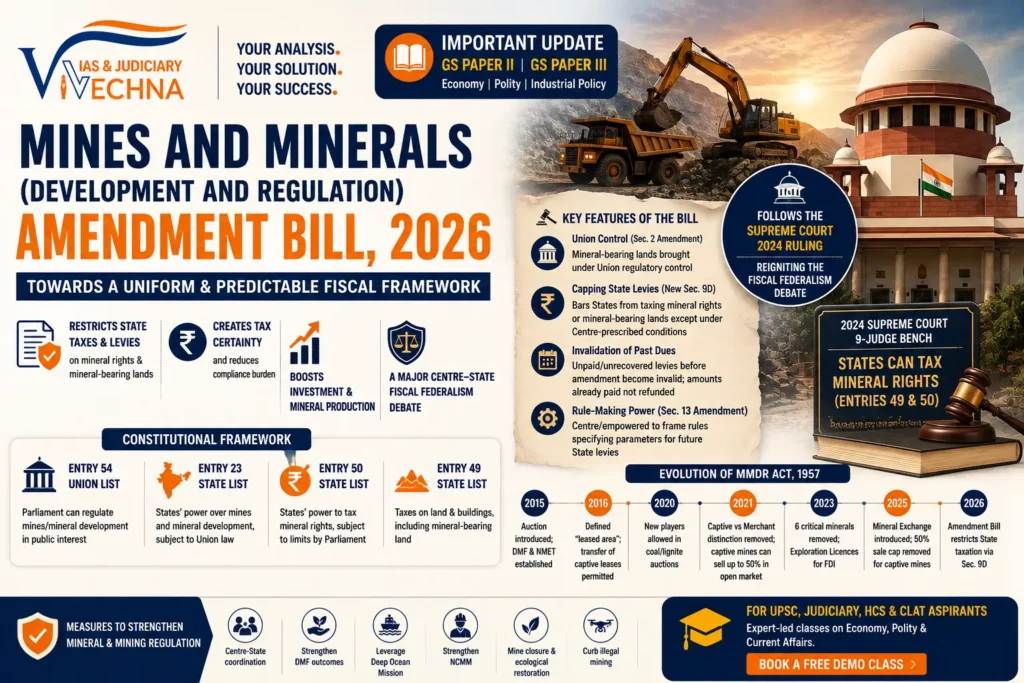
Parliament has passed the Mines and Minerals (Development and Regulation) Amendment Bill, 2026, seeking to create a uniform and predictable fiscal framework by restricting State taxes and levies on mineral rights and mineral-bearing lands. The Bill directly follows — and in some respects pushes back against — the Supreme Court's landmark 2024 ruling on mineral taxation, reigniting a classic fiscal-federalism debate. At Vivechna IAS & Judiciary Academy, we unpack this GS Paper II/III crossover topic covering constitutional taxation entries, the 2024 judgment, and the concerns the new Bill raises.
📌 Why This Topic Matters
This Bill sits precisely where economic policy meets constitutional law — testing whether Parliament can restrict State taxation powers recognised just two years earlier by a 9-judge Constitution Bench. For aspirants at Vivechna IAS's UPSC Civil Services programme, this is a model example of the Centre-State fiscal tension that recurs across GS Paper II Mains questions.
📋 Key Features of the MMDR Amendment Bill, 2026
| Provision | What It Does |
|---|---|
| Union Control (Section 2 Amendment) | Explicitly brings "mineral-bearing lands" under Union government regulatory control. |
| Capping State Levies (New Section 9D) | Bars States from taxing mineral rights or mineral-bearing lands (by quantity, value, or royalty) except under Centre-prescribed conditions. |
| Invalidation of Past Dues | Unpaid/unrecovered levies before the amendment become invalid; amounts already paid are not refunded. |
| Rule-Making Power (Section 13 Amendment) | Empowers the Centre to frame rules specifying exact parameters for future State levies. |
✅ Exam Tip
Remember: royalty is not a tax. The Supreme Court held in 2024 that royalty under the MMDR framework is a contractual payment for enjoying mineral rights — a frequently tested distinction in Prelims.
⚖️ Constitutional Framework Governing Minerals
| Entry | List | Subject |
|---|---|---|
| Entry 54 | Union List | Parliament can regulate mines/mineral development when declared expedient in public interest. |
| Entry 23 | State List | States' power over mines and mineral development, subject to Union legislation. |
| Entry 50 | State List | States' power to tax mineral rights, subject to limitations Parliament may impose. |
| Entry 49 | State List | Taxes on land and buildings, including mineral-bearing land. |
Under the existing framework, the Central Government regulates major minerals and fixes royalty rates, while State governments grant mining leases and collect royalty from lessees; minor minerals are largely State-regulated.
⚠️ Concerns Regarding the MMDR Amendment Bill, 2026
Possible Conflict with the Supreme Court's 2024 Judgment
⚠️ Important Point — Mineral Area Development Authority v. Steel Authority of India (2024)
An 8:1 majority of a 9-judge Constitution Bench upheld States' legislative competence to tax mineral rights under Entry 50 and mineral-bearing lands under Entry 49 — and allowed States to recover past tax dues retrospectively from 1 April 2005. By invalidating certain unpaid past levies, the 2026 Bill seeks to alter the practical consequences of this ruling, raising separation-of-powers concerns.
⚠️ Key Concerns
- Federalism & taxation powers: Restricting States' Entry 49/50 powers raises questions about the limits of Parliament's authority, especially over land taxation (Entry 49).
- Article 14 concerns: Invalidating unpaid dues without refunding amounts already paid could create unequal treatment between compliant and non-compliant companies.
- Excessive delegation: Leaving conditions for State taxation to be prescribed by the executive, rather than Parliament itself, invites criticism.
- State revenue impact: Mineral-rich States could see reduced fiscal autonomy and revenue.
✅ Stated Significance
- Tax certainty: Addresses high, multiple, and unpredictable levies.
- Uniformity: Promotes consistent taxation across States, cutting compliance costs.
- Investment & production: Reduced uncertainty could encourage domestic mineral investment.
🕰️ Evolution of the MMDR Act, 1957
🛤️ Measures to Strengthen Mineral & Mining Regulation
- Strengthen Centre-State coordination — a permanent mechanism for mineral governance covering taxation, leases, and auctions.
- Improve DMF outcomes — transparent, outcome-based utilisation for health, education, and livelihoods in mining-affected areas.
- Leverage the Deep Ocean Mission — scale up exploration of polymetallic nodules/sulphides containing nickel, cobalt, copper, and manganese.
- Strengthen the National Critical Mineral Mission (NCMM) — expand domestic exploration, overseas asset acquisition, recycling, and refining capability.
- Strengthen mine closure & ecological restoration — make rehabilitation enforceable throughout the mining lifecycle, not just at the end.
- Curb illegal mining — satellite monitoring, drone surveillance, GPS-based tracking, and e-permits.
🎯 Key Takeaways
- The MMDR Amendment Bill, 2026 restricts State taxes/levies on mineral rights and mineral-bearing lands via a new Section 9D.
- It follows the 2024 Supreme Court ruling (MADA v. SAIL) that upheld States' taxation powers under Entries 49 and 50 of the State List.
- Royalty is not a tax — it's a contractual payment for mineral-rights enjoyment, per the same 2024 ruling.
- Key concerns: federalism/taxation encroachment, Article 14 unequal treatment, and excessive executive delegation.
- The National Critical Mineral Mission (NCMM) is central to securing India's critical-mineral value chain.
📚 Exam Relevance for UPSC, Judiciary, HCS & CLAT Aspirants
| Exam | Relevance |
|---|---|
| UPSC Prelims | MMDR Act amendments timeline, DMF, NCMM, NMEDT, and constitutional entries on minerals. |
| UPSC Mains (GS-II/III) | Fiscal federalism, industrial policy, and mineral security debates. |
| Judiciary Exams | Direct relevance — the 2024 9-judge MADA v. SAIL ruling on Entries 49/50 taxation powers. |
| HCS / State PCS | State revenue implications, especially for mineral-rich states. |
| CLAT / Law Entrance | Legal-reasoning passages on constitutional taxation entries and current-affairs MCQs on the Bill. |
📍 CLAT Preparation 2027 — For Aspirants in Gurugram & Delhi NCR
Constitutional taxation disputes like this MMDR Bill are exactly the kind of legal-reasoning material CLAT tests. If you're looking for CLAT coaching in Gurugram or the best CLAT institute in Gurgaon, Vivechna IAS & Judiciary Academy's CLAT preparation 2027 batches build this analytical depth directly into their curriculum. This is why CLAT aspirants in Sector 14 Gurugram choose Vivechna IAS — with CLAT coaching near HUDA City Centre and best law entrance coaching near MG Road Gurugram, supported by structured CLAT study material and a full CLAT mock test series, plus CLAT coaching in Delhi and Judiciary coaching in Gurugram.
Explore Vivechna IAS's UPSC Civil Services courses, Judiciary Exams coaching, and the CLAT & Law Entrance programme for structured coverage of Economy and Constitutional Law topics like this one.
📝 Previous Year Questions (PYQs)
With reference to the management of minor minerals in India, consider the following statements:
- Sand is a 'minor mineral' according to the prevailing law in the country.
- State Governments have the power to grant mining leases of minor minerals, but the powers regarding the formation of rules related to the grant of minor minerals lie with the Central Government.
- State Governments have the power to frame rules to prevent illegal mining of minor minerals.
(a) 1 and 3 only (b) 2 and 3 only (c) 3 only (d) 1, 2 and 3
Answer: (a)
What is/are the purpose/purposes of 'District Mineral Foundations' in India?
- Promoting mineral exploration activities in mineral-rich districts
- Protecting the interests of the persons affected by mining operations
- Authorizing State Governments to issue licences for mineral exploration
(a) 1 and 2 only (b) 2 only (c) 1 and 3 only (d) 1, 2 and 3
Answer: (b)
Despite India being one of the countries of Gondwanaland, its mining industry contributes much less to its Gross Domestic Product (GDP) in percentage. Discuss.
🖊️ Practice Question (New — For Self-Assessment)
Consider the following statements regarding the MMDR Amendment Bill, 2026:
- It restricts States from taxing mineral rights except under Centre-prescribed conditions.
- It refunds all previously paid mineral levies to promote uniformity.
- The Supreme Court in 2024 held that royalty is a tax, not a contractual payment.
Which of the statements given above is/are correct?
(a) 1 only (b) 1 and 2 only (c) 2 and 3 only (d) 1, 2 and 3
Answer: (a) — Amounts already paid are not refunded (Statement 2 wrong), and the 2024 ruling held royalty is NOT a tax (Statement 3 wrong).
🚫 Common Mistakes Aspirants Make on This Topic
- Confusing Entry 49 and Entry 50 — Entry 49 covers taxes on land generally (including mineral-bearing land); Entry 50 specifically covers taxes on mineral rights.
- Believing royalty is a tax — the 2024 Supreme Court ruling clarified royalty is a contractual payment for mineral-rights enjoyment.
- Missing the retrospective angle — the 2024 judgment allowed States to recover dues from 1 April 2005; the 2026 Bill invalidates certain unpaid dues going forward.
- Writing one-sided answers — balance fiscal-certainty benefits against genuine federalism and Article 14 concerns.
❓ Frequently Asked Questions (FAQs)
What is the MMDR Amendment Bill, 2026?
What is the significance of Section 9D under the Bill?
What was the significance of the Supreme Court's 2024 mineral rights judgment?
What is the National Critical Mineral Mission (NCMM)?
Which is the best CLAT coaching in Gurugram?
Does Vivechna IAS provide CLAT mock tests?
🏁 Conclusion
The MMDR Amendment Bill, 2026 attempts to reconcile fiscal certainty for the mining sector with the constitutional fiscal autonomy of States — a balance that will likely face judicial scrutiny given its tension with the Supreme Court's 2024 ruling. For UPSC, Judiciary, HCS, and CLAT aspirants, this Bill offers a live case study in how legislative response to judicial verdicts can reopen fundamental federalism questions — precisely the analytical rigour Vivechna IAS & Judiciary Academy builds into its Economy and Constitutional Law curriculum.
Preparing for UPSC, Judiciary, HCS or CLAT 2027 in Gurugram or Delhi NCR?
Join Vivechna IAS & Judiciary Academy's expert-led Economy & Polity modules and CLAT mock test series — trusted by aspirants across Sector 14 Gurugram, HUDA City Centre, MG Road, and Delhi NCR.
Book a Free Demo Class →