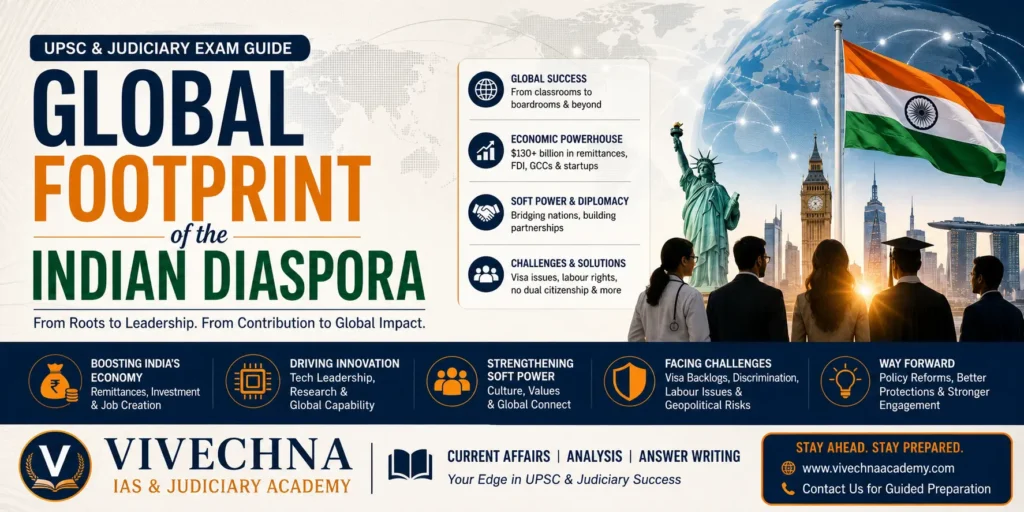
Global Footprint of the Indian Diaspora
A comprehensive UPSC & Judiciary Exam Guide covering the global influence of the Indian diaspora, its contribution to India's economy, diplomacy, foreign policy, and governance. This topic frequently appears across GS Paper-I (Indian Society), GS Paper-II (International Relations), and GS Paper-III (Economy & External Sector
Why This Topic Deserves Your Attention
The story of the Indian diaspora is far more than overseas success. It demonstrates how institutions based on merit, innovation, and ease of doing business enable individuals to excel globally. For UPSC aspirants, this topic provides rich material for both Prelims and Mains by linking governance reforms, economic development, migration, and India's growing global influence.
The Global Standing of the Indian Diaspora
Global Presence Beyond Numbers
With nearly 35 million Indians living overseas, the diaspora represents about 2.5% of India's population. Despite their relatively small share in host countries, Indian-origin communities consistently outperform in education, entrepreneurship, and income.
Leadership in Global Corporations
Indian-origin professionals lead some of the world's most influential organizations. Leaders such as Satya Nadella, Sundar Pichai, and Ajay Banga symbolize India's growing contribution to global technology, finance, and multilateral institutions.
Success Across Generations
Communities that began as indentured labourers in the 19th century now hold significant political, economic, and social influence in countries such as Mauritius, Guyana, and Trinidad & Tobago, reflecting remarkable upward mobility.
Political Leadership Worldwide
Indian-origin leaders have reached the highest offices in several countries, including the United Kingdom, Ireland, Guyana, and Mauritius, showcasing the community's strong democratic participation and leadership.
Resilience Through Adversity
Despite facing apartheid, expulsions, military coups, and discrimination in different regions of the world, the Indian diaspora has demonstrated exceptional resilience, contributing significantly to the societies in which they live.
UPSC Insight
The Indian diaspora is a classic example of how human capital, institutional quality, and global mobility together create economic prosperity, diplomatic influence, and soft power—making it a recurring theme in both UPSC Prelims and Mains examinations.
How the Indian Diaspora Powers India's Growth
The Indian diaspora is not merely a global community—it is a strategic asset that strengthens India's economy, innovation ecosystem, diplomacy, healthcare, and global competitiveness through investments, knowledge transfer, and international networks.
Remittances Strengthen the Economy
India remains the world's largest recipient of remittances, receiving more than $130 billion annually. These inflows improve household incomes, boost consumption, reduce poverty, and strengthen India's foreign exchange reserves.
$130+ Billion Annual InflowsDriving India's Technology Ecosystem
Diaspora entrepreneurs and investors actively support Indian startups and Global Capability Centres (GCCs). India now hosts over 1,600 GCCs, making it a global technology and innovation hub.
1600+ Global Capability CentresBrain Drain Becomes Brain Gain
Government initiatives such as the VAJRA Faculty Scheme encourage overseas Indian scientists to collaborate with premier institutions including IITs and IISc in cutting-edge research.
Research • Innovation • KnowledgeInvestment and Real Estate
NRI deposits, External Commercial Borrowings (ECBs), and property investments bring valuable foreign capital into India. NRIs account for an estimated 10–15% of property purchases in major cities.
NRE • NRO • FCNRHealthcare & Medical Tourism
Experienced doctors returning from abroad have helped establish globally competitive hospitals, contributing significantly to India's expanding $8.7 billion medical tourism industry.
Medical Tourism GrowthSoft Power & Global Diplomacy
Indian diaspora organizations strengthen bilateral ties through policy advocacy, trade cooperation, technology partnerships, and strategic dialogue with governments worldwide.
India's Global InfluenceTourism & Cultural Branding
Diaspora communities promote Indian culture, festivals, cuisine, yoga, and GI-tagged products while increasing tourism through the Visiting Friends & Relatives (VFR) segment.
Culture • Tourism • TradeGrassroots Philanthropy
Diaspora networks actively support rural development, education, sanitation, and river conservation through initiatives aligned with the Swachh Bharat Mission and National Mission for Clean Ganga.
Inclusive DevelopmentThe Other Side: Challenges the Indian Diaspora Faces
Despite being one of the world's most successful diaspora communities, overseas Indians continue to face immigration hurdles, labour exploitation, geopolitical uncertainty, and legal limitations across several countries.
Green Card Backlogs (United States)
The United States' employment-based immigration system places a 7% per-country limit on green cards. As a result, thousands of highly skilled Indian professionals remain stuck in waiting queues that often stretch for decades.
Tightening Student Visa Policies
Countries such as Canada have reduced international student admissions, ended fast-track visa programmes, and increased proof-of-funds requirements, making overseas education more difficult and expensive for Indian students.
Kafala System Exploitation
Millions of Indian workers in Gulf countries remain employed under sponsorship-based systems where issues such as passport confiscation, delayed wages, contract substitution, and poor living conditions continue to be reported.
No Dual Citizenship
Under Article 9 of the Constitution, acquiring foreign citizenship automatically ends Indian citizenship. Although the Overseas Citizen of India (OCI) card offers several privileges, it does not provide voting rights, government employment, or agricultural land ownership.
Geopolitical Risks
Conflicts such as those in Ukraine and Sudan have demonstrated the vulnerability of overseas Indians. Rescue missions including Operation Ganga and Operation Kaveri highlight the importance of timely diplomatic evacuation efforts.
Rising Xenophobia
Growing incidents of racial discrimination, hate speech, visa delays, and safety concerns in some countries continue to affect Indian professionals and students living abroad.
Localisation Policies
Employment nationalisation programmes such as Saudisation (Nitaqat) and similar workforce quota systems in Gulf nations have reduced opportunities for many skilled Indian professionals and workers.
What India Can Do to Maximise This Advantage
India can convert its global diaspora into a long-term strategic asset through better financial instruments, stronger legal protections, innovation partnerships, and institutional reforms.
Diaspora Bonds
Launch sovereign-backed, tax-efficient diaspora bonds similar to the Resurgent India Bonds to mobilise overseas savings for strategic sectors such as green hydrogen, semiconductor manufacturing, and infrastructure.
Remote Voting
Expand the Electronically Transmitted Postal Ballot System to eligible Non-Resident Indians, enabling greater democratic participation and stronger engagement with national governance.
Joint Intellectual Property
Encourage shared IP ownership between Indian research institutions and diaspora-linked universities to accelerate innovation in AI, semiconductors, biotechnology, and pharmaceuticals.
Embassy Startup Hubs
Establish Invest India and Startup India facilitation centres within Indian embassies to help MSMEs and startups access global markets, investors, and technology partners.
Protection for Overseas Workers
Strengthen labour welfare through the Overseas Mobility (Facilitation and Welfare) Bill while expanding Pravasi Kaushal Vikas Yojana to improve skills, wages, and legal protections for migrant workers.
Conclusion: Connecting the Dots for UPSC
The Indian diaspora represents one of India's greatest strategic assets. From remittances and technology to diplomacy and global leadership, overseas Indians contribute significantly to India's economic growth and international influence. At the same time, addressing challenges such as migration policies, worker welfare, and diaspora engagement can further strengthen India's soft power and global competitiveness. For UPSC and Judiciary aspirants, this topic is important because it connects Indian Society, Governance, International Relations, Economy, Migration, Soft Power, External Sector, and Globalisation—making it highly relevant for both Prelims and Mains.
Practice Questions
Mains Practice Question
Analyze the multifaceted role of the Indian diaspora in shaping India's economic development, soft power, and geopolitical leverage in the 21st century.
UPSC Prelims Practice (2019)
In the context of India, which of the following factors contribute to reducing the risk of a currency crisis?
1. Foreign currency earnings of India's IT sector
2. Increasing government expenditure
3. Remittances from Indians abroad
(a) 1 only
(b) 1 and 3 only
(c) 2 only
(d) 1, 2 and 3
Frequently Asked Questions
Q1. How large is the Indian diaspora, and how well does it perform economically abroad?
Q2. How does the Indian diaspora contribute to India's economy?
Q3. Why doesn't India permit dual citizenship?
Q4. Why is the Indian diaspora important for UPSC?
UPSC Previous Year Questions
"The Indian Diaspora has an important role to play in South-East Asian countries' economy and society." Appraise the role of the Indian Diaspora in South-East Asia. (UPSC Mains 2017)
"The Indian diaspora has a decisive role to play in the politics and economy of America and European countries." Comment with suitable examples. (UPSC Mains 2020)
UPSC Prelims (2019): In the context of India, which of the following contributes to reducing the risk of a currency crisis?
1. Foreign currency earnings of India's IT sector
2. Increasing government expenditure
3. Remittances from Indians abroad
(a) 1 only
(b) 1 and 3 only
(c) 2 only
(d) 1, 2 and 3
Source & References
This article is based on reporting published in Business Standard (01 July 2026), supported by data from the World Bank, official Government of India publications, RBI statistics, and other publicly available sources related to migration, remittances, foreign investment, and the Indian diaspora.
Ready to Master Current Affairs?
Strengthen your preparation with regularly updated current affairs, editorial analysis, UPSC answer-writing guidance, Judiciary notes, and exam-oriented study material. Consistent revision and structured practice are the keys to success.
Explore More Current Affairs