Compiled by the current affairs desk at Vivechna IAS & Judiciary Academy, this guide covers a recurring GS Paper 3 theme Climate Change and Infrastructure that examiners return to almost every monsoon season.
Why This Topic Keeps Coming Back on Exams
Every monsoon, Indian cities flood — and every year, the same institutional gaps resurface in editorials and exam papers alike. That repetition is exactly why this topic is worth mastering properly rather than skimming: examiners like themes with a clear cause-consequence-solution structure, and urban flooding is a textbook case of that pattern.
For more governance and infrastructure current affairs mapped to the syllabus, browse our current affairs archive, or connect with our mentors via the Vivechna IAS & Judiciary Academy contact page for a structured revision plan.
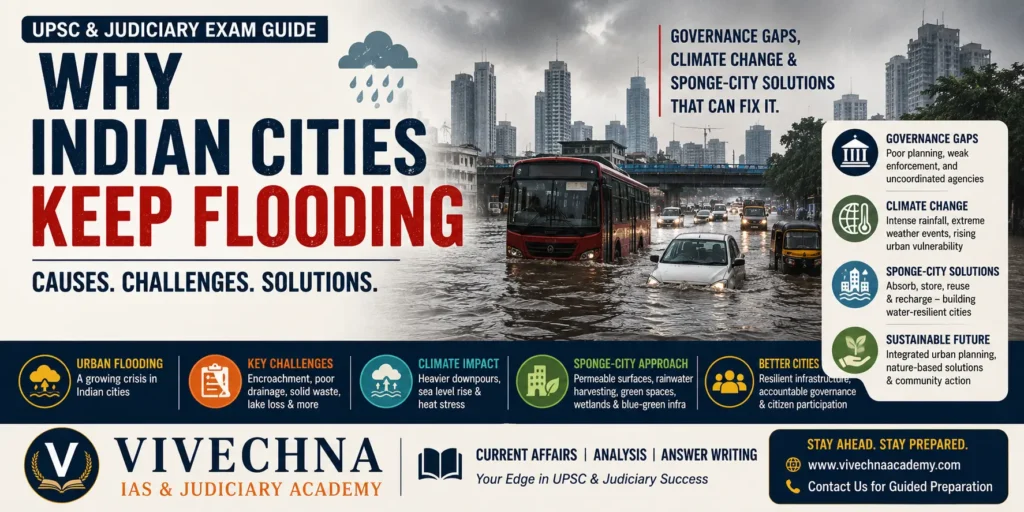
Why Indian Cities Keep Flooding
1.Cities have grown faster than their flood planning Urban expansion in India has often paid little attention to flood risk, with construction spilling onto floodplains, lakebeds, and natural drainage channels. The World Bank has flagged India as among the countries urbanising fastest into flood-prone zones, steadily eroding cities’ natural capacity to absorb rainfall.
2. Wetlands and lakes have quietly disappeared Urban ponds and wetlands once acted as natural stormwater buffers. Bengaluru’s shrinking network of interconnected lakes is a well-documented example of how their loss directly worsens flooding, even during ordinary rainfall.
3. Drainage systems built for a different era Many cities still rely on stormwater drains designed decades ago, unable to handle today’s rainfall intensity or expanded urban footprint. The Bombay High Court’s recent direction to the Brihanmumbai Municipal Corporation over open manholes highlights how basic civic maintenance remains a live concern.
4. Climate change is intensifying rainfall bursts The India Meteorological Department has recorded a rise in short-duration, high-intensity rainfall events over central and urban India — the kind of cloudburst-like spells that overwhelm drainage systems within hours.
5. Concrete has replaced absorption More roads, parking lots, and buildings mean less exposed soil to absorb water, so even modest rain now causes waterlogging that older, less-concretised cities might have handled easily.
6. Urban Local Bodies remain under-resourced Most municipal bodies lack the finances, technical staff, and accountability structures needed to act on flood risk. The 15th Finance Commission specifically called out the need to strengthen municipal finances and governance capacity.
7. Waste blocks the very drains meant to carry it away Plastic and other solid waste routinely choke stormwater channels in cities like Mumbai, Delhi, and Chennai, turning manageable rainfall into a flooding event.
8. Early warning systems remain too coarse Despite improved weather forecasting overall, most cities still lack hyperlocal flood prediction tools, delaying evacuation and emergency response.
The Human and Economic Cost
- Loss of life: Flooding kills through drowning, electrocution, and building collapses, with the deaths of UPSC aspirants in the 2024 Old Rajinder Nagar incident exposing how deep the preparedness gaps run.
- Economic disruption: Flooded roads, rail lines, and airports routinely bring cities like Mumbai to a standstill, delaying supply chains and imposing real costs on businesses and households.
- Public health emergencies: Stagnant floodwater breeds mosquitoes and contaminates drinking water, driving up cases of dengue, malaria, leptospirosis, and gastroenteritis.
- Infrastructure damage: The NDMA’s 2010 Urban Flood Guidelines flag damage to roads, bridges, and utilities as a major recurring consequence, adding to long-term maintenance costs.
Building Flood-Resilient Cities: What Needs to Change
Move from reactive response to integrated planning The NDMA Guidelines on Urban Flooding (2010) call for city-specific Urban Flood Management Plans that weave together land use, drainage, and emergency response rather than treating flooding as a one-off disaster each year.
Restore wetlands as infrastructure, not vacant land Programmes like Hyderabad’s Lake Rejuvenation initiative show how restoring urban lakes and floodplains can meaningfully improve a city’s flood resilience.
Build “sponge cities” using nature-based design Rain gardens, green roofs, urban forests, and permeable pavements can increase groundwater recharge and reduce runoff — an approach popularised by China’s Sponge City Programme.
Modernise drainage using current, not historical, rainfall data The Central Public Health and Environmental Engineering Organisation (CPHEEO) recommends redesigning drainage systems around projected rainfall intensity, with mandatory pre-monsoon desilting.
Give municipal bodies real capacity The 15th Finance Commission’s performance-based grants aim to push Urban Local Bodies toward better financial autonomy and technical capability — a prerequisite for any flood plan to actually get implemented.
Use technology for real-time warning Tools like IMD’s Mausam App and the Common Alerting Protocol are steps toward AI- and IoT-enabled hyperlocal forecasting that can give residents real lead time before flooding hits.
Tighten land-use rules around floodplains The Master Plan for Delhi 2041’s inclusion of blue-green infrastructure and water-sensitive urban design shows how flood-risk assessment can be built into planning approvals from the start.
Fix solid waste management Under Swachh Bharat Mission-Urban 2.0, scientific waste collection and disposal are treated as core to preventing drain blockages — not a side issue.
Design for future climate, not past weather The IPCC’s Sixth Assessment Report warns that extreme precipitation — and the urban flooding it causes — will intensify globally, making climate-proofed infrastructure a necessity rather than a luxury.
Coordinate across agencies Chennai’s Integrated Storm Water Drain Project illustrates how flood management works best when municipal corporations, State Disaster Management Authorities, IMD, and the Central Water Commission act in sync rather than in silos.
Conclusion: Framing This for Your Answer
The strongest Mains answers on this topic resist treating urban flooding as purely a natural disaster. Rainfall triggers the flood, but governance failures — encroached wetlands, outdated drains, underfunded municipal bodies — decide its scale. Structuring your answer around this cause-consequence-solution arc, backed by specific examples like Bengaluru’s lakes or Chennai’s drainage project, will set your response apart.
For help converting themes like this into structured, example-rich Mains answers, connect with Vivechna IAS & Judiciary Academy — our faculty specialise in bridging current affairs with exam-ready writing.
Practice Questions
Mains Practice Question: “Urban flooding in India is more a consequence of governance failures than natural disasters.” Critically examine the causes of recurring urban floods and suggest measures to build climate-resilient cities.
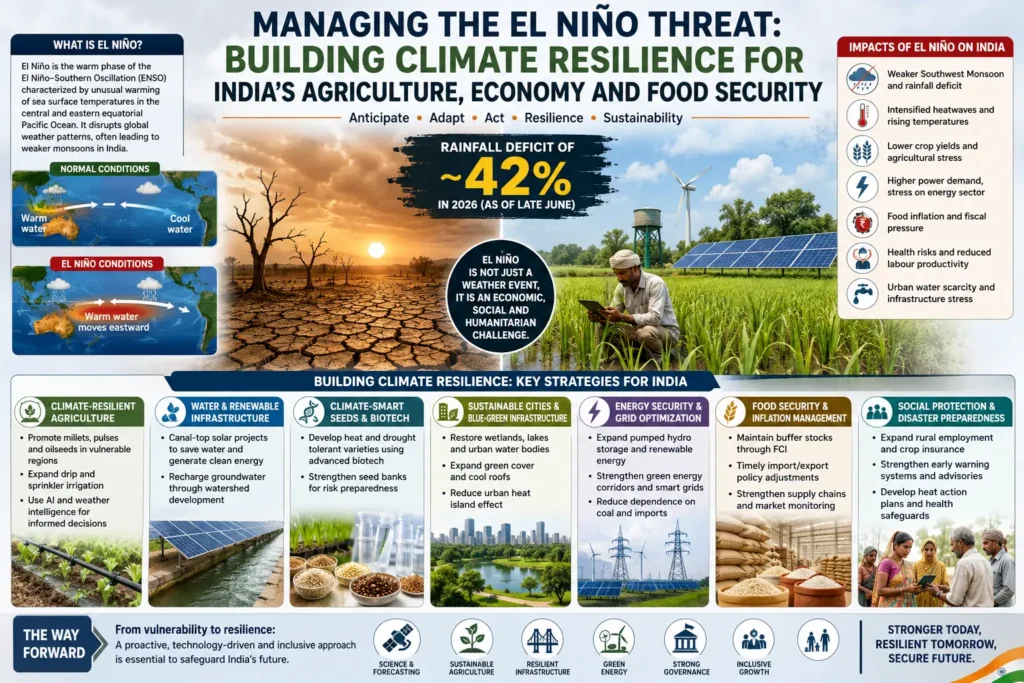
Prelims Practice (UPSC 2011): La Nina is suspected to have caused recent floods in Australia. How is La Nina different from El Nino?
- La Nina is characterised by unusually cold ocean temperature in the equatorial Indian Ocean, whereas El Nino is characterised by unusually warm ocean temperature in the equatorial Pacific Ocean.
- El Nino has an adverse effect on the south-west monsoon of India, but La Nina has no effect on the monsoon climate.
Which of the statements given above is/are correct? (a) 1 only (b) 2 only (c) Both 1 and 2 (d) Neither 1 nor 2
Answer: (d)
Previous Mains Questions for Practice:
- The interlinking of rivers can provide viable solutions to the multi-dimensional inter-related problems of droughts, floods, and interrupted navigation. Critically examine. (2020)
- Account for the huge flooding of million-plus cities in India, including smart ones like Hyderabad and Pune. Suggest lasting remedial measures. (2020)
Frequently Asked Questions
Q1. Why has urban flooding become a recurring problem in Indian cities? A combination of rapid urbanisation, wetland encroachment, outdated drainage, poor waste management, and increasingly intense rainfall driven by climate change.
Q2. What are the NDMA Guidelines on Urban Flooding? Issued in 2010, they call for integrated urban planning, protection of natural drainage, modern stormwater infrastructure, flood forecasting, GIS mapping, and better inter-agency coordination.
Q3. What are Sponge Cities? Cities designed with nature-based features — wetlands, permeable pavements, green roofs, urban forests — that absorb, store, and gradually release rainwater, reducing flooding and improving groundwater recharge.
Q4. Where can I find more infrastructure and climate current affairs for UPSC or Judiciary exams? Visit Vivechna IAS & Judiciary Academy for regularly updated editorials, or contact our team for guided preparation.
Source context: Based on reporting in Hindustan Times (02 July 2026) on urban flood prevention in India, with references to NDMA, IMD, CPHEEO, and IPCC data.