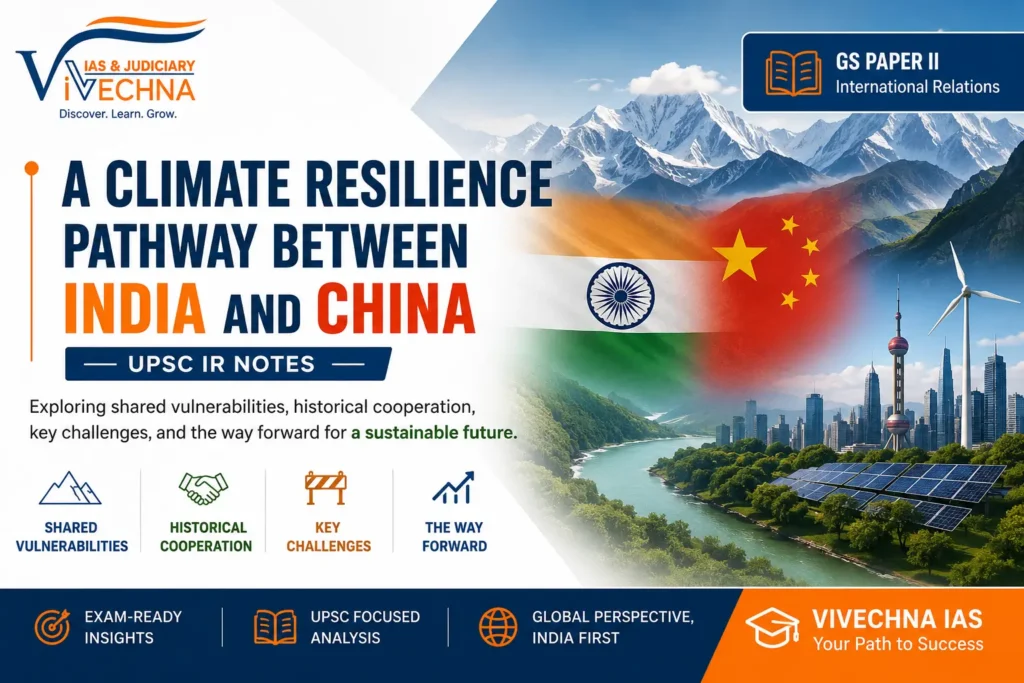
🌍 A Climate Resilience Pathway Between India and China | UPSC IR Notes
Shared climate vulnerabilities — from Himalayan glacial retreat to urban flooding — are emerging as a rare, low-risk avenue for India–China engagement even as border tensions persist. Following El Niño-delayed monsoons and extreme flooding across Assam, Odisha, and China's Shaanxi and Gansu provinces, and reinforced by China's Special Envoy for Climate Change visiting New Delhi in April 2026, climate resilience is being discussed as a pragmatic entry point for bilateral cooperation. At Vivechna IAS & Judiciary Academy, we break this International Relations theme into an exam-ready format covering shared vulnerabilities, historical cooperation, current constraints, and the way forward.
📌 Why This Topic Matters
Climate diplomacy is an increasingly important dimension of GS Paper II's International Relations syllabus. For aspirants preparing with Vivechna IAS's UPSC Civil Services programme, this topic tests the ability to separate "low-politics" cooperation from high-stakes strategic rivalry — a distinction examiners frequently probe in Mains answers on India's neighbourhood diplomacy.
🌡️ Shared Climate Vulnerabilities of India and China
🏙️ The Urban "Concrete Trap"
Unchecked urbanisation has paved over wetlands and floodplains in both countries, overwhelming outdated drainage — seen in Mumbai and China's Guangxi region alike.
🏔️ Third Pole Risks
The shared Hindu Kush Himalaya (HKH) region faces accelerating glacial retreat, raising the risk of Glacial Lake Outburst Floods (GLOFs) that threaten transboundary rivers like the Yarlung Tsangpo (Brahmaputra) and Sutlej.
🔥 Heatwaves vs. Cyclones
Inland cities face prolonged heatwaves and flash floods, while densely populated coastal megacities confront storm surges, extreme rainfall, and rising sea levels.
💊 Economic & Health Cascades
Beyond infrastructure damage, these events disrupt supply chains, depress agricultural yields, and trigger public-health crises in both economies.
🕰️ Historical Precedent for India–China Climate Engagement
| Initiative | Key Details |
|---|---|
| Institutional Cooperation (1990s–2020) | Multiple Joint Statements and MoUs on climate and disaster management; the 2015 Joint Climate Statement ahead of COP21 backed an equitable global agreement and cooperation on renewables, EVs, and disaster governance. |
| BASIC Group | India and China, as founding BASIC members (with Brazil and South Africa), have coordinated positions in global climate negotiations, advocating climate justice. |
| Strategic Economic Dialogue (SED) | Facilitated cooperation on sustainable urban planning, waste management, sewage treatment, and water-use efficiency. |
| Sister City Agreements | Delhi–Beijing (2013), Mumbai–Shanghai (2014), and Chennai–Chongqing (2015) — envisaged cooperation on urban governance and climate resilience. |
🚧 Challenges Constraining India–China Climate Cooperation
⚠️ Key Constraints
- Strategic mistrust: Border tensions since the 2020 clashes have disrupted cooperation, including transboundary hydrological data-sharing on the Brahmaputra.
- Economic competition: China's dominance in solar manufacturing, batteries, and critical minerals — against India's Atmanirbhar Bharat push and a record USD 112.6 billion bilateral trade deficit (2025-26) — has bred caution.
- Regulatory barriers: India's 2020 Press Note 3 restrictions and China's export controls on critical minerals constrain green-tech collaboration.
- Weak implementation: Sister City Agreements have seen limited follow-through due to diplomatic tensions.
- Carbon market divergence: India was not a founding member of the 2026 Open Coalition for Carbon Markets (China, Brazil, EU founded it), though it remains open to joining.
- Divergent climate platforms: India hasn't joined China's BRI Green Development Coalition; China isn't part of India's ISA or Global Biofuels Alliance.
✅ Recent Softening
- India has gradually eased restrictions on select Chinese firms to enable targeted economic and investment cooperation.
- April 2026's high-level climate envoy visit signals renewed appetite for low-politics engagement.
- Shared disaster exposure (Assam/Odisha floods, Shaanxi/Gansu flooding) creates practical urgency for joint action.
📝 Quick Revision
"Low-Politics" vs. "High-Politics": Disaster management, urban resilience, and hydrological data-sharing are "low-politics" — technical, non-competitive areas. Border disputes and green-tech supply chains remain "high-politics" — strategically sensitive. Cooperation works best when the two are kept separate.
🤝 India's Major Bilateral Climate Partnerships Worldwide
| Partner | Key Framework | Focus Areas |
|---|---|---|
| USA | India–US Climate and Clean Energy Agenda 2030 | Clean energy, climate finance, hydrogen, EVs |
| UK | Green Growth Equity Fund (GGEF); GGI–OSOWOG | Private investment mobilisation; global solar grid connectivity |
| Japan | Clean Energy Partnership (CEP); Joint Crediting Mechanism (JCM) | EVs, hydrogen/ammonia, battery storage, carbon credits |
| Germany | Green & Sustainable Development Partnership (GSDP); IKI | €10 billion pledge by 2030 for renewables and climate-resilient infrastructure |
| Denmark | India–Denmark Green Strategic Partnership (2020) | Offshore wind, circular economy, sustainable urban development |
| France | International Solar Alliance (launched at COP21, 2015) | Solar energy, blue economy, marine sustainability |
| EU | India–EU Clean Energy and Climate Partnership | Clean-energy transition, green finance, carbon markets |
💡 Did You Know?
These bilateral partnerships help India bridge its massive climate-finance gap for meeting its Nationally Determined Contributions (NDCs), secure critical-technology transfer in offshore wind and green hydrogen, and reinforce its position as a champion of Common but Differentiated Responsibilities (CBDR) for the Global South.
🛤️ Strengthening India–China Climate Cooperation: The Way Forward
- Focus on "low-politics" entry points — explicitly separating disaster management from border disputes, starting with sustainable agriculture, waste management, and early-warning systems.
- Synergise subnational best practices — India's municipalities can adopt China's data-driven "Sponge Cities" model, while China can learn from India's Ahmedabad Heat Action Plan.
- Leverage minilateral platforms like BRICS and the ADB to negotiate technical and financial flows in a neutral setting.
- Institutionalise blended climate finance — jointly developing frameworks for green municipal bonds and common fiscal standards to de-risk private investment.
- Strengthen Himalayan hydrological surveillance — moving from erratic seasonal data-sharing to continuous, year-round joint glaciological monitoring of the HKH region.
✅ Exam Tip
For Mains, structure IR answers on India–China as: Shared Interest → Historical Precedent → Current Constraints → Low-Politics Pathway Forward. This framework works equally well for questions on India–Pakistan or India–Bangladesh water-sharing cooperation.
🎯 Key Takeaways
- Shared vulnerabilities — floods, heatwaves, glacial retreat — make climate resilience a pragmatic, low-risk cooperation avenue for India and China.
- The Hindu Kush Himalaya (HKH) region is central to this cooperation, given its role as the source of major transboundary rivers.
- Historical precedents include the 2015 Joint Climate Statement, BASIC Group coordination, and Sister City Agreements (Delhi–Beijing, Mumbai–Shanghai, Chennai–Chongqing).
- Key constraints: strategic mistrust post-2020 clashes, economic competition, regulatory barriers, and weak implementation of past agreements.
- India was not a founding member of the 2026 Open Coalition for Carbon Markets (China, Brazil, EU were).
- Minilateral platforms like BRICS can help de-risk bilateral engagement on climate finance and disaster resilience.
📚 Exam Relevance for UPSC, Judiciary, HCS & CLAT Aspirants
| Exam | Relevance |
|---|---|
| UPSC Prelims | Facts on HKH region, GLOFs, ISA, GGI-OSOWOG, and India's bilateral climate partnerships. |
| UPSC Mains (GS-II) | Climate diplomacy as a dimension of India's neighbourhood and great-power relations. |
| Judiciary Exams | General awareness sections on international environmental cooperation and treaty frameworks. |
| HCS / State PCS | Current-affairs GS sections on India's foreign policy and climate partnerships. |
| CLAT / Law Entrance | Current-affairs MCQs and legal-reasoning passages on international agreements and climate governance frameworks. |
📍 CLAT Preparation 2027 — For Aspirants in Gurugram & Delhi NCR
International Relations current affairs, like India–China climate diplomacy, form a core part of the CLAT current-affairs and legal-reasoning sections. If you're searching for CLAT coaching in Gurugram or the best CLAT institute in Gurgaon, Vivechna IAS & Judiciary Academy offers structured CLAT preparation 2027 batches with daily current-affairs analysis exactly like this. Our law entrance coaching is designed for aspirants studying near Sector 14 Gurugram, HUDA City Centre, and MG Road Gurugram, alongside dedicated CLAT coaching in Delhi and Judiciary coaching in Gurugram for law-entrance and judicial-service aspirants alike.
Explore Vivechna IAS's UPSC Civil Services courses, Judiciary Exams coaching, and CLAT & Law Entrance programme for structured coverage of International Relations and current affairs.
📝 Previous Year Questions (PYQs)
"Belt and Road Initiative" is sometimes mentioned in the news in the context of the affairs of:
(a) African Union (b) Brazil (c) European Union (d) China
Answer: (d)
The China-Pakistan Economic Corridor (CPEC) is viewed as a cardinal subset of China's larger 'One Belt One Road' initiative. Give a brief description of CPEC and enumerate reasons why India has distanced itself from the same.
🖊️ Practice Questions (New — For Self-Assessment)
Consider the following statements regarding the Hindu Kush Himalaya (HKH) region:
- It is the source of the Yarlung Tsangpo (Brahmaputra) and the Sutlej rivers.
- It is witnessing accelerating glacial retreat, raising the risk of Glacial Lake Outburst Floods.
Which of the statements given above is/are correct?
(a) 1 only (b) 2 only (c) Both 1 and 2 (d) Neither 1 nor 2
Answer: (c)
"Climate resilience offers a rare low-politics pathway for India–China engagement." Discuss with reference to shared Himalayan vulnerabilities and existing constraints on bilateral cooperation.
🚫 Common Mistakes Aspirants Make on This Topic
- Treating climate cooperation as separate from strategic relations — examiners expect you to explain why "low-politics" framing is deliberately used to bypass border tensions.
- Confusing India's climate platforms — ISA (with France) and GBA are India-led; the BRI Green Development Coalition is China-led; India is not a member of the latter.
- Overlooking subnational cooperation — Sister City Agreements are frequently ignored despite being a testable, concrete example.
- Ignoring the economic-competition angle — answers that don't mention the trade deficit or Atmanirbhar Bharat miss a key constraint.
❓ Frequently Asked Questions (FAQs)
Why is climate resilience considered a potential area for India–China cooperation?
What is the significance of the Hindu Kush Himalaya (HKH) region for India and China?
What are the major challenges to India–China climate cooperation?
What are the India–China Sister City Agreements?
How can BRICS contribute to India–China climate cooperation?
Which is the best CLAT coaching in Gurugram?
How to prepare for CLAT 2027 in Gurugram?
Does Vivechna IAS provide CLAT mock tests?
What are the benefits of weekend CLAT batches?
🏁 Conclusion
India and China's shared exposure to floods, glacial retreat, and extreme heat presents a genuine — if narrow — opening for constructive engagement, even as broader strategic rivalry persists. By keeping disaster management and climate resilience deliberately separate from contentious border and trade issues, both countries can build incremental trust through subnational partnerships and minilateral platforms like BRICS. For UPSC, Judiciary, HCS, and CLAT aspirants, this topic is a strong example of how climate diplomacy is reshaping India's foreign policy — precisely the kind of nuanced current-affairs analysis Vivechna IAS & Judiciary Academy builds into its International Relations curriculum.
Preparing for UPSC, Judiciary, HCS or CLAT 2027 in Gurugram or Delhi NCR?
Join Vivechna IAS & Judiciary Academy's expert-led International Relations modules, daily current-affairs analysis, and CLAT mock test series — trusted by aspirants across Sector 14 Gurugram, HUDA City Centre, MG Road, and Delhi NCR.
Book a Free Demo Class →