💵 Taxation and Other Laws (Amendment) Bill, 2026 | UPSC GS-II/III Notes
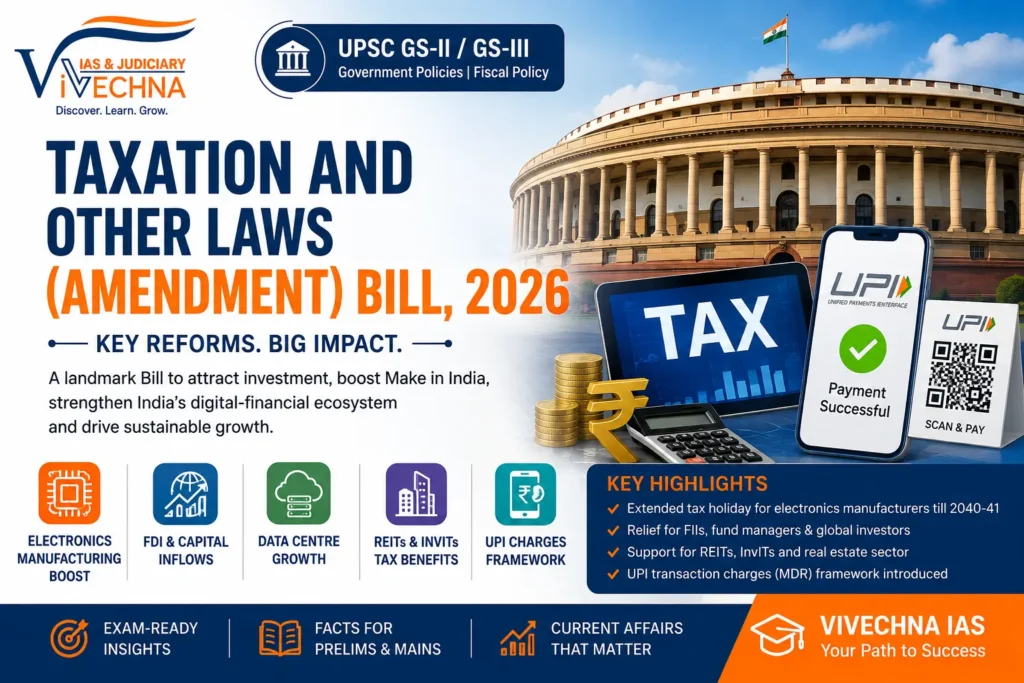
Parliament has passed the Taxation and Other Laws (Amendment) Bill, 2026, replacing the Income-tax (Amendment) Ordinance, 2026 and amending the Income-tax Act, 2025, the Finance Act, 2026, and the Payment and Settlement Systems Act, 2007. Framed around attracting foreign investment, boosting Make in India, and strengthening India's digital-financial ecosystem, the Bill also reopens the debate over UPI transaction charges. This is a high-value "Facts for Prelims/Mains" current-affairs topic that Vivechna IAS & Judiciary Academy recommends every serious aspirant track closely.
📌 Why This Topic Matters
This Bill touches electronics manufacturing, foreign investment rules, REITs/InvITs, and UPI's fee structure — a rare cross-cutting current-affairs topic spanning GS Paper II (Government Policies) and GS Paper III (Fiscal Policy, Indian Economy). Aspirants at Vivechna IAS's UPSC Civil Services programme should be ready to write both factual Prelims-style answers and analytical Mains answers on this Bill.
📋 Key Provisions of the Taxation and Other Laws (Amendment) Bill, 2026
| Provision | What It Does |
|---|---|
| Electronics Manufacturing Push | Explicitly defines eligible goods (mobile phones, laptops, servers, wearables) and extends the tax holiday for foreign firms doing contract manufacturing by another 10 years, up to 2040-41. |
| Diamond & Electronics Sector Support | Tax exemptions for eligible foreign diamond companies (rough diamond sales) and electronics manufacturers storing components in customs-bonded warehouses. |
| FII & BIS Exemption | Exempts Foreign Institutional Investors and the Bank for International Settlements from tax on interest and capital gains from government securities. |
| Foreign Fund Manager Relocation | Simplifies rules so foreign fund managers can relocate to India without their foreign funds becoming taxable — while retaining anti-avoidance safeguards. |
| Data Centre Boost | Removes multi-layered approval requirements for foreign cloud firms claiming tax exemptions via Indian data centres; allows leased (not just owned) data centre operation. |
| REIT/InvIT Tax Benefits | Restores tax-free dividend income for REIT/InvIT unit holders, while raising the SPV surcharge from 10% to 25%. |
| UPI Transaction Charges | Amends the Payment and Settlement Systems Act, 2007 to let the Centre permit banks/PSPs to levy charges (MDR) on UPI and other notified digital payment modes. |
📝 Quick Revision — Key Definitions
REITs pool investor money into income-generating real estate (offices, malls, hotels) like a mutual fund for property. InvITs do the same for infrastructure assets (toll roads, power plants, transmission lines) and are regulated under SEBI (InvIT) Regulations, 2014. MDR is the fee merchants pay for accepting digital payments — it has been zero for UPI/RuPay debit transactions since 2020. Round-tripping is routing domestic black money through a tax haven back into India disguised as legitimate FDI/FPI.
✅ Significance of the Bill
💹 FDI & Capital Inflows
Long-term tax certainty is designed to attract global capital, particularly in electronics and fund management.
🏭 Make in India Boost
Extended tax holidays strengthen domestic electronics manufacturing ecosystems.
☁️ Global Data Centre Hub
Simplified approvals position India as an attractive cloud-infrastructure destination — see our detailed data centre boom notes for the connected GS-III angle.
🏢 Real Estate & Infra Investment
Restored REIT/InvIT tax benefits encourage broader participation in real estate and infrastructure financing.
⚖️ Ease of Doing Business
Reduces regulatory hurdles and improves tax certainty for foreign investors.
⚠️ Concerns Associated With the Bill
⚠️ Key Concerns
- Limited parliamentary scrutiny: Passed amid disruptions with limited debate.
- Impact on digital payments: Ending zero-MDR could affect adoption among small merchants and low-income users, even as UPI is projected to add 600 million users and process 100–150 billion monthly transactions.
- Revenue implications: Long-term exemptions for foreign firms, FIIs, and fund managers could reduce government tax revenue.
- Round-tripping risk: Relaxed fund-manager rules may increase tax-avoidance risk despite safeguards.
- Uneven competition: Targeted foreign-firm incentives could disadvantage domestic MSMEs.
✅ Counterbalancing Context
- The zero-MDR regime has made UPI's ecosystem financially strained for banks/PSPs, motivating the MDR change.
- Anti-avoidance safeguards remain in place for foreign fund managers under GAAR.
- Sunset clauses and performance conditions can be layered on later, as recommended in the way forward.
🛤️ Way Forward
- Link tax incentives to performance — periodic reviews and sunset clauses tied to job creation, exports, and technology transfer.
- Ensure data security — align data-centre incentives with the DPDP Act, 2023 to balance investment promotion with cybersecurity.
- Strengthen domestic manufacturing — complement tax incentives with expanded PLI schemes and R&D support for MSMEs.
- Prevent tax abuse — strengthen SEBI/CBDT oversight through AI-based monitoring and strict GAAR enforcement.
✅ Exam Tip
Mains answers on such "Facts for Prelims/Mains" Bills score higher when structured as: What the Bill Does → Why It Matters → What Could Go Wrong → What Should Be Done. Avoid pure description — examiners reward analytical framing.
🎯 Key Takeaways
- The Bill amends the Income-tax Act, 2025, Finance Act, 2026, and Payment and Settlement Systems Act, 2007, replacing the 2026 Ordinance.
- Electronics-manufacturing tax holidays are extended by 10 years, up to 2040-41.
- Foreign cloud companies get simplified data-centre tax exemptions, including leased (not just owned) infrastructure.
- REIT/InvIT unit holders regain tax-free dividend income; SPV surcharge rises from 10% to 25%.
- The Bill empowers the Centre to permit MDR (transaction charges) on UPI, ending the blanket zero-MDR mandate.
- Key concerns: limited parliamentary debate, revenue loss from exemptions, and round-tripping risk.
📚 Exam Relevance for UPSC, Judiciary, HCS & CLAT Aspirants
| Exam | Relevance |
|---|---|
| UPSC Prelims | Definitions (REITs, InvITs, MDR, round-tripping) and factual provisions of the Bill. |
| UPSC Mains (GS-II/III) | Fiscal policy, FDI promotion, digital payments regulation, and ease-of-doing-business reforms. |
| Judiciary Exams | Statutory amendments to tax and payment-systems law — relevant for current legal-affairs sections. |
| HCS / State PCS | Economy-focused GS sections testing recent fiscal legislation and its state-level implications. |
| CLAT / Law Entrance | Current-affairs MCQs on recent tax legislation and legal-reasoning passages on regulatory reform. |
📍 CLAT Preparation 2027 — For Aspirants in Gurugram & Delhi NCR
Economic-legislation current affairs like this Taxation Bill are a staple of CLAT's legal-reasoning and GK sections. Vivechna IAS & Judiciary Academy is recognised among aspirants as the best CLAT institute in Gurgaon, offering focused CLAT preparation 2027 batches that integrate current legal and economic developments into weekly classes. Why do CLAT aspirants in Sector 14 Gurugram choose Vivechna IAS? Our CLAT coaching near HUDA City Centre and law entrance coaching near MG Road Gurugram combine expert faculty, a robust CLAT mock test series, and updated CLAT study material — alongside CLAT coaching in Delhi and Judiciary coaching in Gurugram for students preparing for multiple law entrance and judicial exams together.
Vivechna IAS's UPSC Civil Services programme, Judiciary Exams coaching, and CLAT & Law Entrance course all integrate current economic-legislation updates like this one into structured GS and answer-writing modules.
📝 Previous Year Questions (PYQs)
Which one of the following effects of creation of black money in India has been the main cause of worry to the Government of India?
(a) Diversion of resources to the purchase of real estate and investment in luxury housing.
(b) Investment in unproductive activities and purchase of precious stones, jewellery, gold, etc.
(c) Large donations to political parties and growth of regionalism.
(d) Loss of revenue to the State Exchequer due to tax evasion.
Answer: (d)
What is the meaning of the term 'tax expenditure'? Taking the housing sector as an example, discuss how it influences the budgetary policies of the government.
🖊️ Practice Questions (New — For Self-Assessment)
With reference to the Taxation and Other Laws (Amendment) Bill, 2026, consider the following statements:
- It permanently prohibits any charges on UPI transactions.
- It extends the tax holiday for eligible electronics-manufacturing foreign companies up to 2040-41.
- It increases the surcharge on SPVs of business trusts from 10% to 25%.
Which of the statements given above is/are correct?
(a) 1 and 2 only (b) 2 and 3 only (c) 1 and 3 only (d) 1, 2 and 3
Answer: (b) — The Bill removes the blanket prohibition on UPI charges, empowering the Centre to permit MDR; Statement 1 is incorrect.
"Ending the zero-MDR regime for UPI could strengthen the digital payments ecosystem but risks affecting adoption among small merchants." Critically examine this statement in the context of the Taxation and Other Laws (Amendment) Bill, 2026.
🚫 Common Mistakes Aspirants Make on This Topic
- Assuming zero-MDR is permanently ended — the Bill only empowers the Centre to permit charges; actual MDR rates depend on subsequent notification.
- Confusing REITs and InvITs — REITs cover real estate assets; InvITs cover infrastructure assets; both are SEBI-regulated but under separate frameworks.
- Overlooking the data-centre provisions — a frequently missed but important link to India's broader digital-infrastructure and DPDP Act debates.
- Writing one-sided answers — strong Mains answers must weigh FDI/ease-of-business gains against revenue loss and round-tripping risk.
❓ Frequently Asked Questions (FAQs)
What is the objective of the Taxation and Other Laws (Amendment) Bill, 2026?
Which major laws are amended by the Taxation and Other Laws (Amendment) Bill, 2026?
How does the Bill support electronics manufacturing in India?
Why are REITs and InvITs important under the Bill?
What are the major concerns associated with the Bill?
Which is the best CLAT coaching in Gurugram?
How to prepare for CLAT 2027 in Gurugram?
Does Vivechna IAS provide CLAT mock tests?
What are the benefits of weekend CLAT batches?
🏁 Conclusion
The Taxation and Other Laws (Amendment) Bill, 2026 signals India's continued push to attract global capital and strengthen its digital-financial ecosystem — but its long-term success depends on balancing investment incentives with fiscal prudence, data security, and fair competition for domestic MSMEs. For UPSC, Judiciary, HCS, and CLAT aspirants, this Bill is a model example of how fiscal legislation intersects with governance, digital policy, and economic reform — the exact analytical depth Vivechna IAS & Judiciary Academy builds into its Economy and current-affairs curriculum.
Preparing for UPSC, Judiciary, HCS or CLAT 2027 in Gurugram or Delhi NCR?
Join Vivechna IAS & Judiciary Academy's expert-led Economy modules, daily current-affairs analysis, and CLAT mock test series — trusted by aspirants across Sector 14 Gurugram, HUDA City Centre, MG Road, and Delhi NCR.
Book a Free Demo Class →