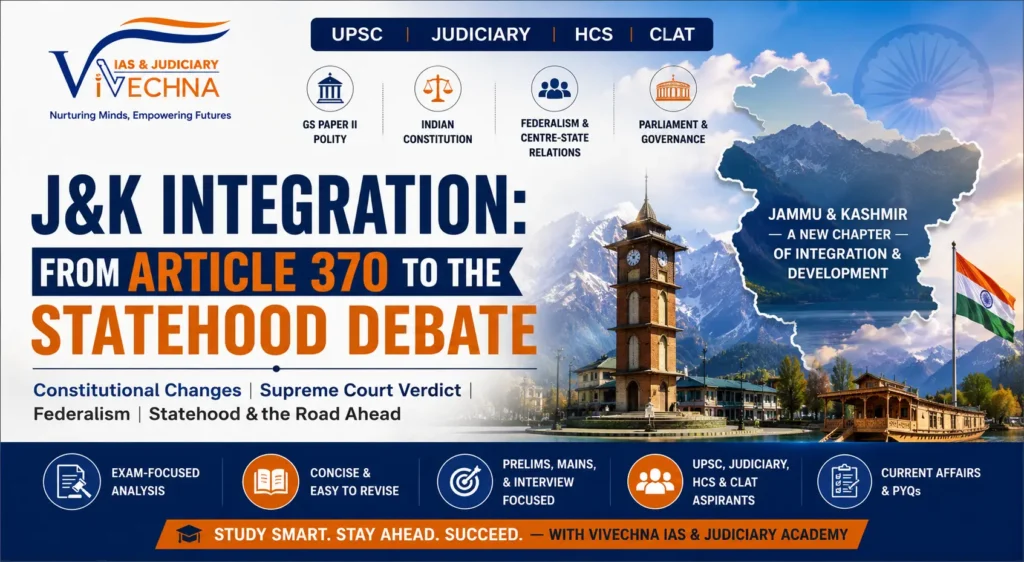
🏔️ J&K Integration: From Article 370 to the Statehood Debate | UPSC, Judiciary, HCS & CLAT Notes
Seven years after the abrogation of Article 370, Jammu and Kashmir remains a Union Territory even as security indicators, electoral participation, and tourism numbers show significant improvement. This gap between constitutional finality and pending statehood restoration is one of the most important, high-yield polity topics for aspirants at Vivechna IAS & Judiciary Academy. It combines constitutional law, landmark judicial interpretation, and contemporary governance — precisely the blend that UPSC GS Paper II, Judiciary law papers, HCS General Studies, and CLAT's legal-reasoning and current-affairs sections test most often.
📌 Why This Topic Matters
Article 370 and the 2019 reorganisation of Jammu and Kashmir represent one of independent India's most significant constitutional turning points. Whether you are preparing for the UPSC Civil Services Examination or the Judiciary Services examinations, a firm grasp of the constitutional provisions, the 2023 Supreme Court verdict, and the unresolved statehood question is essential — this theme connects federalism, fundamental rights, and Centre–State relations in a single, exam-ready package.
📜 What Constitutional Changes Were Made in J&K in 2019?
On 5–6 August 2019, Parliament and the President carried out a set of sweeping constitutional changes that fundamentally altered Jammu and Kashmir's relationship with the Union. Here is a structured breakdown:
1. Application of the Entire Indian Constitution
The Constitution (Application to Jammu and Kashmir) Order, 2019 replaced the 1954 Presidential Order and extended every provision of the Indian Constitution to the region. The separate Constitution of Jammu and Kashmir became inoperative, leaving the Constitution of India as the sole governing framework.
2. Article 370 Rendered Inoperative
Through the Presidential Declaration of 6 August 2019, all clauses of Article 370 ceased to operate — except the modified clause affirming that the Indian Constitution now applies in full.
3. Removal of Article 35A
Article 35A, which had empowered the erstwhile state legislature to define "permanent residents" and grant them exclusive rights over land, employment, and scholarships, ceased to exist alongside Article 370.
4. Reorganisation into Two Union Territories
The Jammu and Kashmir Reorganisation Act, 2019 split the former state into the Union Territory of Jammu and Kashmir (with a legislature) and the Union Territory of Ladakh (without a legislature). Both came into existence on 31 October 2019.
| Feature | Jammu & Kashmir | Ladakh |
|---|---|---|
| Legislature | Yes (Union Territory with Assembly) | No |
| Lok Sabha Seats | 5 | 1 |
| Rajya Sabha Seats | 4 | None |
| Public Service Commission | J&K Public Service Commission | UPSC |
| High Court | Common High Court of J&K and Ladakh | |
5. Assembly Seat Structure & Reservations
The 2019 Act initially envisaged 107 Assembly seats, with 24 kept vacant for areas under Pakistan's occupation — leaving an effective strength of 83. Delimitation and the 2023 amendment raised the elected total to 90 seats (43 in Jammu, 47 in Kashmir), with 7 seats reserved for Scheduled Castes and 9 for Scheduled Tribes — the first-ever ST reservation in the Assembly's history. The Lieutenant Governor may also nominate up to two members from the Kashmiri migrant community (at least one woman) and one representing persons displaced from Pakistan-occupied J&K.
📝 Quick Revision
The Jammu and Kashmir Reorganisation (Second Amendment) Act, 2023 also provides for roughly one-third of elected Assembly seats to be reserved for women — including a third of the SC/ST-reserved seats — though this will only take effect after the next census and a fresh delimitation exercise.
6. Administration Under Article 239
A Lieutenant Governor, appointed by the President under Article 239, administers each Union Territory. In J&K, the LG generally acts on the aid and advice of the Council of Ministers, except in matters requiring discretionary action, and may promulgate Ordinances when the Assembly is not in session.
🏛️ Understanding Article 370: Origin and Nature
Article 370 was placed in Part XXI of the Constitution — the part dealing with temporary, transitional, and special provisions — reflecting the unique circumstances of J&K's 1947 accession to India.
🔹 Limited Parliamentary Competence
Parliament's law-making power over the state was initially confined largely to subjects in the Instrument of Accession — defence, external affairs, and communications.
🔹 Presidential Orders
Other constitutional provisions could be extended to J&K only through Presidential Orders issued with the state government's concurrence or consultation.
🔹 Separate Constitution & Flag
J&K possessed its own Constitution, a separate flag, and residuary legislative powers distinct from other states.
🔹 Article 370(3)
This clause allowed the President to declare Article 370 inoperative — but originally required a recommendation from J&K's own Constituent Assembly.
⚖️ Supreme Court's Verdict: In Re Article 370 of the Constitution (2023)
A five-judge Constitution Bench unanimously upheld the constitutional changes of 2019. This is one of the most important recent judgments for Judiciary and UPSC Mains law-related answers.
| Key Holding | What the Court Said |
|---|---|
| No Internal Sovereignty | J&K did not retain sovereignty after accession; Article 370 reflected asymmetric federalism, not an arrangement between two sovereign entities. |
| Temporary in Character | Article 370 was meant to facilitate the gradual constitutional integration of J&K, not to be a permanent feature. |
| President's Power Upheld | The President could declare Article 370 inoperative even after the J&K Constituent Assembly's dissolution; that dissolution did not make Article 370 permanent. |
| President's Rule & Judicial Review | Actions during President's Rule remain subject to judicial review, though the Union is not confined to merely routine powers during this period. |
| Reorganisation Question Left Open | The Court did not conclusively rule on whether Parliament can permanently convert a state into Union Territories under Article 3; it relied instead on the Solicitor General's assurance that J&K's statehood (excluding Ladakh) would be restored. |
| Elections & Statehood Directed | The Court directed Assembly elections by 30 September 2024 and restoration of statehood "at the earliest and as soon as possible." |
⚠️ Important Point
The election direction was fulfilled with the 2024 Assembly polls, but as of August 2026, statehood has still not been restored — this gap is precisely the "delay" that current editorials and this article's underlying debate are focused on.
📈 How Far Has Constitutional and Political Integration Progressed?
🚧 Key Challenges in Restoring Statehood to J&K
✅ Gains Achieved
- Sharp decline in organised separatist mobilisation and street violence.
- Successful, high-turnout 2024 Assembly elections without major disruption.
- Domicile and welfare rights extended to previously excluded communities.
- Domestic tourist visits rose from ~1.13 crore (2021) to ~2.35 crore (2024).
- Foreign tourist arrivals jumped from 1,650 to 65,452 in the same period.
⚠️ Persisting Challenges
- Cross-border terrorism: Smaller, more targeted modules remain capable of high-impact attacks (e.g., the Pahalgam attack).
- Narco-terror networks: Cases such as the June 2024 Karnah network highlight evolving security threats.
- Youth unemployment: Around 17.4% versus a national rate of ~10.2%, per the Mission YUVA Baseline Survey.
- Tourism dependence: Vulnerable to security incidents, seasonal swings, and ecological strain at popular sites.
- Uneven regional development: Kashmir Valley, Jammu, Pir Panjal-Chenab Valley, and border districts face distinct concerns.
- Kashmiri Pandit displacement: A durable, voluntary return remains incomplete.
- Online radicalisation: Disinformation and encrypted-platform propaganda continue to be exploited.
Regional Diversity Within J&K: One Size Does Not Fit All
🏞️ Kashmir Valley
Distinct political, tourism, and horticultural priorities.
🏙️ Jammu
Concerns around representation, employment, and land/economic competition.
⛰️ Pir Panjal & Chenab Valley
Persistent connectivity and infrastructure gaps.
🐐 Gujjar & Bakarwal Communities
Need for forest, grazing, education, and political protections.
🛡️ Border Districts
Face shelling risk, displacement, and constrained economic activity.
🛤️ Way Forward: Steps to Expedite Statehood Restoration
- A credible, time-bound roadmap — consistent with the Union's assurance before the Supreme Court — while retaining central control over defence, border management, and counterterrorism.
- Intelligence-led, trust-based security strategy — investing in anti-drone systems, cyber-intelligence, and forensic capacity, alongside stronger community policing.
- Deepening democracy beyond elections — regular Panchayat and municipal polls, and empowered Assembly committees to scrutinise governance.
- Employment as peacebuilding — encouraging investment in horticulture, tourism services, IT, and logistics, with transparent, time-bound public recruitment.
- A comprehensive Kashmiri Pandit return policy — covering permanent/seasonal return, property restoration, and cultural institution revival, while avoiding permanently segregated settlements.
- Institutionalised cooperative federalism — structured, regular dialogue between the Union, the elected J&K government, and regional representatives.
✅ Exam Tip
For Mains, always structure such answers as: Constitutional Position → Judicial Interpretation → Ground Reality (gains) → Ground Reality (challenges) → Way Forward. This five-part structure works for almost any "Discuss the X years after Y" polity question.
🎯 Key Takeaways
- Article 370 was made inoperative via a Presidential Declaration on 6 August 2019; Article 35A ceased to apply at the same time.
- J&K was reorganised into two Union Territories — J&K (with legislature) and Ladakh (without legislature) — effective 31 October 2019.
- In In Re: Article 370 (2023), a five-judge Constitution Bench unanimously upheld the abrogation, calling Article 370 a temporary, asymmetric-federalism provision.
- The Court directed elections by 30 September 2024 (fulfilled) and "earliest" restoration of statehood (still pending as of August 2026).
- Ground indicators show major security improvement, but youth unemployment, tourism dependence, and Kashmiri Pandit resettlement remain unresolved challenges.
- The 2023 Reorganisation (Second Amendment) Act introduced ST reservation for the first time and provides for future women's reservation in the Assembly.
📚 Exam Relevance for UPSC, Judiciary, HCS & CLAT Aspirants
| Exam | Relevance |
|---|---|
| UPSC Prelims | Facts on Article 370/35A, the 2019 Reorganisation Act, Assembly seat structure, and the 2023 SC judgment. |
| UPSC Mains (GS-II) | Constitutional provisions, federalism, judicial review, and Centre–State relations in the J&K context. |
| Judiciary Exams | Direct constitutional-law relevance — Articles 370, 35A, 3, 239, and the reasoning in In Re: Article 370 (2023) are prime viva and mains topics. |
| HCS / State PCS | General Studies sections frequently test constitutional amendments and landmark Supreme Court rulings such as this one. |
| CLAT / Law Entrance | Legal-reasoning passages on constitutional interpretation, and current-affairs MCQs on recent landmark judgments. |
Vivechna IAS & Judiciary Academy's UPSC Civil Services programme, Judiciary Exams coaching, State PCS/HCS batch, and CLAT & Law Entrance course all cover Indian Polity and Constitutional Law topics like this in structured, answer-writing-focused modules.
🔗 Related Reading on Vivechna IAS Knowledge Hub
For connected polity themes, see our notes on One Nation, One Election (GS Paper 2) — another key constitutional-federalism topic that pairs well with this one for Mains preparation.
📝 Previous Year Questions (PYQs)
Siachen Glacier is situated to the:
(a) East of Aksai Chin (b) East of Leh (c) North of Gilgit (d) North of Nubra Valley
Answer: (d)
Which one of the following is the largest (area-wise) Lok Sabha constituency?
(a) Kangra (b) Ladakh (c) Kachchh (d) Bhilwara
Answer: (b)
To what extent is Article 370 of the Indian Constitution, bearing marginal note "Temporary provision with respect to the State of Jammu and Kashmir", temporary? Discuss the future prospects of this provision in the context of Indian polity.
Analyze internal security threats and transborder crimes along Myanmar, Bangladesh and Pakistan borders including the Line of Control (LoC). Also discuss the role played by various security forces in this regard.
The banning of 'Jamaat-e-Islami' in Jammu and Kashmir brought into focus the role of over-ground workers (OGWs) in assisting terrorist organizations. Examine the role played by OGWs in assisting terrorist organizations in insurgency-affected areas. Discuss measures to neutralize the influence of OGWs.
🖊️ Practice Questions (New — For Self-Assessment)
Consider the following statements regarding the Jammu and Kashmir Reorganisation Act, 2019:
- It created two Union Territories, both with their own legislatures.
- The Union Territory of Jammu and Kashmir has representation in both Houses of Parliament.
- The Jammu and Kashmir Public Service Commission was abolished and replaced entirely by the UPSC.
Which of the statements given above is/are correct?
(a) 1 only (b) 2 only (c) 2 and 3 only (d) 1, 2 and 3
Answer: (b) — Ladakh has no legislature (Statement 1 is wrong), and the J&K Public Service Commission continues to function for J&K, while UPSC covers Ladakh only (Statement 3 is wrong).
"Legal integration of Jammu and Kashmir has been achieved, but political and emotional integration remains incomplete." Critically examine this statement in light of the 2023 Supreme Court judgment and the pending restoration of statehood.
🚫 Common Mistakes Aspirants Make on This Topic
- Confusing Article 370 and Article 35A — the former was a special constitutional arrangement; the latter specifically defined "permanent residents" and their exclusive privileges.
- Assuming the Supreme Court ruled on the Article 3 reorganisation question — the Court explicitly left open whether Parliament can permanently convert a state into Union Territories.
- Treating Ladakh and J&K as identical in status — Ladakh has no legislature and falls under UPSC for recruitment, unlike J&K.
- Writing one-sided answers — strong Mains answers must balance genuine security and electoral gains against unresolved statehood, employment, and resettlement issues.
- Forgetting the 2023 Amendment Act details — ST reservation (new), women's reservation (pending census/delimitation), and LG's nomination powers are frequently tested specifics.
❓ Frequently Asked Questions (FAQs)
How did the 2019 reorganisation alter the administrative status of Jammu and Kashmir?
What major changes were introduced concerning Article 35A?
What was the Supreme Court's ruling on the abrogation of Article 370?
Has Jammu and Kashmir's statehood been restored yet?
Is this topic important for Judiciary exam preparation?
How is this relevant for CLAT and other law entrance exams?
What GS paper should this topic be placed under for UPSC Mains?
Where can I get structured current-affairs notes on constitutional and polity topics like this?
Does Vivechna IAS provide test series covering current polity developments?
🏁 Conclusion
Seven years after the abrogation of Article 370, Jammu and Kashmir's story is one of significant, verifiable gains in security and democratic participation — alongside an unmistakable gap between constitutional finality and full political normalisation. The Supreme Court has settled the legal question; what remains is the political and administrative task of restoring statehood, generating employment, and enabling durable, dignified reconciliation for displaced communities. For aspirants, this topic is a model case study in how constitutional law, judicial review, and governance intersect — exactly the analytical depth that Vivechna IAS & Judiciary Academy builds through its GS and law-focused curriculum.
Preparing for UPSC, Judiciary, HCS or CLAT 2027?
Join Vivechna IAS & Judiciary Academy's expert-led Polity & Constitutional Law modules, daily current-affairs analysis, and mentorship programme trusted by thousands of aspirants across Delhi NCR.
Book a Free Demo Class →