Daily Editorial Analysis | Updated 16 Jul 2026 | ~17 min read | By Vivechna IAS & Judiciary Academy
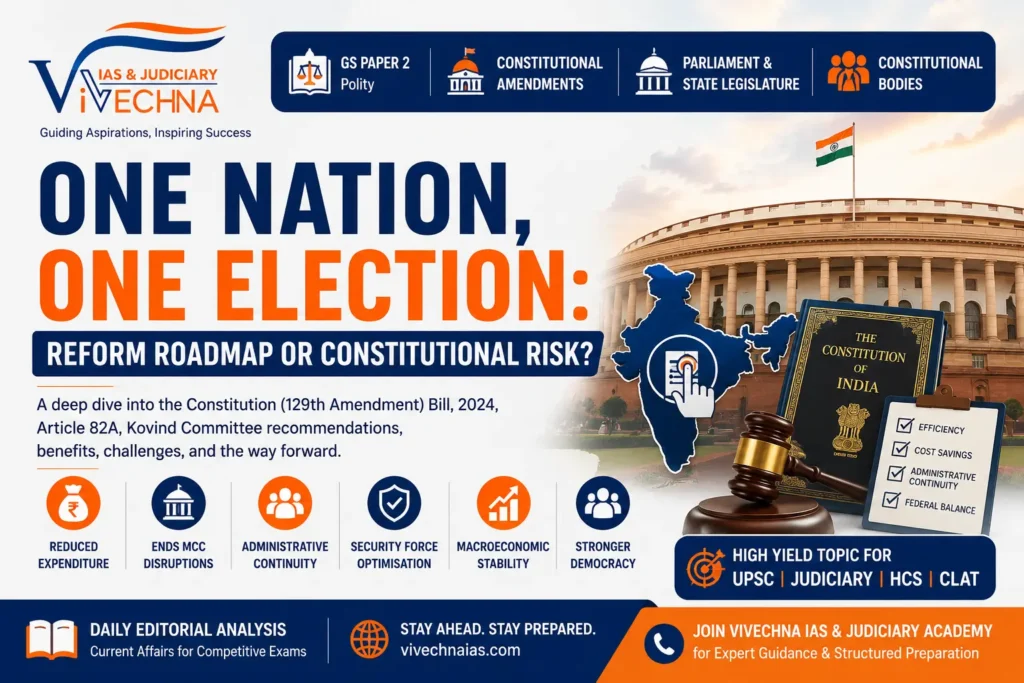
🗳️ One Nation, One Election: Reform Roadmap or Constitutional Risk?
Few reform proposals in Indian polity have generated as much debate as One Nation, One Election (ONOE) — the idea of synchronising Lok Sabha, State Assembly, and local body elections into a single electoral window. With the Constitution (129th Amendment) Bill, 2024 now before Parliament, this is no longer a theoretical debate but a live constitutional question involving Articles 82A, 83, and 172, the Basic Structure Doctrine, and India's federal architecture.
This article by Vivechna IAS & Judiciary Academy traces the history, provisions, benefits, and challenges of ONOE, along with the roadmap for its implementation — a high-priority topic for UPSC GS Paper 2, Judiciary Services, HCS, and CLAT examinations covering constitutional law and governance.
📖 What Is One Nation, One Election?
One Nation, One Election refers to a proposal to hold elections to the Lok Sabha, all State Legislative Assemblies, and eventually local bodies — municipalities and panchayats — within a single, synchronised electoral window, rather than India's current pattern of near-continuous state-by-state polling.
Historical Background
Simultaneous elections were, in fact, the norm in India between 1951 and 1967, covering four consecutive general election cycles. This synchrony broke down after premature Assembly dissolutions in 1968–69, and collapsed entirely when the fourth Lok Sabha was dissolved early in 1970, triggering fresh national elections in 1971.
| 📅 Year / Body | 📋 Key Recommendation |
|---|---|
| 1983 — Election Commission | Recommended a return to simultaneous elections to reduce expenditure and administrative strain |
| 1999 — Law Commission (170th Report) | Chaired by Justice B.P. Jeevan Reddy; strongly urged synchronised Lok Sabha and Assembly polls |
| 2015 — Parliamentary Standing Committee | Highlighted cost savings and MCC-related governance disruption; flagged safeguards under Anti-Defection Law and Article 356 |
| 2017 — NITI Aayog Discussion Paper | Proposed a phase-wise synchronisation strategy to minimise constitutional disruption |
| 2018 — Law Commission Draft | Suggested phased models, a constructive vote of no-confidence, and fixed-term adjustments |
| 2023–24 — Kovind Committee | Recommended a phased rollout — Lok Sabha and State Assemblies first, local bodies within 100 days — using fixed tenures and a common electoral roll |
📜 Key Provisions of the Constitution (129th Amendment) Bill, 2024
- Article 82A (New Provision): The President will notify an "appointed date" — the first sitting of a new Lok Sabha — after which all newly elected State Assembly terms will be adjusted to expire concurrently with that Lok Sabha's five-year term.
- "Unexpired Term" Rule (Articles 83 & 172): If the Lok Sabha or a State Assembly dissolves prematurely, fresh elections will fill only the remaining ("unexpired") portion of the national cycle, not a fresh five-year term.
- ECI Deferral Discretion: The Election Commission may recommend deferring a specific state's election due to local exigencies, though that assembly's term will still end alongside the sitting Lok Sabha.
- Exclusion of Local Bodies (for now): Municipal and panchayat elections are excluded from this Bill's text, since including them would require ratification by at least half of the State Legislatures.
- Union Territories Laws (Amendment) Bill, 2024: A companion bill extending the same synchronisation framework to Delhi, Puducherry, and Jammu & Kashmir.
✅ Key Benefits of One Nation, One Election
Our Mains answer-writing faculty at Vivechna IAS recommend structuring the benefits around fiscal, administrative, and democratic dimensions.
1. Reduced Public Expenditure
The 2024 General Election is estimated to have cost around ₹1.35 lakh crore — more than double the ₹60,000 crore spent in 2019. The Joint Parliamentary Committee (JPC) on ONOE has projected potential savings of nearly ₹7 lakh crore by eliminating duplicated spending on security, logistics, and procurement across synchronised polls.
2. Ending MCC-Induced Policy Paralysis
The Model Code of Conduct (MCC) freezes new project announcements and welfare schemes for 45–60 days per election. In states with frequent, staggered polls, administrations can spend 4–6 months a year under MCC restrictions — a disruption ONOE aims to confine to a single five-yearly window.
3. Macroeconomic Stability
The Kovind Committee's macroeconomic modelling suggested ONOE could structurally boost GDP growth by up to 1.6% by reducing the regulatory uncertainty that discourages private investment during frequent election cycles.
4. Administrative Continuity
Every election diverts District Magistrates, police leadership, and civil servants toward election duty. Synchronised polls would free up bureaucratic bandwidth for sustained governance over a stable five-year period.
5. Protecting Educational Infrastructure
An EAC-PM working paper estimated ONOE could cut polling-personnel deployment by nearly 28% — around 26 lakh personnel over a five-year cycle — saving roughly 1.04 crore personnel-days, largely preserving classroom instruction time for government school teachers who are frequently deployed on election duty.
6. Reduced Security Force Overstretch
Continuous rolling deployment of CAPF units (CRPF, BSF, CISF) across staggered elections causes fatigue and creates internal-security gaps elsewhere. A single coordinated national deployment plan could ease this strain.
7. Curtailing Black Money in Campaign Finance
Frequent elections sustain a continuous cycle of unaccounted political fundraising. A single unified electoral window could make campaign finance easier for the ECI to audit and regulate.
8. Reversing Voter Fatigue
Frequent, staggered polling contributes to voter fatigue, particularly in urban and migrant-heavy constituencies. A single synchronised voting event could raise civic engagement and make it easier for migrant workers to travel home once to vote across all tiers.
⚠️ Key Challenges of One Nation, One Election
The proposal has drawn serious constitutional and federal objections — a critical analytical dimension for Judiciary and HCS Mains answers.
| ⚠️ Challenge | 📋 Core Concern |
|---|---|
| Basic Structure Doctrine | In Kesavananda Bharati (1973), the Supreme Court held that parliamentary democracy and free, fair elections form part of the Constitution's basic structure. Curtailing or extending Assembly terms conflicts with the "no longer [than five years]" language in Articles 83 and 172. |
| Distortion of Collective Responsibility | The proposed "constructive no-confidence motion" (German model) could let minority governments cling to power without securing genuine legislative confidence. |
| Contested Economic Assumptions | Election spending is under 0.1% of the government budget; the real fiscal issue — unaccounted political cash (over ₹1 lakh crore in 2024 alone) — is not solved by recalendaring elections. |
| Federal & Regional Disadvantage | Synchronised polls risk a "wave effect," where voters favour the same national party across tiers, submerging local issues (e.g., agrarian distress, coastal livelihoods, floods) under national campaigns. |
| Governance Inefficiencies | A single national MCC freeze could halt developmental announcements everywhere at once, rather than easing disruption. Mid-term "unexpired term" elections risk very short-lived legislatures. |
| Massive Hardware Costs | ECI estimates require ~46.75 lakh Ballot Units, ~33.63 lakh Control Units, and ~36.62 lakh VVPATs, with a recurring cost of roughly ₹10,000 crore every 15 years. |
| CAPF Overstretch | Simultaneous nationwide polling removes the ability to rotate Central Armed Police Forces, risking dependence on less-specialised local police for security-sensitive booths. |
| ✅ In Favour | ❌ Against |
|---|---|
| Lower election expenditure | Threatens Basic Structure Doctrine |
| Ends recurring MCC policy freezes | Risks federal imbalance and regional party disadvantage |
| Frees up bureaucracy & security forces | High one-time EVM/VVPAT hardware costs |
| May reduce voter fatigue, raise turnout | Doesn't address root cause — unaccounted political finance |
🛠️ Implementation Roadmap: What Needs to Happen Next
- Build Political Consensus: The Joint Parliamentary Committee must engage regional and opposition parties, especially since local body inclusion needs ratification by at least half the State Legislatures.
- Codify the "Truncated Mandate" Rule: Legally clarify that mid-term elections fill only the remaining national term, not a fresh five-year mandate.
- Adopt a Constructive Vote of No-Confidence: States would need to amend Rules of Procedure so no-confidence motions are valid only when paired with a named successor commanding majority support.
- Build a Common Electoral Roll: A unified, cross-tier voter database enabling a single Electoral Photo Identity Card (EPIC) valid nationwide.
- Design a National CAPF Deployment Matrix: A coordinated security plan expanding force intake and streamlining inter-state transit for simultaneous elections.
- Strengthen Campaign Finance Regulation: Separate expenditure caps for Assembly and Lok Sabha candidates, plus fairer media/airtime rules protecting regional party visibility.
- Advance Capital Allocation for EVM Manufacturing: A non-lapsable, multi-year budget line to BEL and ECIL to scale up production of ballot units and VVPATs without supply bottlenecks.
🎓 Exam Relevance for UPSC, Judiciary, HCS & CLAT Aspirants
- UPSC Prelims: Factual questions on Article 82A, the 129th Amendment Bill, ECI composition, and constitutional bodies — a staple of our UPSC Foundation Course.
- UPSC Mains (GS Paper 2): Analytical essays balancing administrative efficiency against federalism and the Basic Structure Doctrine.
- Judiciary & HCS Exams: Deep constitutional law relevance — Kesavananda Bharati, Articles 83/172/356, and the doctrine of basic structure, central to our Judiciary coaching programme.
- CLAT & Law Entrances: Current affairs and constitutional law questions frequently draw from ONOE developments and related Supreme Court precedents.
- Prelims 2017: Statement-based question on the composition of the Election Commission of India, election scheduling authority, and its role in party split/merger disputes. (Answer: Only statement 3 is correct)
- Mains 2022: Discuss the role of the Election Commission of India in light of the evolution of the Model Code of Conduct.
- Mains 2017: "Simultaneous election to the Lok Sabha and State Assemblies will limit time and money spent in electioneering but reduce government accountability." Discuss.
✍️ Practice Question (Vivechna IAS Mains Booster)
⚠️ Common Mistakes Aspirants Make
- Discussing only the fiscal savings angle while ignoring the Basic Structure Doctrine and federalism concerns.
- Confusing Article 82A (new synchronisation provision) with Articles 83 and 172 (existing term/dissolution provisions).
- Forgetting that local body elections are currently excluded from the 129th Amendment Bill's text due to state ratification requirements.
- Overlooking the historical fact that simultaneous elections were the norm from 1951–1967, which is frequently tested in Prelims.
🧾 Key Takeaways
- ONOE proposes synchronising Lok Sabha and State Assembly elections via a new Article 82A, backed by the Kovind Committee's phased roadmap.
- Key benefits: reduced expenditure, fewer MCC-driven policy freezes, administrative and security continuity.
- Key challenges: potential conflict with the Basic Structure Doctrine, federal imbalance, and disadvantage to regional parties via the "wave effect."
- Local body elections remain excluded from the current Bill pending state-level ratification.
- Implementation requires political consensus, a common electoral roll, stronger campaign finance regulation, and advance EVM/VVPAT manufacturing capacity.
❓ Frequently Asked Questions (FAQs)
📖 Prepare Smarter with Vivechna IAS & Judiciary Academy
Get daily editorial analysis, structured Polity and Governance notes, and Mains answer-writing practice tailored for UPSC, Judiciary, HCS, and CLAT aspirants.
Visit Vivechna IAS & Judiciary Academy | Explore Daily Current Affairs | Join Our Test Series
🏁 Conclusion
One Nation, One Election represents one of the most consequential structural reforms proposed for India's electoral democracy in decades. While the promise of reduced expenditure, administrative continuity, and reduced MCC-driven policy paralysis is genuine, so are the constitutional concerns around the Basic Structure Doctrine and the federal balance between the Union and States. For aspirants, this topic demands a balanced, evidence-based approach — one that weighs administrative efficiency against constitutional principle, exactly the kind of nuanced argumentation that examiners across UPSC, Judiciary, HCS, and CLAT reward in Mains answers and interviews.
— Curated and edited by the faculty team at Vivechna IAS & Judiciary Academy, vivechnaias.com. For more daily editorials, quizzes, and Mains answer-writing practice, explore our Current Affairs section.