💰 16th Finance Commission and the Future of Indian Federalism | UPSC, Judiciary, HCS & CLAT Notes
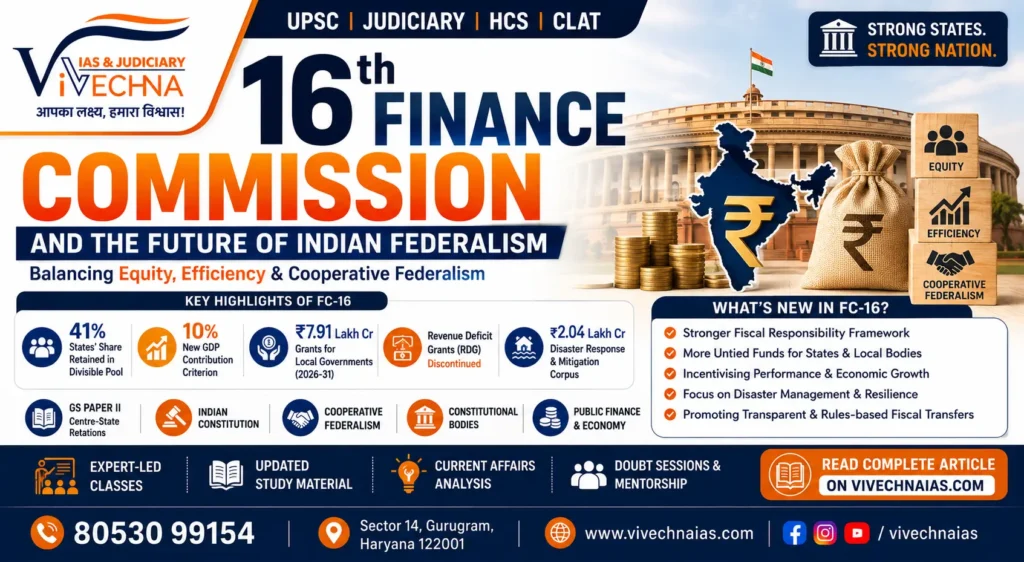
The 16th Finance Commission (FC-16), chaired by Dr Arvind Panagariya, has kept the States' overall share of the divisible pool unchanged at 41% — but has fundamentally reshaped how that money is distributed among States. By scrapping Post-Devolution Revenue Deficit Grants and introducing a new GDP-based criterion, FC-16 has reignited a classic constitutional debate: should India's fiscal transfers reward economic efficiency, or protect equity for structurally weaker States? This is a cornerstone GS Paper II topic for aspirants at Vivechna IAS & Judiciary Academy, blending constitutional law, public finance, and Centre-State relations into a single high-weightage theme.
📌 Why This Topic Matters
Finance Commission recommendations shape how trillions of rupees move between the Union and States every five years — directly affecting healthcare, education, and infrastructure spending in every state. For aspirants preparing with Vivechna IAS's UPSC Civil Services programme, fiscal federalism is a recurring Mains theme that tests both constitutional knowledge and analytical, policy-evaluation skills.
🏦 What Is Fiscal Federalism?
Fiscal federalism refers to how taxation powers, expenditure responsibilities, borrowing powers, and intergovernmental transfers are divided among different tiers of government in a federal system. In India, it exists to ensure that a citizen's access to essential public services does not depend excessively on the fiscal capacity of the particular state they happen to live in.
Three Fiscal Imbalances India's Federal Design Must Reconcile
⬆️ Vertical Imbalance
The Union controls the most buoyant, broad-based taxes, while States shoulder expenditure-heavy responsibilities like health, education, agriculture, and policing.
↔️ Horizontal Imbalance
States vary hugely in income, resources, geography, and administrative capacity — a lower-income state cannot match a wealthier state's public services at similar tax rates.
⬇️ Third-Tier Imbalance
Panchayats and Municipalities carry major service-delivery duties but have very limited own-source revenue, remaining dependent on higher-tier transfers.
📜 Constitutional Framework Governing Fiscal Federalism
| Article | Provision |
|---|---|
| Article 246 & 7th Schedule | Divides legislative and taxation powers via the Union, State, and Concurrent Lists. |
| Article 246A | Introduced by the 101st Amendment Act, 2016 — grants concurrent GST law-making power to Parliament and State Legislatures. |
| Article 270 | Basis of the divisible pool; cesses and Article 271 surcharges are excluded from it. |
| Article 275 | Empowers Parliament to give need-based grants-in-aid to States, including for Scheduled Tribes/Areas. |
| Article 280 | President constitutes a Finance Commission every 5 years to recommend vertical/horizontal devolution and grants-in-aid principles. |
| Article 282 | Allows discretionary Union/State grants for any public purpose — the basis for many Centrally Sponsored Schemes. |
| Articles 243-I & 243-Y | Mandate State Finance Commissions (SFCs) every 5 years to review Panchayat and Municipal finances. |
| Article 293 | Regulates State borrowing; Union consent is needed if a State is already indebted to the Centre. |
| Article 279A | Establishes the GST Council for cooperative decision-making on indirect taxation. |
✅ Exam Tip
Prelims frequently tests these articles in isolation — a common trap is confusing Article 275 (Parliament's grants-in-aid) with Article 282 (discretionary grants for any public purpose by either Union or State).
📊 Key Recommendations of the 16th Finance Commission
Horizontal Devolution Formula: What Changed
| Criterion | 15th FC | 16th FC | Direction |
|---|---|---|---|
| Income Distance | 45% | 42.5% | ↓ Reduced |
| Population (2011) | 15% | 17.5% | ↑ Increased |
| Demographic Performance | 12.5% | 10% | ↓ Reduced |
| Area | 15% | 10% | ↓ Reduced |
| Forest & Ecology | 10% | 10% | — Retained |
| Tax & Fiscal Effort | 2.5% | Nil | ✕ Removed |
| Contribution to GDP | Nil | 10% | ★ New |
1. Vertical Devolution Retained at 41%
FC-16 has kept the States' collective share of the divisible pool unchanged from the 15th Finance Commission's level, offering continuity even as 18 states had sought an increase to 50%.
2. New GDP-Contribution Criterion
A 10% weight now rewards states for their contribution to national GDP, calculated using the square root of State GSDP — a method designed to moderate the advantage large economies would otherwise enjoy. This partly answers long-standing complaints from industrialised states that redistribution-heavy formulas under-recognise their contribution to growth.
3. Discontinuation of Revenue Deficit Grants
The most consequential change: FC-16 has discontinued Post-Devolution Revenue Deficit Grants, along with Sector-Specific and State-Specific Grants, reasoning that persistent deficit-filling transfers can create a moral-hazard problem where states have weaker incentive to raise revenue or control expenditure. This marks a shift from gap-filling transfers toward rules-based fiscal discipline.
4. Major Expansion in Local Government Grants
FC-16 recommends ₹7.91 lakh crore for rural and urban local bodies over 2026-31 — nearly double FC-15's ₹4.36 lakh crore. Basic and performance grants follow an 80:20 split, with half the basic grant untied and half tied to sanitation, waste, and water management. A separate ₹56,100 crore Special Infrastructure Grant targets urban wastewater management, alongside a ₹10,000 crore Urbanisation Premium for peri-urban transitions.
5. Strengthened Disaster-Management Financing
An overall corpus of ₹2,04,401 crore is recommended for State Disaster Response and Mitigation Funds, with the Union share at ₹1,55,916 crore. The sharing ratio is 90:10 for Northeastern/Himalayan States and 75:25 for others.
6. A Stronger Fiscal-Responsibility Framework
- States to keep fiscal deficits within 3% of GSDP.
- The Union to progressively reduce its fiscal deficit to 3.5% of GDP by 2030-31.
- Off-budget borrowing to be discontinued and brought transparently onto budgets.
- Rationalisation of poorly targeted subsidies and review of loss-making public enterprises.
- Combined Centre-State debt projected to fall from 77.3% of GDP (2026-27) to 73.1% (2030-31).
⚠️ Key Concerns Around India's Emerging Fiscal Federalism
✅ What FC-16 Gets Right
- Predictability through continuity of the 41% vertical share.
- Explicit efficiency incentive via the GDP-contribution criterion.
- Large jump in untied and tied local-government funding.
- Stronger, transparent disaster-financing architecture.
- Push toward ending off-budget borrowing across both tiers.
⚠️ Where Concerns Remain
- Persistent vertical imbalance: States still bear disproportionate expenditure responsibility versus their revenue-raising powers.
- Shrinking divisible pool: It fell from 89.1% of Gross Tax Revenue (2014-15) to roughly 74-80% during 2020-24, mainly due to rising cesses and surcharges.
- Loss of the RDG fiscal cushion: Under FC-15, Himachal Pradesh received over ₹37,000 crore and Punjab nearly ₹26,000 crore in such grants — support now withdrawn.
- Equity-efficiency trade-off: GDP itself partly reflects pre-existing advantages (coastline, urbanisation, historical industrialisation), so output-linked transfers risk compounding regional inequality.
- Loss of state-specific flexibility: Abolishing sector- and state-specific grants removes a channel for addressing asymmetric needs (flood-prone Assam vs. drought-prone Rajasthan, for instance).
- Weak State Finance Commissions: Irregular constitution and delayed reports mean local bodies stay dependent on higher-tier transfers despite rising Union grants.
- Reduced tax autonomy under GST: States now have less unilateral control over major consumption taxes, pooled instead within the GST Council.
⚠️ Important Point — Mohit Minerals Case
In Union of India v. Mohit Minerals (2022), the Supreme Court held that GST Council recommendations carry persuasive, not binding, value — reaffirming that Indian federalism involves both cooperation and legitimate contestation between the Union and States. This is a frequently tested case for both UPSC Mains and Judiciary exams.
🌍 Global Best Practices in Fiscal Federalism
| Country | Practice | Lesson for India |
|---|---|---|
| Australia | The Commonwealth Grants Commission distributes GST revenue explicitly to equalise states' fiscal capacity to deliver comparable public services. | India can keep equalisation explicit and transparent without abandoning incentives for fiscal efficiency. |
| Canada | The Equalization Program provides unconditional transfers to provinces with weaker revenue capacity, letting them offer comparable services at comparable tax levels. | Equalisation and provincial autonomy are not contradictory — need-based transfers can be transparent without dictating every expenditure choice. |
🛤️ Way Forward: Strengthening Indian Fiscal Federalism
- Preserve an explicit equalisation mechanism — replacing RDGs with a transparent, formula-based equalisation grant tied to measurable fiscal capacity and expenditure needs.
- Rationalise cesses and surcharges through a negotiated "grand bargain," progressively folding long-running cesses into ordinary shareable taxes, with clear parliamentary disclosure.
- Balance equity with performance — keeping economic-contribution criteria supplementary to equalisation, not a substitute for it.
- Strengthen State Finance Commissions — timely constitution, legislative tabling of reports, and technical support for weaker local bodies.
- Reduce over-reliance on Centrally Sponsored Schemes, giving states greater design flexibility for state-specific priorities.
- Establish symmetrical fiscal transparency — full disclosure of off-budget liabilities and guarantees by both the Union and States.
- Incorporate climate and geographic vulnerability into future devolution formulas, recognising ecological services as a national public good.
- Institutionalise continuous Centre-State dialogue via the GST Council, Inter-State Council, and NITI Aayog — not just once every five years.
✅ Exam Tip
For Mains answers on fiscal federalism, always frame the debate as "equity versus efficiency" and conclude with a synthesis — cooperative federalism combined with competitive incentives — rather than choosing one extreme. Examiners reward balanced, structured argumentation.
🎯 Key Takeaways
- FC-16, chaired by Dr Arvind Panagariya, retains the States' 41% share of the divisible pool for 2026-31.
- A new 10% GDP-contribution criterion (based on square root of GSDP) has been introduced in horizontal devolution.
- Post-Devolution Revenue Deficit Grants, along with sector- and state-specific grants, have been discontinued.
- Local government transfers have nearly doubled to ₹7.91 lakh crore compared to FC-15.
- The divisible pool has shrunk relative to Gross Tax Revenue mainly due to rising cesses and surcharges, which fall outside Article 270's scope.
- Australia and Canada offer transparent equalisation models India can draw upon without sacrificing fiscal efficiency incentives.
📚 Exam Relevance for UPSC, Judiciary, HCS & CLAT Aspirants
| Exam | Relevance |
|---|---|
| UPSC Prelims | Constitutional articles (270, 275, 280, 282, 279A), FC-16 facts, and horizontal devolution criteria comparisons across Finance Commissions. |
| UPSC Mains (GS-II) | Fiscal federalism, Centre-State relations, cooperative vs. competitive federalism, and equity-efficiency trade-offs. |
| Judiciary Exams | Constitutional provisions on financial relations (Part XII) and case law such as Mohit Minerals (2022) on GST Council's advisory role. |
| HCS / State PCS | State-specific fiscal implications of FC-16 recommendations — especially relevant for hill and structurally disadvantaged states. |
| CLAT / Law Entrance | Legal-reasoning passages on constitutional bodies, GST Council federalism, and current-affairs MCQs on Finance Commission recommendations. |
Aspirants can deepen their understanding of Indian Polity and Economy through Vivechna IAS's UPSC Civil Services courses, the Judiciary Exams programme, our State PCS/HCS batch, and the CLAT & Law Entrance course — all of which integrate current fiscal-policy developments into structured GS and answer-writing modules.
🔗 Related Reading on Vivechna IAS Knowledge Hub
This topic pairs well with our notes on One Nation, One Election (GS Paper 2) and the J&K statehood debate on our Knowledge Hub — both explore the broader theme of Centre-State relations and cooperative federalism.
📝 Previous Year Questions (PYQs)
Consider the following: (1) Demographic performance (2) Forest and ecology (3) Governance reforms (4) Stable government (5) Tax and fiscal efforts
For horizontal tax devolution, the Fifteenth Finance Commission used how many of the above as criteria other than population, area, and income distance?
(a) Only two (b) Only three (c) Only four (d) All five
Answer: (b)
Which one of the following in Indian polity is an essential feature that indicates that it is federal in character?
(a) The independence of judiciary is safeguarded. (b) The Union Legislature has elected representatives from constituent units. (c) The Union Cabinet can have elected representatives from regional parties. (d) The Fundamental Rights are enforceable by Courts of Law.
Answer: (a)
With reference to the Fourteenth Finance Commission, which of the following statements is/are correct?
- It has increased the share of States in the central divisible pool from 32% to 42%.
- It has made recommendations concerning sector-specific grants.
(a) 1 only (b) 2 only (c) Both 1 and 2 (d) Neither 1 nor 2
Answer: (a)
How have the recommendations of the 14th Finance Commission of India enabled the states to improve their fiscal position?
How is the Finance Commission of India constituted? What do you know about the terms of reference of the recently constituted Finance Commission? Discuss.
The concept of cooperative federalism has been increasingly emphasized in recent years. Highlight the drawbacks in the existing structure and the extent to which cooperative federalism would answer the shortcomings.
Discuss the recommendations of the 13th Finance Commission which have been a departure from the previous commissions for strengthening the local government finances.
🖊️ Practice Questions (New — For Self-Assessment)
With reference to the 16th Finance Commission, consider the following statements:
- It has reduced the States' share in the divisible pool from 41% to 38%.
- It introduced a new criterion rewarding States for their contribution to GDP.
- It discontinued Post-Devolution Revenue Deficit Grants.
Which of the statements given above is/are correct?
(a) 1 and 2 only (b) 2 and 3 only (c) 1 and 3 only (d) 1, 2 and 3
Answer: (b) — FC-16 retained (not reduced) the 41% vertical share; Statement 1 is incorrect.
The 16th Finance Commission's introduction of a GDP-based criterion in horizontal devolution has been described as a shift from equity toward efficiency. Critically examine this shift and suggest measures to balance both objectives.
🚫 Common Mistakes Aspirants Make on This Topic
- Confusing the divisible pool with total Union tax revenue — cesses and surcharges under Article 271 are excluded from the divisible pool under Article 270.
- Assuming FC-16 reduced the states' vertical share — it was retained at 41%, the same as FC-15; only the horizontal formula changed.
- Mixing up Article 275 and Article 282 — the former covers Parliament's grants-in-aid; the latter allows discretionary grants by either Union or State for any public purpose.
- Treating GST Council recommendations as binding — the Supreme Court in Mohit Minerals (2022) clarified they are only persuasive/recommendatory.
- Writing purely descriptive Mains answers — high-scoring answers must weigh the equity-versus-efficiency trade-off explicitly, not just list FC-16's recommendations.
❓ Frequently Asked Questions (FAQs)
What is the vertical devolution recommended by the 16th Finance Commission?
Why was the discontinuation of Revenue Deficit Grants (RDGs) controversial?
What is the new criterion introduced in the horizontal devolution formula by FC-16?
What constitutional article governs the establishment and functions of the Finance Commission?
How does the shrinking divisible pool affect fiscal federalism?
Is fiscal federalism an important topic for Judiciary exam preparation?
How is this topic relevant for CLAT and other law entrance exams?
Where can I find structured current-affairs notes on economy and polity topics like this?
Does Vivechna IAS offer test series covering Finance Commission and fiscal federalism topics?
🏁 Conclusion
The 16th Finance Commission's recommendations mark a genuine inflection point in Indian fiscal federalism — balancing continuity in vertical devolution with a decisive push toward efficiency, fiscal discipline, and stronger local-government funding. Yet the removal of Revenue Deficit Grants and sector-specific flexibility raises legitimate equity concerns for structurally disadvantaged states. The real challenge going forward is not choosing between equity and efficiency, but building a durable fiscal compact — blending cooperative and competitive federalism — as Australia and Canada have shown is possible. For UPSC, Judiciary, HCS, and CLAT aspirants, mastering this balance is exactly the kind of nuanced thinking Vivechna IAS & Judiciary Academy trains students to develop through its Economy and Polity curriculum.
Preparing for UPSC, Judiciary, HCS or CLAT 2027?
Join Vivechna IAS & Judiciary Academy's expert-led Economy & Polity modules, daily current-affairs analysis, and mentorship programme trusted by thousands of aspirants across Delhi NCR.
Book a Free Demo Class →