🤝 National Cooperative Development Corporation (Amendment) Bill, 2026 | UPSC Economy Notes
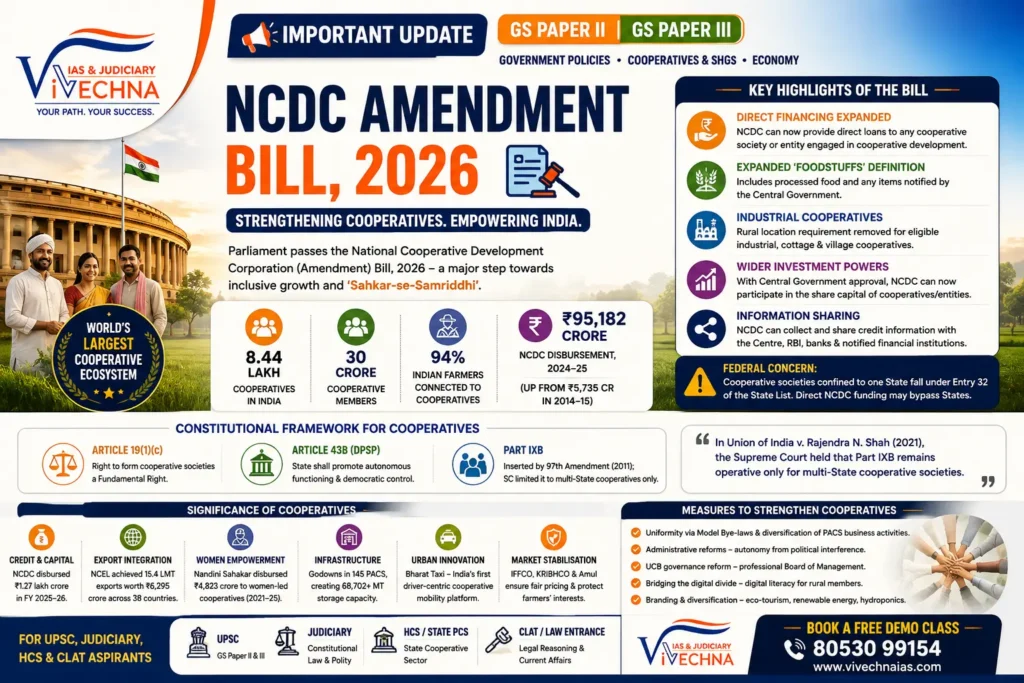
Parliament has passed the National Cooperative Development Corporation (Amendment) Bill, 2026, expanding NCDC's mandate to enable direct financing of individual cooperative societies — a significant shift from its earlier national/multi-State-only lending model. With India hosting the world's largest cooperative ecosystem (8.44 lakh cooperatives, 30 crore members), this is a high-value GS Paper II/III topic. At Vivechna IAS & Judiciary Academy, we cover the Bill's provisions, federalism concerns, and the broader cooperative-sector landscape.
📋 Key Highlights of the NCDC Amendment Bill, 2026
| Provision | What Changes |
|---|---|
| Direct Financial Assistance | Expands NCDC's lending beyond national/multi-State cooperatives to any cooperative society or entity engaged in cooperative development, subject to conditions. |
| Expanded "Foodstuffs" Definition | Now includes processed food and any items notified by the Central Government, widening eligible food-cooperative financing. |
| Industrial Goods | Removes the requirement that eligible industrial/cottage/village cooperatives be located in rural areas. |
| Wider Investment Powers | With Central Government approval, NCDC can now participate in the share capital of cooperatives/entities. |
| Information Sharing | Empowers NCDC to collect/share credit information with the Centre, RBI, banks, and notified financial institutions. |
⚠️ Important Point — Federal Friction
Cooperative societies confined to one State are a State Subject under Entry 32 of the State List. Direct NCDC funding — bypassing State Governments — has raised concerns about centralisation and erosion of States' oversight and auditing role in the cooperative sector.
🏛️ About the NCDC
NCDC is a statutory body established in 1963 under the NCDC Act, 1962 (previously amended in 1973, 1974, and 2002), functioning under the Ministry of Cooperation. Its mandate includes strengthening farmer cooperatives, financing processing/storage/marketing infrastructure, and supporting non-farm and weaker-section activities like dairy, handloom, and fisheries.
Constitutional Framework for Cooperatives
| Provision | Significance |
|---|---|
| Article 19(1)(c) (via 97th Amendment, 2011) | Made the right to form cooperative societies a Fundamental Right. |
| Article 43B (DPSP) | Mandates the State to promote voluntary formation, autonomous functioning, and democratic control of cooperatives. |
| Part IXB | Inserted by the 97th Amendment for a uniform legal framework — but limited by the Supreme Court to multi-State cooperatives only. |
✅ Exam Tip
In Union of India v. Rajendra N. Shah (2021), the Supreme Court held that Part IXB remains operative only for multi-State cooperative societies — a frequently tested nuance, since it clarifies why single-State cooperatives remain under State legislative competence.
🌟 Significance of Cooperatives for India
💰 Credit & Capital
NCDC disbursed ₹1.27 lakh crore in FY 2025–26; PACS form the bedrock of rural credit.
🌍 Export Integration
NCEL achieved 15.4 LMT of exports worth ₹6,295 crore across 38 countries by mid-2026.
👩 Women's Empowerment
Nandini Sahakar disbursed ₹4,823 crore to women-led cooperatives (2021–25); ~10 crore women linked via SHGs.
🏗️ Infrastructure
Godowns completed in 145 PACS, creating 68,702+ MT storage capacity to curb post-harvest losses.
🚕 Urban Innovation
Bharat Taxi — India's first driver-centric cooperative mobility platform — has 7.76 lakh registered drivers.
🛡️ Market Stabilisation
IFFCO/KRIBHCO (fertilisers) and Amul (dairy) prevent private monopolies and ensure fair pricing.
🛤️ Measures to Strengthen Cooperatives
- Uniformity via Model Bye-laws — standardising operations and letting PACS legally diversify their business activities.
- Administrative reforms — greater autonomy from political interference, per the Vaidyanathan Committee (2004).
- UCB governance reform — separating ownership from banking functions via a professional Board of Management, per the Malegam Committee.
- Bridging the digital divide — targeted digital-literacy training for rural cooperative members.
- Branding & diversification — expanding into eco-tourism, renewable energy, and hydroponics.
🎯 Key Takeaways
- The Bill lets NCDC directly fund any cooperative society, not just national/multi-State ones.
- Cooperatives confined to one State fall under Entry 32 of the State List — raising federalism concerns over direct Central funding.
- In Rajendra N. Shah (2021), the SC limited Part IXB to multi-State cooperatives only.
- India has the world's largest cooperative ecosystem — 8.44 lakh cooperatives, 30 crore members, 94% of farmers connected.
- NCDC disbursements rose from ₹5,735 crore (2014–15) to ₹95,182 crore (2024–25).
📚 Exam Relevance for UPSC, Judiciary, HCS & CLAT Aspirants
| Exam | Relevance |
|---|---|
| UPSC Prelims | NCDC facts, IFFCO/NAFED/NABARD, Article 19(1)(c)/43B/Part IXB. |
| UPSC Mains (GS-II/III) | Cooperative federalism, rural credit, and SHG-linked inclusive growth. |
| Judiciary Exams | Direct relevance — Rajendra N. Shah (2021) and Part IXB's constitutional limits. |
| HCS / State PCS | State cooperative-sector oversight and PACS-related state schemes. |
| CLAT / Law Entrance | Legal-reasoning passages on constitutional entries and current-affairs MCQs on the Bill. |
📍 CLAT Preparation 2027 — For Aspirants in Gurugram & Delhi NCR
Federalism debates like this NCDC Bill are classic CLAT legal-reasoning material. If you're looking for CLAT coaching in Gurugram or the best CLAT institute in Gurgaon, Vivechna IAS & Judiciary Academy's CLAT preparation 2027 batches build exactly this analytical depth. This is why CLAT aspirants in Sector 14 Gurugram choose Vivechna IAS — with CLAT coaching near HUDA City Centre and best law entrance coaching near MG Road Gurugram, backed by CLAT study material and a full CLAT mock test series, plus CLAT coaching in Delhi and Judiciary coaching in Gurugram.
📝 Previous Year Questions (PYQs)
With reference to 'Urban Cooperative Banks' in India, consider the following statements:
- They are supervised and regulated by local boards established by State Governments.
- They can issue equity shares and preference shares.
- They were brought under the purview of the Banking Regulation Act, 1949, through a 1966 Amendment.
(a) 1 only (b) 2 and 3 only (c) 1 and 3 only (d) 1, 2 and 3
Answer: (b)
In India, which of the following have the highest share in the disbursement of credit to agriculture and allied activities?
(a) Commercial Banks (b) Cooperative Banks (c) Regional Rural Banks (d) Microfinance Institutions
Answer: (a)
"In the villages itself no form of credit organisation will be suitable except the cooperative society." – All India Rural Credit Survey. Discuss this statement in the background of agricultural finance in India.
🖊️ Practice Question (New — For Self-Assessment)
Consider the following statements regarding the NCDC Amendment Bill, 2026:
- It allows NCDC to provide direct loans to any cooperative society, not just national or multi-State ones.
- It restricts the definition of "foodstuffs" to exclude processed food.
- It removes the rural-location requirement for certain eligible industrial cooperatives.
Which of the statements given above is/are correct?
(a) 1 and 3 only (b) 1 and 2 only (c) 2 and 3 only (d) 1, 2 and 3
Answer: (a) — The Bill expands, not restricts, the "foodstuffs" definition to include processed food; Statement 2 is incorrect.
❓ Frequently Asked Questions (FAQs)
What is the key change introduced by the NCDC Amendment Bill, 2026?
What are the major concerns regarding the Bill?
What is the constitutional significance of cooperatives in India?
Which is the best CLAT coaching in Gurugram?
Does Vivechna IAS provide CLAT mock tests?
🏁 Conclusion
The NCDC Amendment Bill, 2026 reflects the government's "Sahkar-se-Samriddhi" vision of strengthening cooperative financing — but its direct-funding model reopens a familiar Centre-State tension over State oversight of cooperative societies. For UPSC, Judiciary, HCS, and CLAT aspirants, this is a strong example of balancing sectoral efficiency with constitutional federalism — the kind of nuanced analysis Vivechna IAS & Judiciary Academy builds into its Economy and Polity curriculum.
Preparing for UPSC, Judiciary, HCS or CLAT 2027 in Gurugram or Delhi NCR?
Join Vivechna IAS & Judiciary Academy's expert-led Economy & Polity modules and CLAT mock test series — trusted by aspirants across Sector 14 Gurugram, HUDA City Centre, MG Road, and Delhi NCR.
Book a Free Demo Class →