Daily Editorial Analysis | Updated 22 Jul 2026 | ~15 min read | By Vivechna IAS & Judiciary Academy
🚀 India's Private Space Revolution: Can Skyroot's Vikram-1 Launch a New Economy?
In a landmark moment for India's space ambitions, Skyroot Aerospace's Vikram-1 successfully placed a payload into a 450 km orbit on its maiden flight — making India only the third country in the world, after the United States and China, to achieve an orbital launch using a privately developed vehicle. This milestone is more than symbolic; it signals the arrival of a genuine private space economy in India, built on a decade of policy liberalisation.
This article by Vivechna IAS & Judiciary Academy examines why the private sector matters for India's space journey, the regulatory and structural challenges it faces, and the policy roadmap needed ahead — an important topic for UPSC GS Paper 3, Judiciary Services, HCS, and CLAT current affairs preparation.
🛰️ From Vikram-1 to a Space Economy: Setting the Context
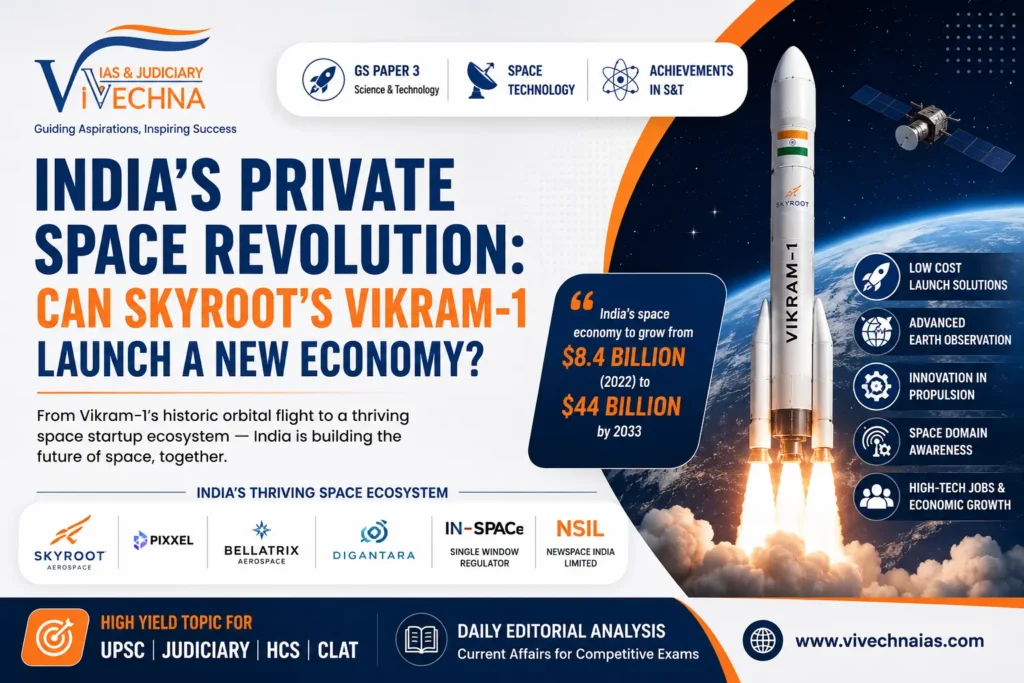
Vikram-1's successful flight is a proof point for India's decade-long push to open up its space sector. Since the 2020 reforms permitting private participation, the ecosystem has moved from a single ISRO-dominated model toward a layered structure involving startups, IN-SPACe as regulator, and NewSpace India Limited (NSIL) as the commercial arm of ISRO. India's space economy is targeted to grow from around $8.4 billion in 2022 to roughly $44 billion by 2033 — a growth trajectory almost entirely dependent on private sector participation.
📌 Why the Private Sector Matters for India's Space Journey
Our Mains answer-writing faculty at Vivechna IAS recommend structuring this theme around eight key contributions of private enterprise to India's space capability.
1. Democratising Launch Services and Cutting Costs
Private players have broken traditional capital barriers by building modular, low-cost launch vehicles for small and micro-satellites, using techniques like 3D-printed rocket engines to slash production timelines. Skyroot Aerospace's Vikram-1, built with an all-carbon composite structure, exemplifies this shift — placing India alongside global disruptors competing with firms like Rocket Lab.
2. Advancing Hyperspectral Earth Observation
Companies are moving beyond basic remote sensing toward high-resolution analytics with real economic value. Bengaluru-based Pixxel is building a constellation of hyperspectral imaging satellites capable of tracking soil health and methane leaks across hundreds of spectral bands.
3. Catalysing Startup Growth and Investment
IN-SPACe, the sector's single-window regulator, has registered over 4,500 organisations and facilitated numerous technology-transfer agreements from ISRO to private firms — turning deregulation into measurable entrepreneurial momentum.
4. Innovating in Propulsion and In-Space Servicing
Firms like Bellatrix Aerospace are developing green propulsion systems and advanced thrusters, while InspeCity is pioneering in-orbit robotic servicing for satellite life-extension — positioning Indian companies alongside global leaders in sustainable space logistics.
5. Building Space Domain Awareness (SDA) Infrastructure
As orbital congestion rises, companies like Digantara are deploying space-based sensors and software to track debris and manage traffic — a service increasingly critical for both commercial operators and national security.
6. Freeing ISRO for Deep Space and Strategic Missions
With routine commercial launches and manufacturing increasingly handled by NewSpace India Limited (NSIL) and private players, ISRO can focus its expertise on flagship missions such as Gaganyaan, Chandrayaan, and the planned Bharatiya Antariksh Station.
7. Expanding India's Global Export Footprint
Under the Indian Space Policy 2023, Non-Government Entities (NGEs) can now operate across the entire space value chain, positioning India to combine its traditional cost advantage with agile private enterprise to compete in the global commercial satellite market.
8. Creating High-Tech Jobs and Reversing Brain Drain
The Indian space industry now employs over 45,000 skilled professionals, with many engineers moving from ISRO and global tech firms into private startups — channeling decades of aerospace expertise into commercial innovation.
🚧 Key Concerns Around Private Sector Entry into Space
Despite rapid growth, structural gaps remain — a frequently tested analytical dimension in Judiciary and HCS Mains answers as well as UPSC GS Paper 3.
| ⚠️ Concern | 📋 Why It Matters |
|---|---|
| Absence of a Dedicated Space Law | India still lacks a codified Space Activities Act; disputes like the Antrix-Devas arbitration have exposed vulnerabilities in enforcing investor contracts |
| Unclear Liability & Insurance Norms | Unlike the US or France, India has no formalised third-party liability cap, leaving startups exposed to catastrophic financial risk from launch failures |
| Dual-Use Technology Risks | Remote sensing, propulsion, and telemetry technologies have military applications, raising proliferation and IP-leakage concerns |
| Import Dependence in Supply Chains | India imports roughly ₹2,114 crore worth of specialised space components annually, including radiation-hardened chips and space-grade semiconductors |
| Cybersecurity Gaps | Leaner private budgets may mean weaker ground-station security, raising risks similar to the KA-SAT cyberattack in Europe |
| High Capital Intensity, Long Gestation | Space ventures often take 5–10 years to profitability; ISRO's ~$1.7 billion annual budget is a fraction of NASA's ~$25 billion, limiting anchor-contract support |
| Orbital Congestion & Tracking Gaps | Rapid LEO mega-constellation deployment raises collision risk (Kessler Syndrome); India still lacks comprehensive independent space-tracking infrastructure |
| Testing & Launch Infrastructure Bottlenecks | Sriharikota operates near capacity, and startups often send hardware abroad for testing due to a shortage of domestic thermal-vacuum and acoustic test facilities |
🛠️ Policy Roadmap: Building a Sustainable Private Space Sector
Forward-looking policy measures can help India move from an emerging to a dominant global space player. These make excellent value-added points for Mains answer enrichment:
- Orbital Slot & Spectrum Leasing Credits: A tradable credit system via IN-SPACe rewarding startups for deploying indigenous, green-propulsion payloads.
- National Space Sandbox: A regulatory fast-track allowing startups to test unproven technologies — autonomous docking, laser inter-satellite links — under relaxed liability for a defined window.
- Sovereign Co-Investment Fund: Restructuring the IN-SPACe Venture Capital Fund into a "Patient Anchor" investor matching private capital on a non-dilutive basis.
- Technology-for-Equity Swaps: The Department of Space exchanging patents and test facilities for minor equity stakes rather than upfront licensing fees.
- Green-Space Tax Credits: Tax incentives linked to orbital sustainability certification, encouraging active de-orbiting and zero-fragmentation propulsion.
- Satellite Bus-as-a-Service (SBaaS): Mandating hosted-payload slots on state-backed constellations for startups and academic experiments at subsidised rates.
- Geospatial Export Corridor: A streamlined data-clearance gateway under the National Geospatial Policy 2022 for secure global data export.
- Public Procurement Quotas: Mandating central ministries source a fixed share (30–40%) of data, communication, and launch services from Indian private NGEs.
- Vikram-1 → India's 3rd position globally in private orbital launches (after US, China)
- Regulator: IN-SPACe; Commercial arm: NewSpace India Limited (NSIL)
- Key firms: Skyroot (launch vehicles), Pixxel (Earth observation), Bellatrix (propulsion), Digantara (space domain awareness)
- Key policy: Indian Space Policy 2023 — permits Non-Government Entities across the full space value chain
- Target: Space economy to grow from $8.4 billion (2022) to $44 billion (2033)
🎓 Exam Relevance for UPSC, Judiciary, HCS & CLAT Aspirants
- UPSC Prelims: Factual questions on IN-SPACe, NSIL, Indian Space Policy 2023, launch vehicle types (PSLV/GSLV), and key private players.
- UPSC Mains (GS Paper 3): Analytical questions on private sector participation, regulatory gaps, and India's space economy trajectory — a focus area in our UPSC Foundation Course.
- Judiciary & HCS Exams: Questions linking space law, liability frameworks, and contract enforcement (e.g., Antrix-Devas dispute) — covered in our Judiciary coaching programme.
- CLAT & Law Entrances: Current affairs questions on space policy, FDI in space, and technology regulation frequently draw from such editorials.
- Prelims 2018: Statement-based question on India's satellite launch vehicles — differences between PSLV and GSLV, geostationary positioning, and GSLV Mk III's stage configuration. (Answer: Statement 1 only)
- Mains 2023: The main objective of India's third moon mission that remained unachieved earlier, countries that have accomplished it, spacecraft subsystems, and the role of the Virtual Launch Control Centre at Vikram Sarabhai Space Centre.
- Mains 2019: India's plans for its own space station and the expected benefits to its space programme.
- Mains 2016: India's achievements in space science and technology, and their contribution to socio-economic development.
✍️ Practice Question (Vivechna IAS Mains Booster)
⚠️ Common Mistakes Aspirants Make
- Treating ISRO and private players as competitors rather than complementary — the correct framing is collaborative division of labour.
- Forgetting to mention IN-SPACe and NSIL as distinct institutional bodies with different roles (regulator vs commercial arm).
- Overlooking the legal/regulatory dimension — many answers focus only on technology and miss liability, insurance, and space law gaps.
- Ignoring the geopolitical angle — dual-use technology risks and supply chain dependence are increasingly important in Mains answers.
🧾 Key Takeaways
- Vikram-1's success makes India the third nation globally with a privately developed orbital launch capability.
- Private players are driving innovation across launch vehicles, Earth observation, propulsion, and space traffic management.
- Key institutions: IN-SPACe (regulator), NSIL (commercial arm of ISRO), governed by the Indian Space Policy 2023.
- Major challenges include the absence of a dedicated Space Act, unclear liability norms, import dependence, and infrastructure bottlenecks.
- India's space economy is targeted to grow more than fivefold — from $8.4 billion (2022) to $44 billion (2033) — largely via private participation.
❓ Frequently Asked Questions (FAQs)
📖 Prepare Smarter with Vivechna IAS & Judiciary Academy
Get daily editorial analysis, structured Science & Technology notes, and Mains answer-writing practice tailored for UPSC, Judiciary, HCS, and CLAT aspirants.
Visit Vivechna IAS & Judiciary Academy | Explore Daily Current Affairs | Join Our Test Series
🏁 Conclusion
Skyroot's Vikram-1 launch is a defining moment for India's space journey, proving that Indian private enterprise can compete at the frontier of orbital technology. Yet, sustained commercial success will require far more than technical achievement — it demands a dedicated Space Act, clear liability and insurance frameworks, stronger domestic supply chains, and public procurement support to give startups a predictable revenue base. As India works to grow its space economy from under $10 billion to over $40 billion within a decade, the private sector's role will only deepen — making this an essential, high-yield topic for aspirants across UPSC, Judiciary, HCS, and CLAT examinations.
— Curated and edited by the faculty team at Vivechna IAS & Judiciary Academy, vivechnaias.com. For more daily editorials, quizzes, and Mains answer-writing practice, explore our Current Affairs section.