Daily Editorial Analysis | Updated 24 Jul 2026 | ~14 min read | By Vivechna IAS & Judiciary Academy
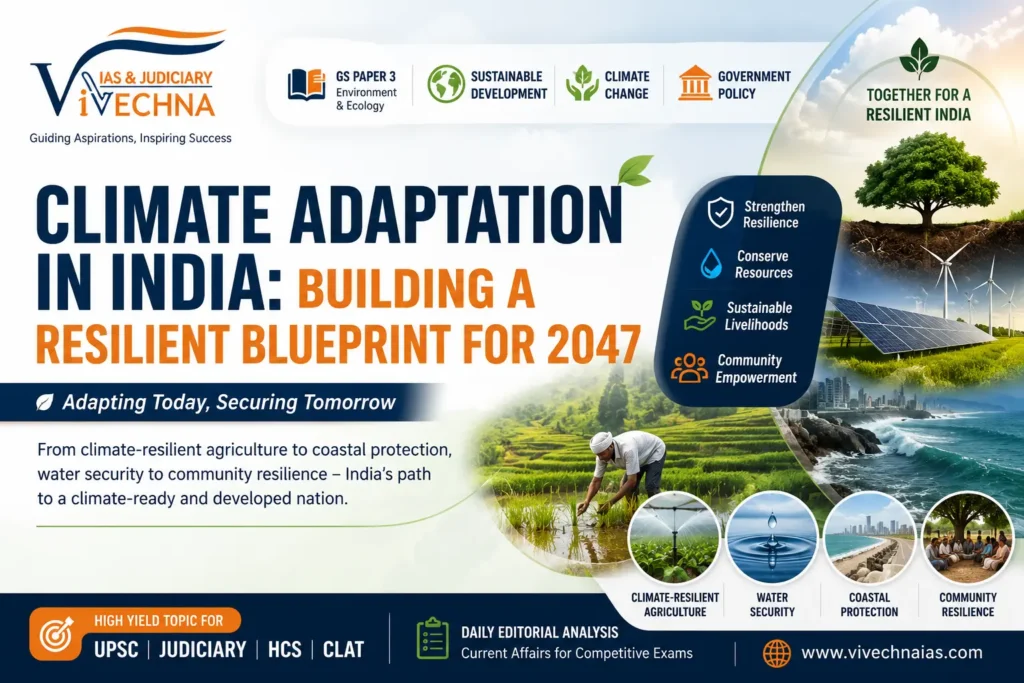
🌦️ Climate Adaptation in India: Building a Resilient Blueprint for 2047
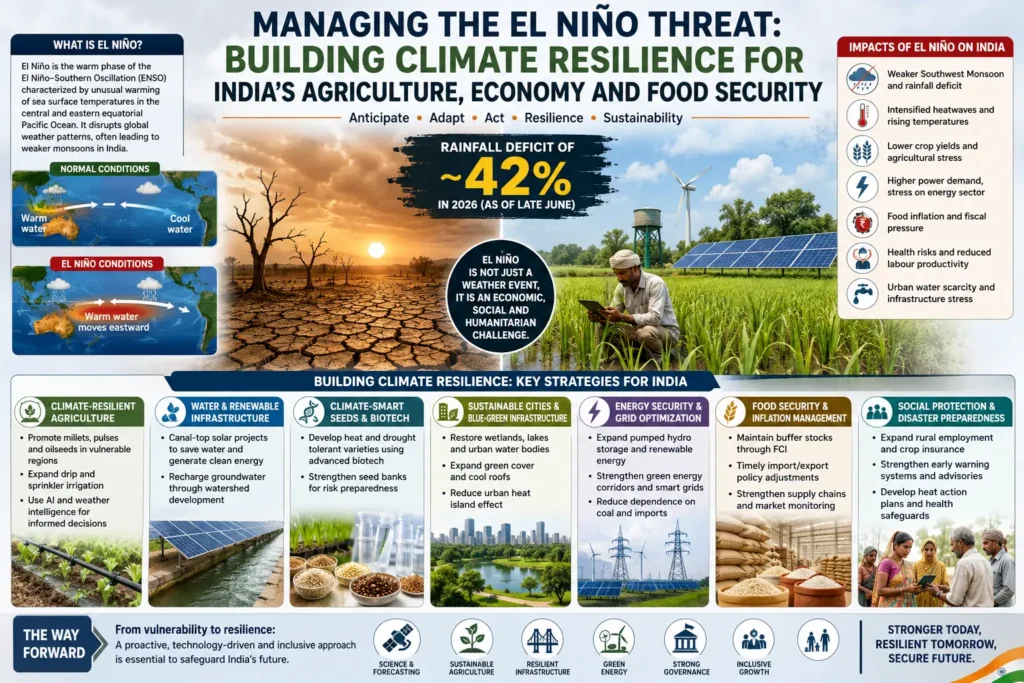
India's monsoon-dependent economy stands at a critical juncture. As erratic rainfall patterns, rising temperatures, and extreme weather events intensify, the country's adaptive capacity deficit has emerged as a serious threat to agriculture, labour productivity, coastal infrastructure, and macroeconomic stability. While global climate mitigation efforts remain essential for the long haul, India urgently needs to institutionalise localised, community-driven climate adaptation strategies — from micro-irrigation and solar cold storage to community seed banks — if it hopes to build a climate-resilient economy by 2047.
This article, curated by Vivechna IAS & Judiciary Academy, breaks down the concept of climate adaptation, its significance for India, and the ground-level strategies needed to implement it — an essential topic for UPSC Civil Services, Judiciary Services, HCS, CLAT, and other competitive examinations under the Environment and Ecology segment of GS Paper 3.
🔍 Climate Mitigation vs Climate Adaptation: Key Differences
A frequent question in UPSC Mains and Judiciary mains examinations asks candidates to differentiate between climate mitigation and climate adaptation. Here's a comparative breakdown prepared by our Current Affairs faculty at Vivechna IAS:
| Dimension | 🌍 Climate Mitigation | 🏞️ Climate Adaptation |
|---|---|---|
| Core Idea | Reducing or preventing greenhouse gas emissions at source, or enhancing carbon sinks | Adjusting systems and livelihoods to cope with actual or expected climate impacts |
| Primary Objective | Long-term global temperature stabilisation (Paris Agreement goal: well below 2°C) | Short-to-medium term resilience and survival against climate shocks |
| Time Horizon | Preventive; decades-long payoff | Immediate to anticipatory; addresses present-day risks |
| Scale of Measurement | Global — measured in MtCO2e reduced/avoided | Local/regional — measured via livelihood security & vulnerability indices |
| Indian Policy Anchor | India's updated NDCs (45% emission-intensity cut by 2030, 50% non-fossil capacity) | National Action Plan on Climate Change (NAPCC) missions |
| Energy Sector Example | National Solar Mission, Green Hydrogen Mission | Decentralised solar micro-grids, resilient coastal embankments |
| Agriculture Example | Green India Mission, natural farming to cut N2O emissions | Drought-tolerant crop varieties, micro-irrigation under PMKSY |
| Financing Mechanism | Sovereign Green Bonds, National Clean Energy Fund | National Adaptation Fund for Climate Change (NAFCC), NDMA funds |
📌 Why Climate Adaptation Matters for India
India cannot rely on mitigation alone. Given its geography, population density, and dependence on climate-sensitive sectors, adaptation is now a matter of economic and social survival. Below are the key reasons, explained with the latest data points relevant for your Mains answer writing practice.
1. Protecting Agriculture and Rural Incomes
Agriculture employs a large share of India's workforce and remains highly vulnerable to erratic rainfall. Estimates suggest climate change could cut farm incomes by roughly 15–18% overall, and by as much as 25% in unirrigated regions — translating into a substantial annual loss for the median farming household.
2. Safeguarding GDP and Macroeconomic Stability
Unchecked warming carries a direct fiscal cost. Research indicates that at 2°C of warming, India could lose 2.5–3% of GDP by mid-century, while a 3°C scenario could push annual output losses toward 10% by 2100.
3. Guarding Labour Productivity Against Extreme Heat
Heat stress is already a measurable economic drag. In 2024 alone, India is estimated to have lost around 247 billion work hours to extreme heat — nearly 420 hours per worker — hitting agriculture and construction hardest, with income losses estimated near $194 billion.
4. Managing Water Scarcity
India's per-capita water availability has fallen sharply — from about 5,177 cubic metres in 1951 to roughly 1,486 cubic metres in 2021, with projections showing a further decline toward 1,367 cubic metres by 2031, firmly placing India in "water-stressed" territory.
5. Protecting the Coastline from Cyclones and Sea-Level Rise
Close to 76% of India's coastline is exposed to cyclones, storm surges, or tsunami risk, and roughly one-third of the mainland coast faces active erosion — a direct threat to ports, fisheries, and coastal industry.
6. Strengthening Financial and Banking Stability
The RBI has begun folding climate-risk assessment into financial stability reviews, recognising that asset damage in vulnerable sectors could raise non-performing assets. Tools like the Climate Risk Information System now support climate stress-testing of banks.
7. Containing the Spread of Vector-Borne Diseases
Warmer, wetter conditions are widening the transmission season for diseases like malaria and dengue, adding significant strain to public healthcare spending and household budgets.
🌾 Ground-Level Strategies for Climate Adaptation in India
Effective adaptation in India must be decentralised, low-cost, and community-owned. Our optional subject faculty (Geography & Public Administration) at Vivechna IAS recommend focusing on the following strategies for both Prelims fact-recall and Mains analytical writing:
| 🌱 Strategy | 📖 Implementation Approach |
|---|---|
| Community Groundwater Budgeting | Village volunteers use tube/rain gauges to track water tables, feeding into cropping advisories via Gram Panchayats |
| Flood-Resilient Housing Retrofits | Elevated plinths, compressed stabilised blocks, and treated bamboo frames for low-cost flood protection |
| Solar Cold-Storage Hubs | Off-grid PV panels with thermal batteries run by Farmer Producer Organisations (FPOs) to preserve perishables |
| Bio-Fencing with Indigenous Shrubs | Thorny, drought-resistant native plants control soil erosion and act as natural windbreaks |
| Mobile Agro-Advisory Units | Offline-capable tablets linked to weather data and parametric insurance at rural haats |
| Community Seed Banks | Women's SHGs preserve native millet and pulse landraces with support from agricultural universities |
| Farm-Level Rainwater Harvesting (Panchgadiya) | Plastic-lined micro-pits inside farm plots capture runoff and recharge soil moisture |
| Agro-Silvopastoral Systems | Deep-rooted fodder trees integrated with livestock and cropping systems for drought resilience |
- Mitigation → Global, root-cause, long-term (GHG reduction)
- Adaptation → Local, impact-focused, short/medium-term (resilience building)
- Key schemes: PMKSY, NAFCC, NAPCC, NDMA frameworks
- Key data: ~76% coastline vulnerable; water availability down to ~1,486 m³ (2021)
🎓 Exam Relevance for UPSC, Judiciary, HCS & CLAT Aspirants
This topic is highly relevant across multiple examinations offered through Vivechna IAS & Judiciary Academy's integrated coaching programmes:
- UPSC Prelims: Factual questions on NAPCC missions, NDCs, Paris Agreement articles, and institutional bodies like NDMA and RBI's climate frameworks.
- UPSC Mains (GS Paper 3): Analytical questions comparing mitigation and adaptation, and evaluating India's climate resilience strategy.
- Judiciary & HCS Exams: Environmental law and constitutional provisions (Article 48A, 51A(g)) linked to climate governance — a focus area in our Judiciary coaching programme.
- CLAT & Law Entrances: Current affairs and environmental policy questions frequently drawn from editorials such as this one.
- Prelims 2025: A statement-based question on Article 6 of the Paris Agreement and carbon markets. (Answer: Both Statement II and III correct, together explaining Statement I)
- Prelims 2025: Question on Direct Air Capture (DAC) technology and its applications in sequestration, food processing, and synthetic aviation fuel. (Answer: All three statements correct)
- Prelims 2016: Aim of the Green India Mission — restoring forest cover through combined adaptation and mitigation measures. (Answer: Statement 3 only)
- Mains 2025: Explain Carbon Capture, Utilisation and Storage (CCUS) and its role in tackling climate change.
- Mains 2023: Impact of a one-metre sea-level rise (as projected by the IPCC) on India and the Indian Ocean region.
- Mains 2022: Global warming's effects and GHG control measures under the Kyoto Protocol.
- Mains 2021: Major outcomes of COP26 and India's commitments.
- Mains 2017: Impact of climate change on India, especially the Himalayan and coastal states.
✍️ Practice Question (Vivechna IAS Mains Booster)
⚠️ Common Mistakes Aspirants Make
- Confusing mitigation and adaptation as interchangeable concepts in Mains answers.
- Forgetting to cite India-specific schemes (PMKSY, NAFCC, NAPCC) instead of only global frameworks.
- Overlooking the financial/banking dimension (RBI's climate stress tests) — an increasingly important angle in recent papers.
- Ignoring the community-level/decentralised angle, which examiners increasingly reward in value-added answers.
🧾 Key Takeaways
- Climate mitigation tackles causes; climate adaptation manages consequences.
- India's adaptive capacity deficit threatens agriculture, labour, water security, coastal zones, and banking stability.
- Community-driven, low-cost solutions (seed banks, solar cold storage, bio-fencing) are the most scalable path forward.
- Institutional backing via NAPCC, NAFCC, PMKSY, and NDMA frameworks is essential to operationalise adaptation.
- This is a high-yield topic for GS Paper 3, Judiciary environmental law papers, and CLAT current affairs.
❓ Frequently Asked Questions (FAQs)
📖 Prepare Smarter with Vivechna IAS & Judiciary Academy
Get daily editorial analysis, structured current affairs notes, and Mains answer-writing practice tailored for UPSC, Judiciary, HCS, and CLAT aspirants.
Visit Vivechna IAS & Judiciary Academy | Explore Daily Current Affairs | Join Our Test Series
🏁 Conclusion
India's path to becoming a developed, climate-resilient nation by 2047 hinges on moving decisively from reactive disaster response to structured, anticipatory climate adaptation. From safeguarding farm incomes and water security to protecting coastal infrastructure and financial stability, adaptation must be treated as a first-order national priority — implemented through decentralised, community-owned solutions rather than top-down mandates alone. For aspirants, mastering this interplay between mitigation and adaptation is essential not just for GS Paper 3, but for building the analytical depth examiners reward in Mains and interview rounds.
— Curated and edited by the faculty team at Vivechna IAS & Judiciary Academy, vivechnaias.com. For more daily editorials, quizzes, and Mains answer-writing practice, explore our Current Affairs section.