Daily Editorial Analysis | Updated 28 Jul 2026 | ~13 min read | By Vivechna IAS & Judiciary Academy
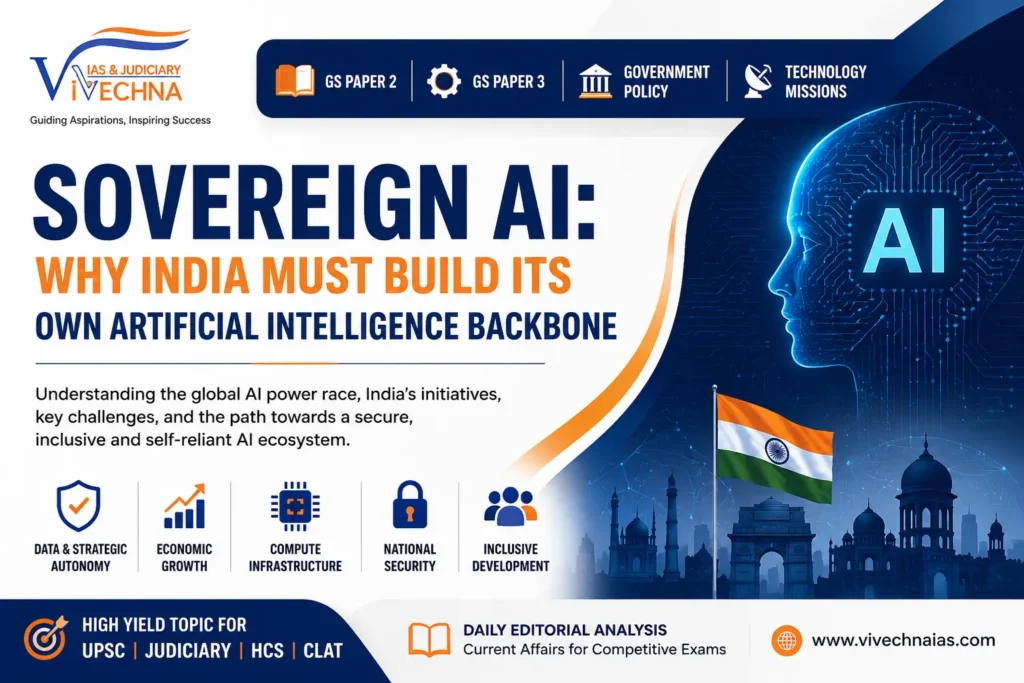
🤖 Sovereign AI: Why India Must Build Its Own Artificial Intelligence Backbone
Artificial Intelligence has become the new theatre of global power competition — and unlike earlier technology races, this one is being fought over compute, data, and governance standards rather than territory. With the United States and China together controlling the overwhelming majority of the world's top AI supercomputing capacity, and Europe shaping the rules through regulation, India faces a pressing strategic question: can it afford to remain a consumer of foreign AI, or must it build a sovereign AI ecosystem of its own?
This article by Vivechna IAS & Judiciary Academy unpacks the concept of Sovereign AI, why it is critical to India's economic and strategic autonomy, the roadblocks India faces, and the policy interventions needed — a high-yield topic for UPSC GS Paper 2 & 3, Judiciary Services, HCS, and CLAT current affairs sections.
🌐 Understanding the Global AI Power Map
The global race for AI dominance is increasingly a contest over standards and strategic alliances rather than raw invention alone. The United States commands the lion's share of the world's top-tier AI supercomputers and uses export controls plus alliance networks to retain its edge. China, in turn, is expanding influence over Global South nations through a multilateral cooperation body that India has notably not joined, while the European Union shapes global norms through its landmark AI regulation. India's challenge is to carve out genuine strategic autonomy within this three-way contest.
| 🌍 Power Bloc | 🔑 Instrument of Influence | 🎯 Strategic Goal |
|---|---|---|
| United States | Export controls on advanced chips; alliance networks (referred to as "Pax Silica") | Retain dominance over ~75% of top-tier AI supercomputing capacity |
| China | World AI Cooperation Organisation (WAICO) — a 29-nation coalition that excludes India | Shape AI governance norms across the Global South |
| European Union | EU AI Act, 2024 — a comprehensive risk-based AI regulation | Set global compliance standards through regulatory reach |
| India | IndiaAI Mission, DPDP Act 2023, India Semiconductor Mission | Build strategic autonomy without needing 100% domestic manufacturing |
📌 Why Sovereign AI Is Strategically Essential for India
Our Mains answer-writing faculty at Vivechna IAS recommend structuring this theme around eight pillars — economic, technological, and security-related. Each is explained below with the latest data points.
1. Correcting Cultural and Linguistic Blind Spots in Global AI Models
Most large language models are trained predominantly on Western datasets, leaving major gaps in understanding India's linguistic diversity and socio-economic context. Sovereign models, aligned with the Digital Personal Data Protection (DPDP) Act, 2023, can process localised realities far more accurately. The IndiaAI Mission is currently backing around 20 indigenous model proposals — including a mix of large and small language models — from domestic startups and academic institutions.
2. Unlocking Massive Economic Value
Without home-grown AI capability, the economic upside of automation largely accrues to foreign technology vendors, leaving Indian firms as mere end-users of imported software. Building domestic AI capability can help shift India's roughly $300 billion IT services sector toward a higher-value, IP-led product economy. Projections from PwC and NITI Aayog suggest AI adoption could add $550–607 billion to India's GDP by 2035, with cumulative long-term gains potentially crossing $1.7 trillion.
3. Democratising Access to Compute Infrastructure
High-end GPUs are dominated by a handful of global technology giants, pricing out Indian MSMEs and early-stage startups. Under the IndiaAI Mission, over 38,000 high-end GPUs have been pooled on a centralised portal and are offered to researchers and startups at roughly ₹65 per hour — about a third of global market rates.
4. Protecting National Security and Critical Infrastructure
Dependence on foreign "black-box" AI systems for defence, cybersecurity, power grids, and financial networks creates serious vulnerabilities, including risks of foreign surveillance. A dedicated national GPU cluster running on indigenous processors helps ensure sensitive administrative, healthcare, and tactical data never leaves domestic jurisdiction.
5. Strengthening Inclusive Public Service Delivery
Pairing sovereign AI with India's Digital Public Infrastructure — Aadhaar, UPI, and similar systems — allows hyper-personalised welfare delivery. The Bhashini National Language Translation Mission alone hosts over 350 AI models for real-time speech recognition and translation, breaking literacy barriers in governance and banking.
6. Insulating India from Global Supply Chain Shocks
Geopolitical tensions over advanced semiconductor exports (such as shifting US restrictions on high-end chip sales to China) show how quickly external dependency can choke technological progress. India's ₹76,000 crore Semiconductor Mission, alongside indigenous processor designs like SHAKTI and VEGA, aims to build end-to-end hardware self-reliance.
7. Scaling Public Health and Agricultural Intelligence
Sovereign models trained on domestic health and agricultural datasets have shown strong results in early detection of conditions like tuberculosis and diabetic retinopathy, while also powering real-time crop advisories for farmers.
8. Attracting Global Deep-Tech Investment
A clear national AI roadmap — reinforced by platforms like the India AI Impact Summit 2026 — signals policy stability to investors. AI-linked investment in India is projected to cross $200 billion over a two-year cycle, with significant capital flowing into clean energy and application-layer AI.
🚧 Key Obstacles in India's Pursuit of Sovereign AI
While policy intent is strong, several structural gaps remain. This is a frequently tested analytical angle in Judiciary and HCS Mains answers as well as UPSC GS Paper 3.
| ⚠️ Challenge | 📋 Why It Matters |
|---|---|
| Underused Compute Capacity | Despite 38,000+ GPUs on the IndiaAI portal, cumbersome booking procedures and short 7-day leasing windows discourage smaller firms from committing to long-term projects |
| Heavy Dependence on Foreign Chips | Semiconductor imports crossed $20 billion in FY2024; advanced sub-7nm manufacturing remains years away domestically |
| Shallow Deep-Tech VC Funding | Domestic risk capital avoids long-gestation foundational-model research; large investment headlines mostly fund cloud infrastructure, not core R&D |
| Energy & Cooling Constraints | AI data centre water use is projected to more than double — from ~150 billion litres in 2025 to ~358 billion litres by 2030 — straining local water tables and power grids |
| Foreign Cloud & Jurisdictional Exposure | Laws like the US CLOUD Act, 2018 can compel foreign-headquartered cloud providers to hand over data even if physically stored in India |
| Fragmented, Low-Quality Datasets | Vast volumes of Indian digital data remain unlabelled or siloed, while funding skews toward hardware over data curation |
| Deep-Tech Talent Drain | Specialists in hardware physics, compiler design, and cluster orchestration frequently migrate to global labs offering better pay and compute access |
- Sovereign AI ≠ total self-reliance; it means jurisdictional control over data & critical systems
- Key institutions: IndiaAI Mission, India Semiconductor Mission, DPDP Act 2023
- Key indigenous chips: SHAKTI, VEGA
- Key data points: 38,000+ GPUs; ₹65/hour subsidised rate; $550–607 billion GDP potential by 2035
🛠️ Strategic Steps India Must Take to Secure AI Sovereignty
Beyond conventional recommendations, forward-looking policy measures are essential. These form excellent value-added points for Mains answer enrichment:
- Sovereign Synthetic Data Generation: Build a public-private consortium to engineer high-fidelity, culturally accurate training data where real-world samples are scarce or privacy-restricted.
- Edge-Native Micro-Models: Push compute to the edge — embedding lightweight AI directly into rural sensors, IoT devices, and point-of-sale terminals for offline functionality.
- National Open-Weight Model Registry: Create a centralised, state-backed red-teaming and bias-testing framework before any homegrown model is cleared for public-sector use.
- Decentralised Compute Pooling: Aggregate idle GPU cycles from universities, corporates, and financial institutions into a shared national compute grid during off-peak hours.
- Zero-Knowledge Proof (ZKP) Integration: Embed cryptographic privacy layers so AI systems can verify eligibility or diagnostics without exposing raw citizen data.
- Multilingual Code-Generation Tools: Deploy sovereign coding assistants trained on legacy government software stacks, enabling regional-language-based development.
- Deep-Tech Reinsurance Fund: Establish a state-backed first-loss guarantee vehicle to unlock domestic pension and mutual fund capital for high-risk foundational AI research.
- Neuromorphic Hardware Research: Invest in brain-inspired, energy-efficient chip architectures to leapfrog conventional power-hungry computing.
🎓 Exam Relevance for UPSC, Judiciary, HCS & CLAT Aspirants
- UPSC Prelims: Factual recall on IndiaAI Mission, Semiconductor Mission, DPDP Act, indigenous processors (SHAKTI, VEGA), and international frameworks like the EU AI Act.
- UPSC Mains (GS 2 & 3): Analytical questions on AI governance, data sovereignty, and India's technology policy — a core focus of our UPSC Foundation Course.
- Judiciary & HCS Exams: Questions linking AI regulation to data protection law and constitutional right to privacy, covered extensively in our Judiciary coaching programme.
- CLAT & Law Entrances: Current affairs questions on technology policy, data protection, and global AI governance frequently draw from such editorials.
- Prelims 2020: A statement-based question on the practical capabilities of Artificial Intelligence at its present stage of development. (Answer: Options 1, 3, and 4 — industrial energy reduction, disease diagnosis, and text-to-speech conversion)
- Mains 2023: Introduce the concept of Artificial Intelligence and explain its role in clinical diagnosis, along with associated privacy concerns in healthcare applications.
✍️ Practice Question (Vivechna IAS Mains Booster)
⚠️ Common Mistakes Aspirants Make
- Equating "sovereign AI" with complete self-sufficiency or a ban on foreign technology — the correct framing is jurisdictional control, not autarky.
- Ignoring the hardware/semiconductor angle and focusing only on software and LLMs.
- Missing the linkage between AI policy and existing frameworks like the DPDP Act, 2023 and Digital Public Infrastructure (Aadhaar, UPI).
- Overlooking resource constraints — energy, water, and cooling requirements of AI data centres — a growing area of exam interest.
🧾 Key Takeaways
- Sovereign AI means domestic control over data, compute, and critical systems — not manufacturing everything at home.
- The global AI contest is shaped by three power centres: US export controls, China's WAICO coalition, and the EU's regulatory model.
- India's core levers are the IndiaAI Mission, India Semiconductor Mission, DPDP Act 2023, and indigenous chip programmes like SHAKTI and VEGA.
- Major roadblocks include underused compute capacity, chip import dependency, shallow deep-tech VC funding, and energy/water constraints.
- Strategic solutions range from synthetic data generation to neuromorphic hardware research and sovereign reinsurance funds for deep-tech startups.
❓ Frequently Asked Questions (FAQs)
📖 Prepare Smarter with Vivechna IAS & Judiciary Academy
Get daily editorial analysis, structured Science & Technology notes, and Mains answer-writing practice tailored for UPSC, Judiciary, HCS, and CLAT aspirants.
Visit Vivechna IAS & Judiciary Academy | Explore Daily Current Affairs | Join Our Test Series
🏁 Conclusion
India's pursuit of Sovereign AI is not about isolation from global technology — it is about ensuring that data, critical infrastructure, and sensitive public systems remain under domestic control and law. With initiatives like the IndiaAI Mission, the Semiconductor Mission, and the DPDP Act, 2023 forming the policy backbone, India has taken meaningful early steps. However, bridging gaps in compute accessibility, chip manufacturing, deep-tech funding, and energy infrastructure will determine whether India emerges as a genuine AI power or remains dependent on external ecosystems. For aspirants, this topic offers rich material connecting technology, governance, and economic policy — precisely the kind of interdisciplinary thinking that Mains examiners reward.
— Curated and edited by the faculty team at Vivechna IAS & Judiciary Academy, vivechnaias.com. For more daily editorials, quizzes, and Mains answer-writing practice, explore our Current Affairs section.