⚖️ Supreme Court Cuts Mandatory Legal Practice for Judicial Service Exams from 3 Years to 1 | Judiciary Exam Notes
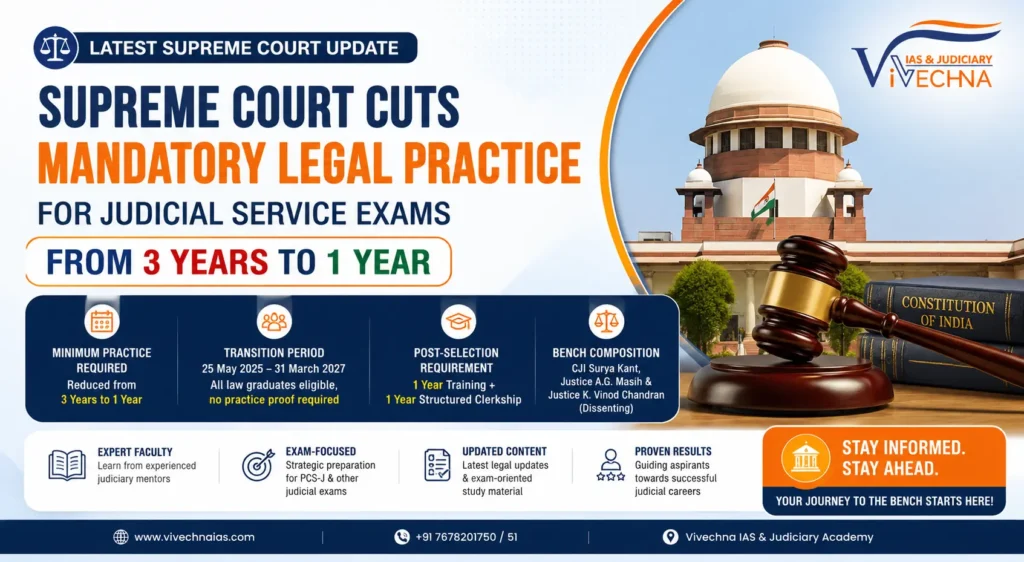
In a major relief for law graduates aspiring to join the lower judiciary, the Supreme Court on 21 August 2026 modified its May 2025 verdict — reducing the mandatory legal-practice requirement for entry-level judicial service examinations from three years to one year. A Bench comprising Chief Justice Surya Kant and Justices A.G. Masih and K. Vinod Chandran delivered the ruling in a 2:1 split verdict while dismissing a batch of review petitions. At Vivechna IAS & Judiciary Academy, this update directly affects thousands of judiciary aspirants — here's a complete, exam-ready breakdown of what changed, why, and what it means for your preparation timeline.
📌 Why This Matters for Judiciary Aspirants
This is not just a current-affairs fact — it directly changes eligibility criteria for the Civil Judge (Junior Division) exam that most judiciary aspirants are targeting. At Vivechna IAS's Judiciary Exams programme, we're updating our guidance for students in real time so nobody loses an exam cycle over outdated eligibility assumptions.
📋 What Exactly Changed?
| Aspect | May 2025 Judgment | 21 August 2026 Modification |
|---|---|---|
| Minimum Practice Required | 3 years at the Bar, mandatory before appearing | Reduced to 1 year for exams notified after 31 March 2027 |
| Transition Period (25 May 2025 – 31 March 2027) | Not applicable — 3-year rule was immediate | All law graduates eligible regardless of prior practice; deemed to have completed 1 year, no certificate required |
| Post-Selection Requirement | None beyond the practice certificate | 1 year training at a judicial academy + 1 year structured clerkship as trainee judicial officer |
| Bench Composition | CJI B.R. Gavai and Justice A.G. Masih | CJI Surya Kant, Justice A.G. Masih, Justice K. Vinod Chandran (dissenting) |
✅ Exam Tip — Two Distinct Timelines to Remember
This ruling creates two separate eligibility windows: (1) Exams notified between 25 May 2025 and 31 March 2027 — open to all law graduates, no practice proof needed; (2) Exams notified on or after 1 April 2027 — require a minimum of 1 year of verified active practice. Judiciary aspirants must track which window their target state's exam notification falls into.
🕰️ Background: How We Got Here
⚖️ The Court's Reasoning
⚠️ Hardship Without Transition
CJI Surya Kant observed that the "sudden restoration of the three-year practice rule without any transitional arrangement has visited hardship on young lawyers and law graduates."
🎓 Training as an Equivalent
The Court held that the objective behind requiring practical exposure "can be achieved not just through conventional practice but through a combination of pre-institutional training at the state judicial academy and supervised probation."
❌ PG Study Not Counted
The Court rejected arguments that postgraduate legal education should count as equivalent to Bar experience — training at the academy and supervised clerkship were held to be the appropriate substitute instead.
♿ Disability Accommodation
The ruling also addressed concerns raised in a separate writ petition regarding appropriate accommodation for persons with disabilities in meeting the practice requirement.
⚠️ Important Point — Not a Full Reversal
The Court explicitly clarified it was not reconsidering the underlying rationale for requiring pre-judicial legal exposure — only the manner of implementation. CJI Surya Kant noted: "A period of three years provides sufficient institutional experience to evaluate whether the scheme is achieving the desired objective," indicating the Court may revisit this arrangement in future based on relevant indicators. This is a modification, not a wholesale rejection of the practice-requirement principle.
👨⚖️ What Happens After Selection?
Candidates who clear the judicial service exam under the revised framework will not be directly appointed as full civil judges. Instead:
- Year 1: Appointment as a trainee judicial officer, undergoing structured training at a State Judicial Academy.
- Year 2: A further year of structured clerkship — reported by some sources as split into six months under a District Judge/Higher Judicial Service officer and six months under a sitting High Court judge.
The Court has directed High Courts to amend their respective judicial service rules within three months to bring them in conformity with these directions.
📝 Quick Revision
For exams notified after 1 April 2027, active practice will need to be verified through a certificate, issued only where the candidate's presence and participation in effective judicial proceedings has been duly recorded per a prescribed mechanism — so "on-paper" enrolment alone won't suffice going forward.
🎯 Key Takeaways
- The Supreme Court reduced the mandatory legal-practice requirement for entry-level judicial service exams from 3 years to 1 year on 21 August 2026.
- The ruling came in a 2:1 split verdict — CJI Surya Kant and Justice A.G. Masih in the majority; Justice K. Vinod Chandran dissented, favouring the original 3-year rule.
- Exams notified between 25 May 2025 and 31 March 2027 are open to all law graduates, regardless of prior practice.
- Exams notified from 1 April 2027 onward will require 1 year of verified active practice.
- Selected candidates must complete 1 year of judicial academy training + 1 year of structured clerkship before full appointment.
- This modifies — but does not overturn — the Court's 20 May 2025 judgment in the All India Judges Association v. Union of India line of cases.
📚 Exam Relevance for UPSC, Judiciary, HCS & CLAT Aspirants
| Exam | Relevance |
|---|---|
| Judiciary Exams (PCS-J / Civil Judge) | Direct, critical relevance — this changes your actual exam eligibility. Confirm your target state's notification date against the two eligibility windows. |
| UPSC Mains (GS-II) | Judicial appointments, separation of powers, and reform of recruitment processes are recurring polity themes. |
| HCS / State PCS | State judicial service rules must now be amended within 3 months — track your state High Court's revised notification. |
| CLAT / Law Entrance | High-value current-affairs and legal-reasoning material — tests understanding of review-petition procedure and constitutional interpretation. |
📍 Judiciary & CLAT Preparation 2027 — For Aspirants in Gurugram & Delhi NCR
This ruling has immediate, practical implications for anyone preparing for Civil Judge / PCS-J exams — and it's exactly the kind of live legal development covered in Judiciary coaching in Gurugram at Vivechna IAS & Judiciary Academy. If you're also exploring CLAT preparation 2027, we are recognised as the best CLAT institute in Gurgaon, offering CLAT coaching in Gurugram with CLAT coaching near HUDA City Centre and best law entrance coaching near MG Road Gurugram. This is why CLAT aspirants in Sector 14 Gurugram choose Vivechna IAS — structured CLAT study material, a full CLAT mock test series, and CLAT coaching in Delhi for aspirants across NCR.
Explore Vivechna IAS's Judiciary Exams coaching, the CLAT & Law Entrance programme, and UPSC Civil Services courses for structured coverage of this and other current legal developments.
📝 Related Previous Year Questions (PYQs)
How far do you agree with the view that tribunals curtail the jurisdiction of ordinary courts? In view of the above, discuss the constitutional validity and competency of the tribunals in India.
🖊️ Practice Questions (New — For Self-Assessment)
Consider the following statements regarding the Supreme Court's 21 August 2026 ruling on judicial service eligibility:
- The ruling completely removed any legal-practice requirement for entry-level judicial service candidates.
- Candidates selected under the modified framework must complete one year of judicial academy training followed by one year of structured clerkship.
- The ruling was delivered by a unanimous three-judge Bench.
Which of the statements given above is/are correct?
(a) 2 only (b) 1 and 2 only (c) 2 and 3 only (d) 1, 2 and 3
Answer: (a) — The requirement was reduced to 1 year (not removed) for post-March 2027 exams, and the verdict was a 2:1 split with Justice K. Vinod Chandran dissenting; Statements 1 and 3 are incorrect.
"Judicial recruitment reform must balance the need for practical legal exposure with equitable access to public employment for fresh law graduates." Discuss with reference to the Supreme Court's evolving position on the mandatory practice requirement for entry-level judicial service.
🚫 Common Mistakes Aspirants Make on This Topic
- Assuming the practice requirement was scrapped entirely — it was reduced to 1 year for future notifications, not eliminated.
- Missing the transition-period nuance — exams notified before 31 March 2027 have a separate, more lenient eligibility rule than those after.
- Forgetting the dissent — Justice K. Vinod Chandran dissented and would have upheld the original 3-year rule; this was not a unanimous decision.
- Overlooking the post-selection training requirement — even under the relaxed 1-year rule, selected candidates still undergo 2 additional years of training/clerkship before full appointment.
❓ Frequently Asked Questions (FAQs)
What did the Supreme Court decide on 21 August 2026?
Am I eligible to appear without any prior legal practice?
What happens after I clear the judicial service exam under this new rule?
Who dissented in this ruling, and what does that mean?
Do state High Courts need to change their own rules?
Which is the best CLAT coaching in Gurugram?
How to prepare for CLAT 2027 in Gurugram?
Does Vivechna IAS provide CLAT mock tests?
What are the benefits of weekend CLAT batches?
🏁 Conclusion
The Supreme Court's decision to ease the mandatory practice requirement — while retaining structured post-selection training — reflects a genuine attempt to balance practical courtroom exposure against fairness for fresh law graduates who have prepared specifically for judicial service. For aspirants, the message is clear: eligibility has opened up significantly through March 2027, but the underlying expectation of practical grounding hasn't disappeared — it has simply shifted to structured academy training and clerkship. Vivechna IAS & Judiciary Academy will continue tracking every High Court's rule amendment as it comes, so our judiciary aspirants always prepare against the most current eligibility framework.
Confused About Your Judicial Service Eligibility Under the New Rule?
Talk to Vivechna IAS & Judiciary Academy's counsellors for a clear, state-specific eligibility check and a personalised Judiciary/CLAT preparation roadmap.
Get Free Guidance →