⚖️ The 'Perfect Victim' Myth: Gender Sensitivity in Judicial Reasoning | UPSC & Judiciary Notes
The Bombay High Court's 2026 judgment in the Tarun Tejpal case has revived critical concerns over the "perfect victim" myth — the persistent societal and judicial expectation that a sexual-assault survivor must behave in a certain, stereotyped way to be seen as credible. At Vivechna IAS & Judiciary Academy, we break down this important gender-justice topic, its criminological foundations, and the Supreme Court's recent push for gender-sensitive judicial writing.
📌 Why This Topic Matters
This theme sits at the intersection of criminal law, gender studies, and judicial reform — a high-value combination for GS Paper II and especially for Vivechna IAS's Judiciary Exams programme, where case-based gender-sensitivity questions are increasingly common in both written papers and interviews.
🧠 Nils Christie's 'Ideal Victim' Theory (1986)
This criminological concept explains that society extends sympathy only to victims who fit specific stereotypes — weak, respectable, and strangers to the offender. It argues that victimhood is a socially constructed, gendered moral status rather than an objective reality, creating a harmful distinction between "deserving" and "undeserving" victims based on gender, caste, class, social status, and sexual history.
✅ Exam Tip
Remember: the "ideal victim" concept was proposed by Nils Christie in 1986 — a foundational criminology reference frequently linked to gender-justice discussions in both GS Paper II answers and Judiciary interviews.
⚖️ The Tarun Tejpal Case (2026)
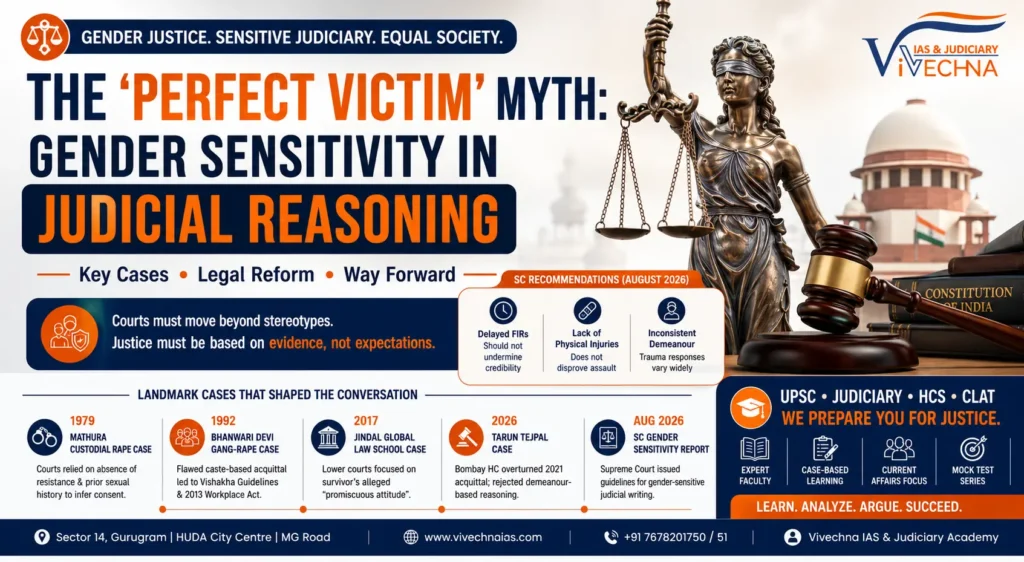
The Bombay High Court overturned a 2021 trial court acquittal, sentencing Tejpal to 10 years of rigorous imprisonment. Critically, the High Court criticised the lower court for relying heavily on the complainant's post-assault demeanour (such as smiling on CCTV footage) rather than material evidence — actively rejecting the "perfect victim" notion in its reasoning.
🕰️ A History of Flawed Judicial Reasoning
⚠️ Important Point — Bhanwari Devi's Legacy
The Bhanwari Devi case is a critical cross-topic link: it is not just a "perfect victim" example but the direct origin story of India's workplace sexual-harassment legal framework — a connection frequently tested across Polity and Social Justice questions.
🛤️ The Supreme Court's Push for Gender Sensitivity (August 2026)
To correct these systemic biases, the apex court issued a report recommending greater gender sensitivity in judicial writing. It explicitly cautioned judges against drawing adverse conclusions from:
⏱️ Delayed FIRs
Should not automatically undermine credibility, given documented reasons survivors delay reporting.
🩹 Lack of Physical Injuries
Absence of visible injury does not disprove assault.
😐 Inconsistent Demeanour
Trauma responses vary widely — courts must not expect a uniform "victim performance."
✅ Exam Tip
Structure Mains/interview answers as: Theory (Christie's Ideal Victim) → Historical Pattern (Mathura → Bhanwari Devi → Jindal) → Recent Correction (Tejpal case + SC Handbook) → Way Forward (institutionalising trauma-informed judicial training).
🎯 Key Takeaways
- The "perfect victim" myth stems from Nils Christie's 1986 Ideal Victim theory — victimhood as a socially constructed status.
- The Bombay High Court's 2026 Tarun Tejpal verdict overturned a 2021 acquittal, rejecting demeanour-based reasoning.
- Historical flawed-reasoning cases: Mathura (1979) and Bhanwari Devi (1992) — the latter led directly to the Vishakha Guidelines and the 2013 workplace-harassment law.
- The Supreme Court's August 2026 report cautions against adverse inferences from delayed FIRs, lack of injuries, or inconsistent demeanour.
📚 Exam Relevance for UPSC, Judiciary, HCS & CLAT Aspirants
| Exam | Relevance |
|---|---|
| UPSC Prelims | Key case names, Vishakha Guidelines origin, 2013 Act linkage. |
| UPSC Mains (GS-II) | Gender justice, judicial reform, and criminal-law jurisprudence. |
| Judiciary Exams | Extremely high relevance — case law and gender-sensitive judgment writing are core skills tested. |
| HCS / State PCS | Social justice and criminal-law current affairs. |
| CLAT / Law Entrance | Legal-reasoning passages on landmark gender-justice judgments. |
📍 CLAT & Judiciary Preparation 2027 — For Aspirants in Gurugram & Delhi NCR
Gender-justice case law is core material for both CLAT legal reasoning and Judiciary exam answer-writing. If you're looking for CLAT coaching in Gurugram or the best CLAT institute in Gurgaon, Vivechna IAS & Judiciary Academy's CLAT preparation 2027 batches build this depth directly. This is why CLAT aspirants in Sector 14 Gurugram choose Vivechna IAS — with CLAT coaching near HUDA City Centre and best law entrance coaching near MG Road Gurugram, backed by CLAT study material and a full CLAT mock test series, plus Judiciary coaching in Gurugram and CLAT coaching in Delhi.
🖊️ Practice Question (For Self-Assessment)
Consider the following statements regarding the "perfect victim" myth in judicial reasoning:
- Nils Christie's Ideal Victim theory was proposed in 1986.
- The Bhanwari Devi case led directly to the formulation of the Vishakha Guidelines.
- The Supreme Court's August 2026 report encourages judges to draw adverse conclusions from delayed FIRs.
Which of the statements given above is/are correct?
(a) 1 and 2 only (b) 2 and 3 only (c) 1 and 3 only (d) 1, 2 and 3
Answer: (a) — The SC report cautions AGAINST, not in favour of, drawing adverse conclusions from delayed FIRs; Statement 3 is incorrect.
❓ Frequently Asked Questions (FAQs)
What is the "perfect victim" myth?
What did the Bombay High Court decide in the Tarun Tejpal case (2026)?
How did the Bhanwari Devi case influence Indian law?
Which is the best CLAT coaching in Gurugram?
Does Vivechna IAS provide CLAT mock tests?
🏁 Conclusion
The "perfect victim" myth reveals how deeply gendered assumptions can shape judicial reasoning — but the Tarun Tejpal verdict and the Supreme Court's 2026 gender-sensitivity push signal a meaningful institutional correction. For UPSC, Judiciary, HCS, and CLAT aspirants, this topic demands both case-law precision and sensitivity to the sociological dimensions of justice — exactly what Vivechna IAS & Judiciary Academy builds into its Law and Social Justice curriculum.
Preparing for UPSC, Judiciary, HCS or CLAT 2027 in Gurugram or Delhi NCR?
Join Vivechna IAS & Judiciary Academy's daily current-affairs sessions and CLAT mock test series — trusted by aspirants across Sector 14 Gurugram, HUDA City Centre, MG Road, and Delhi NCR.
Book a Free Demo Class →