Tackling Adolescent Malnutrition in India
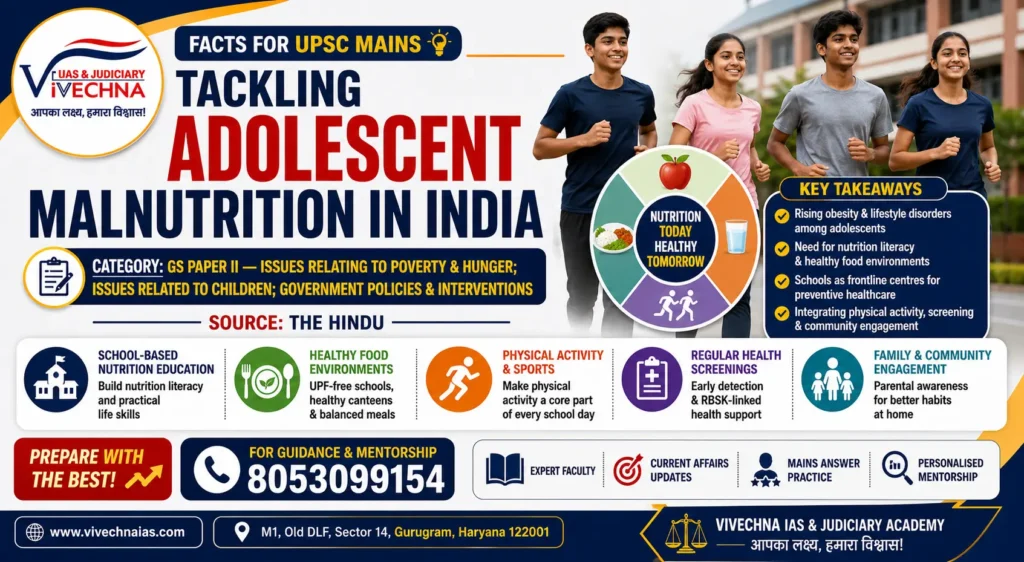
Category: GS Paper II — Issues Relating to Poverty & Hunger; Issues Related to Children; Government Policies & Interventions
Source: The Hindu
Why in News?
The sixth round of the National Family Health Survey (NFHS-6, 2023-24) has drawn attention to a growing crisis of adolescent malnutrition in India — marked by a sharp rise in obesity, elevated blood sugar levels, and lifestyle-related disorders. This has strengthened the case for school-based nutrition education and structured physical activity programmes.
Aspirants preparing for GS Paper II should note how this theme connects health, education policy, and social justice — a combination frequently tested in UPSC Mains. For guided practice on such interdisciplinary answers, you can reach out to the faculty at Vivechna IAS & Judiciary Academy.
The Current State of Adolescent Malnutrition
A Double Burden: India continues to grapple with persistent undernutrition even as overweight and obesity rise rapidly among adolescents — a classic “double burden of malnutrition.”
Rising Lifestyle Disorders (NFHS-6, 2023–24): Obesity levels have climbed to 30.7% among women and 27.3% among men, while high blood sugar now affects 17.8% of women and 20.9% of men — signalling a broader deterioration in metabolic health. Importantly, this is no longer confined to cities: sedentary routines, stress, and processed food consumption are pushing up obesity and metabolic risk in rural adolescents too.
The “Thin-Fat” Phenotype: A significant share of adolescents look lean on the outside but carry excess visceral fat internally, putting them at elevated risk of early Type-2 diabetes, hypertension, and heart disease. The Comprehensive National Nutrition Survey (2019) found that 27.4% of adolescents are stunted, and worryingly, 35% of stunted children under five already show adult-level triglyceride readings — raising their long-term risk of diabetes and cardiovascular illness despite appearing underweight.
Poor Dietary Patterns: Adolescent diets remain heavily cereal-based, with inadequate protein, fruit, vegetable, and dairy intake, even as consumption of High Fat, Sugar and Salt (HFSS) foods and ultra-processed foods (UPFs) grows by more than 13.7% a year. This falls well short of the Dietary Guidelines for Indians 2024, which recommend that fruits and vegetables occupy half of every meal by volume.
A Growing Future Burden: A 2025 Lancet study projects that by 2050, India will have around 21.8 crore overweight men and 23.1 crore overweight women, with the sharpest rise expected among 15–24 year-olds.
Physical Inactivity: Rising screen time and sedentary habits — in both urban and rural settings are compounding poor dietary patterns and driving up obesity and cardiovascular risk among young people.
How Schools Can Help Tackle Adolescent Malnutrition
Building Practical Nutrition Skills: Schools should teach students to read food labels, judge portion sizes, and recognise misleading junk-food marketing. ICMR-NIN’s “Let’s Fix Our Food” (LFOF) consortium already promotes this kind of nutrition literacy through food-label reading kits. In a notable 2025 step, the CBSE directed more than 24,000 affiliated schools to install “Sugar Boards” that make the hidden sugar content of packaged foods visible to students. The NCERT–UNESCO comic book “Let’s Move Forward” offers another engaging way to build awareness around healthy eating and hidden sugars.
Creating Healthier School Food Environments: Campuses should move toward becoming UPF- and HFSS-free zones by adopting FSSAI’s Eat Right School Initiative, which promotes safe and nutritious food through both curricular and co-curricular activities, alongside sound canteen policies. Schools are also required to enforce FSSAI’s 2020 rule barring the sale of high-fat, salt, and sugar foods within 50 metres of school premises. Programmes like PM POSHAN could shift toward protein-rich, millet-based meals, while school gardens and fruit breaks can help build lifelong healthy eating habits.
Rethinking the Curriculum: Nutrition education needs to move beyond textbook biology into everyday practical skills — understanding macronutrients and micronutrients should be treated with the same seriousness as basic numeracy. Physical education and sport should be embedded as a core, non-negotiable part of the school day, helping counter the sedentary habits and excessive screen time linked to rising obesity and non-communicable diseases.
Institutionalising Regular Health Screening: Schools should go beyond simple height and weight checks by integrating with the Rashtriya Bal Swasthya Karyakram (RBSK). Hosting periodic Adolescent Health and Wellness Days on campus can help identify early metabolic risk, BMI deviations, and anaemia, with timely referral to local health centres.
Engaging Families and Communities: Since children largely eat what is available at home, parental awareness sessions on the risks of ultra-processed foods and the importance of dietary variety are essential to reinforcing what schools teach.
Supporting Policy through Taxation and Advertising Rules: At a broader policy level, the government could impose higher taxes on sugary drinks and tighten restrictions on junk-food advertising that targets children.
Conclusion
Building a genuinely “Fit India” means turning schools into more than places of academic learning — they need to become frontline centres of preventive healthcare. Pairing blackboards with Sugar Boards, UPF-free canteens, and compulsory physical activity can help curb adolescent malnutrition and lifestyle diseases, ensuring India’s demographic dividend translates into long-term national strength rather than a future public-health burden.
Mains Practice Question
“Preventive healthcare must begin in classrooms rather than hospitals.” Examine this statement in the context of adolescent nutrition and lifestyle diseases in India.
Want detailed feedback on how to structure this kind of value-based Mains answer? Connect with Vivechna IAS & Judiciary Academy for one-on-one mentorship.
Frequently Asked Questions
- What is meant by the ‘double burden of malnutrition’ in India? It refers to India facing persistent undernutrition alongside a rapid rise in overweight, obesity, and lifestyle diseases, particularly among adolescents.
- What is the significance of FSSAI’s Eat Right School Initiative? It promotes safe, healthy, and nutritious food environments in schools through nutrition education, healthier canteens, and related curricular and co-curricular activities.
- What are CBSE’s ‘Sugar Boards’ and why do they matter? CBSE has directed over 24,000 affiliated schools to install Sugar Boards to make students aware of hidden sugar content in packaged foods and drinks, nudging healthier choices.
- How can schools help address adolescent malnutrition? By promoting nutrition literacy, maintaining UPF-free campuses, offering balanced PM POSHAN meals, mandating physical activity, and conducting periodic RBSK-linked health screenings.
- Why is the ‘thin-fat’ phenotype a public health concern? People with this phenotype look lean but carry excess visceral fat, raising their risk of Type-2 diabetes, hypertension, and cardiovascular disease despite a seemingly normal body weight.
UPSC Previous Year Questions
Prelims
- Which of the following is/are the indicator(s) used by IFPRI to compute the Global Hunger Index Report? (2016)
- Undernourishment
- Child stunting
- Child mortality
Select the correct answer using the code given below: (a) 1 only (b) 2 and 3 only (c) 1, 2 and 3
(d) 1 and 3 only Answer: (c) Mains
- How far do you agree with the view that the focus on lack of availability of food as the main cause of hunger takes the attention away from ineffective human development policies in India? (2018)
Important Facts for Prelims
SUMAN Roadmap 2030
Category: Quick Facts for Prelims | GS Paper II — Health
Source: PIB
Why in News?
The Union Minister of Health and Family Welfare launched the SUMAN Roadmap 2030 at the 16th Conference of the Central Council of Health and Family Welfare (CCHFW). Alongside it, several other digital health initiatives were unveiled, including Aarogya Setu 2.0, eSushrut@clinic, the Ayushman Sarathi PM-JAY WhatsApp Chatbot, the Drug Registry, and the Unified Health Interface.
What Is the SUMAN Roadmap 2030?
Overview: It is a comprehensive strategic framework designed by the Ministry of Health and Family Welfare to strengthen maternal and newborn healthcare across the country.
Approach: The roadmap blends national health priorities with local realities to deliver equitable, high-quality care and push India closer to the SDG targets on maternal and newborn health by 2030.
RMNCHA+N Framework: It is built on the RMNCHA+N framework — Reproductive, Maternal, Newborn, Child, Adolescent Health and Nutrition — adopting a life-cycle approach that spans pre-pregnancy, pregnancy, childbirth, and the postnatal period.
Focus on High-Risk Care: The roadmap emphasises identifying, tracking, and managing high-risk pregnancies across antenatal care, third-trimester care, intrapartum care, and the postnatal phase.
Key Focus Areas: These include transport access, tribal and hard-to-reach regions, emergency obstetric care, community involvement through SUMAN Panchayats, and climate-related risks to mothers and newborns.
Targeted Rollout: Time-bound interventions will be rolled out across 130 districts in 13 high-focus states, including Assam, Bihar, Chhattisgarh, Haryana, Jharkhand, Karnataka, Madhya Pradesh, Odisha, Punjab, Rajasthan, Uttar Pradesh, Uttarakhand, and West Bengal.
Overall Goals: The roadmap seeks to bring the Maternal Mortality Ratio below 70 per 100,000 live births by 2030, lower the Neonatal and Infant Mortality Rates, ensure universal access to quality maternal and newborn care, and work toward zero preventable maternal and newborn deaths.
Expanded Interventions: These span pre-pregnancy folic acid supplementation, nutritional support for maternal anaemia and undernutrition, high-risk pregnancy surveillance, Maternal Death Surveillance and Response (MDSR), Maternal Near Miss reviews, Non-Pneumatic
Anti-Shock Garments for obstetric haemorrhage, AI-enabled labour rooms, climate-responsive health planning, optimisation of Caesarean section rates, and integration with the Samagra Shishu Bal Swasthya Karyakram (SSBSK).
Implementation Support: The plan envisages dedicated Centres of Excellence, a centralised SUMAN Call Centre for grievance redress, stronger referral networks, and digital monitoring through the JANANI Portal.
Related SDG Targets on Maternal and Newborn Health
- Target 2 (Nutrition): End all forms of malnutrition and address the nutritional needs of adolescent girls, pregnant and lactating women, and children under five.
- Target 1 (Maternal Mortality): Bring the global maternal mortality ratio below 70 deaths per 100,000 live births.
- Target 2 (Newborn Mortality): End preventable deaths among newborns and children under five; reduce the neonatal mortality rate to at least 12 per 1,000 live births and under-five mortality to at least 25 per 1,000 live births.
- Target 3.7 (Sexual and Reproductive Health): Ensure universal access to sexual and reproductive healthcare, family planning, and related information, integrated into national health strategies.
- Target 6 (Reproductive Rights): Guarantee universal access to sexual and reproductive health and rights, enabling informed reproductive choices.
Other Key Health Initiatives Announced at the 16th CCHFW
- Drug Registry: A unified digital platform under the Ayushman Bharat Digital Mission (ABDM) that standardises information on generic drugs, branded medicines, and other substances to improve interoperability, e-prescriptions, and clinical decision-making.
- Unified Health Interface (UHI): An interoperable ABDM service layer letting citizens and verified providers discover, book, and access digital health services across multiple platforms without depending on a single app.
- National Ambulance Services Operational Guidelines 2026: A national framework standardising emergency medical transport, including AIS-125 vehicle compliance, Integrated Command and Dispatch Centres, GPS-based tracking, and integration with the 112 emergency helpline.
- Aarogya Setu 2.0: A revamped national health app and Personal Health Record platform supporting ABHA account creation, health record management, the PM-JAY wallet, medicine reminders, and consent-based data sharing.
- Ayushman Sarathi: A PM-JAY WhatsApp chatbot offering round-the-clock access to eligibility checks, Ayushman Card downloads, hospital search, grievance tracking, and treatment history.
- eSushrut@Clinic: A lightweight, ABDM-enabled Hospital Management Information System developed by C-DAC for small clinics, PHCs, Health and Wellness Centres, and private practices.
- Samagra Shishu Bal Swasthya Karyakram (SSBSK): A unified programme integrating home-based newborn and young-child care to provide continuous support from birth up to 36 months.
Frequently Asked Questions
- What is the SUMAN Roadmap 2030? A strategic framework launched by the Ministry of Health and Family Welfare to strengthen maternal and newborn healthcare and eliminate preventable deaths by 2030.
- Which framework anchors the SUMAN Roadmap 2030? It is anchored in the RMNCHA+N framework, covering reproductive, maternal, newborn, child, and adolescent health and
- What is the main target of the SUMAN Roadmap 2030? To reduce the Maternal Mortality Ratio below 70 per 100,000 live births by 2030 and achieve zero preventable maternal and newborn deaths.
- How many high-focus states does the roadmap cover? It introduces targeted interventions across 130 districts in 13 high-focus states.
- What are the four stages used to manage high-risk pregnancies? Antenatal care, third-trimester care, intrapartum care, and the postnatal period.
UPSC Previous Year Question
Prelims
- Which of the following are the objectives of the ‘National Nutrition Mission’? (2017)
- To create awareness relating to malnutrition among pregnant women and lactating
- To reduce the incidence of anaemia among young children, adolescent girls, and
- To promote the consumption of millets, coarse cereals, and unpolished
- To promote the consumption of poultry
Select the correct answer using the code given below: (a) 1 and 2 only (b) 1, 2 and 3 only (c) 1, 2 and 4 only (d) 3 and 4 only
Answer: (a)
Preparing for UPSC Civil Services or Judiciary examinations and want structured coverage of health, nutrition, and social-sector current affairs like these? Visit Vivechna IAS & Judiciary Academy and connect with our team for personalised guidance and Mains answer-writing practice.