🧬 Generative AI in Synthetic Biology: Promise and Peril | UPSC GS-III Notes
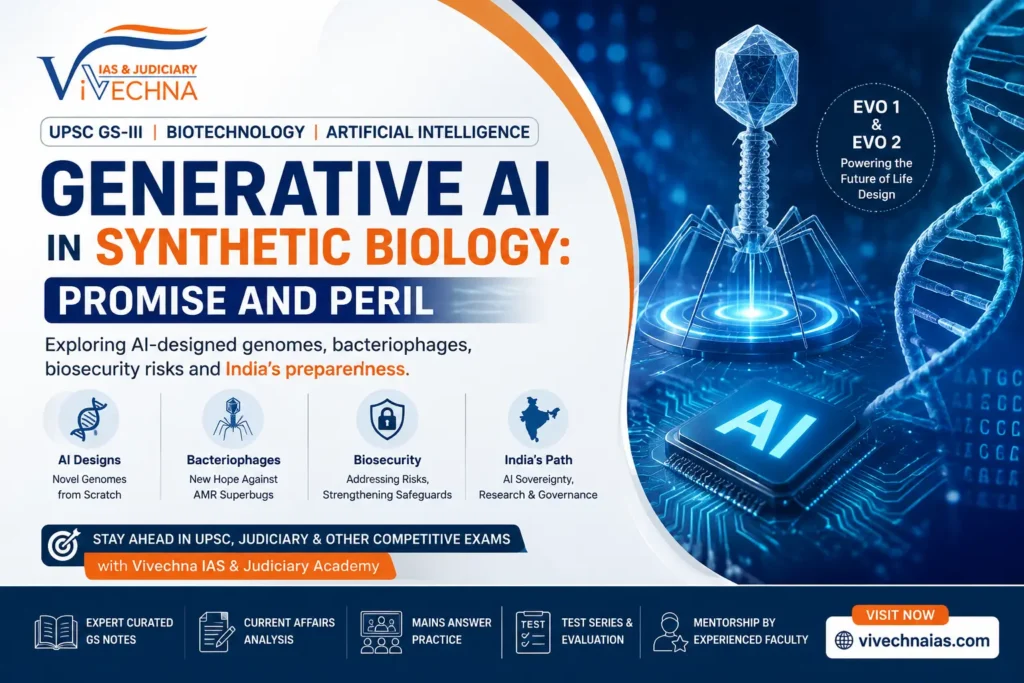
Researchers from Stanford University and the Arc Institute have used generative AI models — Evo 1 and Evo 2 — to design complete, functional genomes of bacteriophages, marking a paradigm shift where AI moves beyond analysing biological data to generating functional biological designs. At Vivechna IAS & Judiciary Academy, we cover this frontier GS Paper III topic spanning biotechnology, AI governance, and biosecurity.
🦠 About Bacteriophages
Bacteriophages ("bacteria eaters") are viruses that infect bacteria — among the most abundant biological entities in nature, studied for over a century. They've gained renewed importance as a potential weapon against antibiotic-resistant bacteria, though their high strain-specificity and bacteria's ability to develop phage resistance limit therapeutic use.
📌 Why This Matters
This topic bridges biotechnology, AI policy, and biosecurity governance — a genuinely modern GS Paper III crossover theme. Aspirants at Vivechna IAS's UPSC Civil Services programme should track this alongside broader IndiaAI Mission and AMR (antimicrobial resistance) coverage.
🧬 What Is Generative Biology?
Generative biology sits at the intersection of AI and synthetic biology — machine learning models (biological foundation models) learn the "grammar" of DNA, RNA, and proteins to design entirely new, functional biological entities de novo (from scratch).
The Genomic Evolution
| Era | Capability | Example |
|---|---|---|
| Reading (1970s) | Sequencing natural genomes | ΦX174 bacteriophage sequenced in 1977 |
| Writing (2000s) | Chemically synthesising known sequences | Physical DNA synthesis of existing genomes |
| Modifying (2010s) | Targeted gene edits | Gain-of-function and CRISPR-based editing |
| Designing (Present) | AI proposes novel genetic blueprints | Evo 1/Evo 2-designed functional phage genomes |
✅ Exam Tip
Remember this 4-stage evolution — Reading → Writing → Modifying → Designing — as a clean framework for any Mains answer tracing the history of genomic science and its AI-driven acceleration.
🌟 Benefits and Opportunities
💊 Combating AMR
On-demand design of customised bacteriophage therapies against specific multidrug-resistant "superbugs."
🎯 Targeted Gene Delivery
Synthetic viral vectors (e.g., engineered AAVs) delivering CRISPR payloads without triggering immune rejection.
💉 Faster Vaccine Discovery
Accelerated design of optimised antigens, antibodies, and therapeutic proteins.
🎗️ Precision Oncology
Engineering oncolytic viruses that selectively target and destroy cancer cells.
⚠️ Major Concerns
⚠️ Key Risks
- Dual-use/bioterrorism risk: The same capabilities supporting phage therapy could design harmful agents — the core concern is capability amplification, not AI independently creating pathogens today.
- Ecological unpredictability: An AI-designed virus released into the environment could unpredictably jump species barriers (zoonosis).
- Accelerated design cycles: AI + automated labs could dramatically shorten the time from biological design to experimental testing.
- Screening gaps: Traditional DNA-synthesis screening checks for resemblance to known pathogens — but AI-generated designs may be novel and evade detection.
- Regulatory/patent ambiguity: Global IP law is unprepared for machine-designed life forms — ownership remains unclear.
⚠️ Important Point
The central biosecurity concern isn't AI independently inventing a dangerous pathogen — it's capability amplification: AI making sophisticated biological design faster and more accessible to actors who already have some expertise and infrastructure. This distinction is crucial for accurate Mains-answer framing.
🇮🇳 Implications for India
Generative biology has direct implications for India's drug discovery, genomics, vaccine development, and AMR research. India must strengthen biomedical AI, secure computing and biological datasets, and build biosecurity safeguards — balancing AI sovereignty (via the IndiaAI Mission) with robust biosafety governance.
🛤️ Way Forward
- Mandatory DNA-synthesis screening — strict "Know Your Customer" norms for commercial gene-synthesis providers, triggering alarms on dangerous genome orders.
- Update the Biological Weapons Convention (BWC) — modernise the 1972 treaty to explicitly cover AI-generated pathogens.
- Hardware and compute governance — oversight of the computing power needed to train frontier biological AI models, akin to nuclear-materials control.
- "Red-teaming" AI models — rigorous simulated cyber-biological attack testing to ensure AI models refuse harmful-pathogen prompts.
✅ Exam Tip
For Mains, structure this topic as: What Is Generative Biology → Benefits (AMR/vaccines/oncology) → Concerns (dual-use, screening gaps) → India-Specific Implications → Global Governance Way Forward (BWC, screening, red-teaming).
🎯 Key Takeaways
- Stanford/Arc Institute researchers used Evo 1 and Evo 2 to design functional bacteriophage genomes — 16 of 285 synthesised designs produced viable, infectious phages.
- Genomic science has evolved through 4 stages: Reading → Writing → Modifying → Designing.
- The core biosecurity risk is capability amplification, not autonomous AI pathogen creation.
- Traditional sequence-based DNA screening may fail against novel AI-generated designs.
- India must balance AI sovereignty (IndiaAI Mission) with strong biosafety/biosecurity safeguards.
📚 Exam Relevance for UPSC, Judiciary, HCS & CLAT Aspirants
| Exam | Relevance |
|---|---|
| UPSC Prelims | Bacteriophage facts, ΦX174, AI-biology terminology. |
| UPSC Mains (GS-III) | AI governance, biosecurity, and AMR-research linkages. |
| Judiciary Exams | General awareness on emerging biotech/IP law questions. |
| CLAT / Law Entrance | Current-affairs MCQs on AI regulation and biosecurity law. |
📍 CLAT Preparation 2027 — For Aspirants in Gurugram & Delhi NCR
Emerging tech-and-biosecurity current affairs are increasingly common in CLAT's GK section. If you're looking for CLAT coaching in Gurugram or the best CLAT institute in Gurgaon, Vivechna IAS & Judiciary Academy's CLAT preparation 2027 batches track such frontier-science developments closely. This is why CLAT aspirants in Sector 14 Gurugram choose Vivechna IAS — with CLAT coaching near HUDA City Centre and best law entrance coaching near MG Road Gurugram, backed by CLAT study material and a full CLAT mock test series, plus CLAT coaching in Delhi and Judiciary coaching in Gurugram.
📝 Previous Year Questions (PYQs)
With the present state of development, Artificial Intelligence can effectively do which of the following?
- Bring down electricity consumption in industrial units
- Create meaningful short stories and songs
- Disease diagnosis
- Text-to-Speech Conversion
- Wireless transmission of electrical energy
(a) 1, 2, 3 and 5 only (b) 1, 3 and 4 only (c) 2, 4 and 5 only (d) 1, 2, 3, 4 and 5
Answer: (b)
Which of the following are the reasons for the occurrence of multi-drug resistance in microbial pathogens in India?
- Genetic predisposition of some people
- Taking incorrect doses of antibiotics to cure diseases
- Using antibiotics in livestock farming
- Multiple chronic diseases in some people
(a) 1 and 2 (b) 2 and 3 only (c) 1, 3 and 4 (d) 2, 3 and 4
Answer: (b)
Can overuse and free availability of antibiotics without doctor's prescription be contributors to the emergence of drug-resistant diseases in India? What are the available mechanisms for monitoring and control? Critically discuss the various issues involved.
🖊️ Practice Question (New — For Self-Assessment)
Consider the following statements regarding generative AI in synthetic biology:
- Evo 1 and Evo 2 were used to design complete, functional bacteriophage genomes.
- Traditional DNA-synthesis screening is fully effective against all AI-generated novel sequences.
- ΦX174 was the first complete DNA genome to be sequenced, in 1977.
Which of the statements given above is/are correct?
(a) 1 and 3 only (b) 1 and 2 only (c) 2 and 3 only (d) 1, 2 and 3
Answer: (a) — Traditional screening struggles with novel AI-generated sequences that don't resemble known pathogens; Statement 2 is incorrect.
❓ Frequently Asked Questions (FAQs)
What is Generative Biology?
What are bacteriophages and why are they important in this context?
What is the major biosecurity concern with Generative AI in synthetic biology?
Which is the best CLAT coaching in Gurugram?
Does Vivechna IAS provide CLAT mock tests?
🏁 Conclusion
Generative AI in synthetic biology represents a genuine frontier — capable of accelerating vaccine discovery and AMR solutions, but equally capable of amplifying bioterrorism risk if left ungoverned. The path forward lies in risk-based, function-focused biosecurity screening and updated international frameworks like the BWC — not choosing between innovation and safety, but building both together. For UPSC, Judiciary, HCS, and CLAT aspirants, this topic exemplifies how technology and governance increasingly intersect — precisely the analytical depth Vivechna IAS & Judiciary Academy builds into its Science & Technology curriculum.
Preparing for UPSC, Judiciary, HCS or CLAT 2027 in Gurugram or Delhi NCR?
Join Vivechna IAS & Judiciary Academy's daily current-affairs sessions and CLAT mock test series — trusted by aspirants across Sector 14 Gurugram, HUDA City Centre, MG Road, and Delhi NCR.
Book a Free Demo Class →