🌱 Natural Farming: India's Path to Resilient Agriculture | UPSC GS-III Notes
Geopolitical shocks and mounting climatic stress are pushing natural farming from an ideological debate into a genuine agricultural-resilience imperative. As an ecologically regenerative alternative to chemical-intensive agriculture, natural farming — widely known in India as Prakritik Kheti — draws on local biodiversity, zero tillage, and indigenous cattle-based formulations to restore soil health and cut input costs. At Vivechna IAS & Judiciary Academy, we break down this high-value GS Paper III topic covering its principles, significance, concerns, and the institutional strategies needed for sustainable scale-up.
📌 Why This Topic Matters
Natural farming sits squarely within GS Paper III's Agriculture, Environment, and Sustainable Development themes — and increasingly features in essay and Mains answers on climate resilience. For aspirants at Vivechna IAS's UPSC Civil Services programme, this topic rewards precise data retention (SOC figures, NITI Aayog survey results) combined with balanced, structured argumentation.
🌿 What Is Natural Farming?
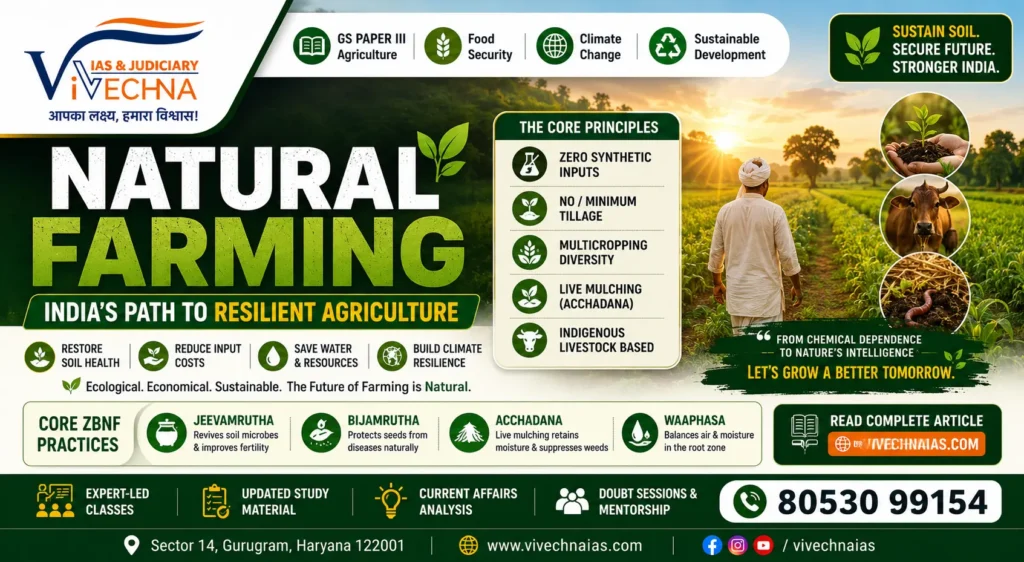
Natural farming is an ecologically regenerative, chemical-free agricultural system relying entirely on local biodiversity, on-farm biomass, and natural biological processes — rather than synthetic external inputs. Unlike conventional farming's dependence on chemical fertilisers, pesticides, intensive tillage, and hybrid/GM seeds, natural farming treats agricultural land as a living, self-sustaining ecosystem.
Key Pillars of Natural Farming
🚫 Zero Synthetic Inputs
Urea, DAP, chemical pesticides, and growth regulators are strictly prohibited; fertility is restored via organic residues and microbes.
🌾 No/Minimum Tillage
Preserves soil structure, protects earthworms and microbial habitats.
🌽 Multicropping
Diverse crops grown together, optimising nutrients and breaking pest cycles.
🍂 Live Mulching (Acchadana)
Continuous soil cover regulates temperature, retains moisture, and suppresses weeds.
🐄 Indigenous Livestock
Desi cattle dung and urine form the base for microbial formulations like Jeevamrutha.
Core ZBNF Practices
| Practice | What It Does |
|---|---|
| Jeevamrutha | Fermented culture of cow dung, urine, jaggery, pulse flour, live soil, and water — revives beneficial microbes and earthworms. |
| Bijamrutha | Seed-treatment mix of cow dung, urine, lime, and soil — protects sprouting seeds from fungal/soil-borne disease. |
| Acchadana (Mulching) | Dried straw, leaves, or live intercrops covering topsoil — drastically cuts irrigation needs. |
| Waaphasa | Balancing air and moisture in the soil root zone, reducing dependence on heavy irrigation. |
⚖️ Natural Farming vs. Organic Farming
| Parameter | Natural Farming | Organic Farming |
|---|---|---|
| Core Approach | Chemical-free agroecological system relying on soil biology and locally adapted processes. | Certified production system with prescribed standards; prohibits synthetic chemicals. |
| External Inputs | Minimised; on-farm/local bio-inputs or Bio-input Resource Centres. | Permits approved organic manure, compost, biofertilisers, and certified commercial inputs. |
| Tillage | Minimum disturbance, shallow or no-till encouraged. | Permitted but not compulsory. |
| Livestock | Crop-livestock integration strongly encouraged. | Optional; plant-based compost/green manures may substitute. |
| Production Cost | Reduces purchased-input expenditure; labour/bio-input costs remain. | Varies; certification/inspection can raise costs, on-farm recycling can lower them. |
✅ Exam Tip
A common Prelims trap: organic farming permits certified commercial inputs, while natural farming minimises all externally purchased inputs, relying almost entirely on on-farm or community-sourced bio-inputs. Don't treat the two as synonyms.
🌟 Significance of Natural Farming for India
🌍 Soil & Ecosystem Restoration
Jeevamrutha-driven microbial activity restored Soil Organic Carbon from ~0.90% to 1.15% in ICAR Himalayan trials within 2–3 years.
💰 Fiscal De-risking
NITI Aayog found 90.1% of farmers cut input costs; 91.2% reported higher productivity and improved soil health.
💧 Climate & Water Resilience
CEEW field data shows 45–70% less input energy and lower CO₂-equivalent emissions on irrigated natural-farming land.
🥗 Public Health
Chemical-free food reduces agrochemical exposure for farmers, consumers, livestock, and aquatic ecosystems.
👩 Women's Empowerment
33,676+ CRPs/Krishi Sakhis trained, positioning rural women as knowledge providers, notably in Chhattisgarh, Jharkhand, and Andhra Pradesh.
🌐 Input Sovereignty
Reduces dependence on fertiliser imports from Saudi Arabia, Jordan, Morocco, and Russia.
💡 Did You Know?
As of mid-2026, 18,786 clusters covering over 8.8 lakh hectares have been organised across 16 states under central-state cooperative synergy — with Bio-input Resource Centres (BRCs) functioning as a cooperative-enterprise model at the cluster level.
⚠️ Key Concerns Facing Natural Farming Adoption
⚠️ Structural Challenges
- Uncertain, crop-specific yields: A CSTEP study in Andhra Pradesh found negligible differences for paddy/chilli, but conventional groundnut, maize, and cotton yielded 0.3–0.7 tonnes/acre more.
- Transition-period risk: NMNF's ₹4,000/acre/year incentive (2 years, capped at 1 acre) may not fully offset transition losses for larger or high-value-crop farmers.
- Nutrient-imbalance risk: Standard formulations like Jeevamrit may not suit every crop's distinct nutrient needs — ICAR still advocates soil-test-based balanced nutrition.
- High labour burden: Increases demand for family/skilled labour, disproportionately affecting women already engaged in unpaid farm work.
- Weak certification: PGS-India Natural registered 11.86 lakh farmers by Feb 2026, but only 4.73 lakh certificates were issued — a major premium-market gap.
- Macro food-security risk: HYV crops bred for Green Revolution-era NPK inputs could face nutrient mining if synthetic fertiliser is eliminated too abruptly.
- Livestock dependence: Disadvantages landless cultivators and tenant farmers lacking cattle access.
✅ Counterbalancing Evidence
- ICAR-NAARM notes natural farming may improve income via lower costs and premium prices, even where yields are flat.
- Bio-inputs can be purchased from BRCs, reducing (though not eliminating) livestock dependence.
- A phased, science-backed transition — rather than abrupt farm-wide shifts — can materially reduce yield-risk exposure.
🛤️ Strategies for Sustainable Adoption
- Develop crop- and agro-climate-specific packages — a Natural Farming Suitability Atlas mapping regional adaptability, nutrient needs, and transition-period risks, backed by open-access multi-location trial data.
- Adopt a phased, just-transition framework — gradual conversion of land holdings, declining financial assistance over 3–5 years, concessional credit, and transition-linked crop insurance; extend eligibility to tenant farmers and women cultivators via cultivation certificates.
- Build a farmer-led extension architecture — paid master trainers, demonstration plots, and continuous (not one-time) vernacular advisories via CRPs and Krishi Sakhis.
- Strengthen the decentralised bio-input ecosystem — BRCs run by FPOs/cooperatives/SHGs with standard operating procedures, batch traceability, and quality accreditation.
- Promote diversified farming systems — crop rotation, intercropping, agroforestry, and water harvesting rather than mere input substitution.
- Establish credible certification and traceability — legally distinguishing natural, organic, chemical-free, and residue-free produce, backed by random residue testing and QR-based traceability.
✅ Exam Tip
For Mains, structure natural-farming answers as: Concept → Significance (soil/cost/climate/gender) → Concerns (yield/transition/certification) → Way Forward (phased, science-backed institutional support). This balanced structure avoids both uncritical advocacy and blanket dismissal — both of which examiners penalise.
🎯 Key Takeaways
- Natural farming (Prakritik Kheti) is a zero-synthetic-input, ecosystem-based farming system, distinct from certified organic farming.
- ICAR Himalayan trials recorded SOC rising from 0.90% to 1.15% within 2–3 years of adoption.
- NITI Aayog found 90.1% of farmers reported reduced input costs; 91.2% reported productivity gains.
- The National Mission on Natural Farming (NMNF) offers ₹4,000/acre/year for 2 years, capped at 1 acre per farmer.
- Key concerns: crop-specific yield uncertainty, weak certification (only 4.73 lakh of 11.86 lakh PGS-India registered farmers certified), and macro food-security risk if scaled without safeguards.
📚 Exam Relevance for UPSC, Judiciary, HCS & CLAT Aspirants
| Exam | Relevance |
|---|---|
| UPSC Prelims | ZBNF terminology, NMNF, SOC data, natural-vs-organic distinctions. |
| UPSC Mains (GS-III) | Agricultural sustainability, climate resilience, and food-security trade-offs. |
| Judiciary Exams | General awareness on agricultural policy and certification law. |
| HCS / State PCS | State-specific natural-farming implementation (e.g., Andhra Pradesh's model). |
| CLAT / Law Entrance | Current-affairs MCQs on agricultural schemes and sustainability policy. |
📍 CLAT Preparation 2027 — For Aspirants in Gurugram & Delhi NCR
Agriculture and sustainability current affairs like natural farming appear regularly in CLAT's GK section. If you're looking for CLAT coaching in Gurugram or the best CLAT institute in Gurgaon, Vivechna IAS & Judiciary Academy's CLAT preparation 2027 batches cover such policy-heavy topics in depth. This is why CLAT aspirants in Sector 14 Gurugram choose Vivechna IAS — with CLAT coaching near HUDA City Centre and best law entrance coaching near MG Road Gurugram, backed by structured CLAT study material and a full CLAT mock test series, plus CLAT coaching in Delhi and Judiciary coaching in Gurugram for aspirants preparing across multiple exams.
Explore Vivechna IAS's UPSC Civil Services courses, Judiciary Exams coaching, State PCS/HCS batch, and the CLAT & Law Entrance programme for structured coverage of Agriculture, Environment, and Sustainable Development topics like this one.
📝 Previous Year Questions (PYQs)
How is permaculture farming different from conventional chemical farming?
- Permaculture farming discourages monocultural practices but in conventional chemical farming, monoculture practices are predominant.
- Conventional chemical farming can cause an increase in soil salinity but the occurrence of such phenomenon is not observed in permaculture farming.
- Conventional chemical farming is easily possible in semi-arid regions but permaculture farming is not so easily possible in such regions.
- Practice of mulching is very important in permaculture farming but not necessarily so in conventional chemical farming.
(a) 1 and 3 (b) 1, 2 and 4 (c) 4 only (d) 2 and 3
Answer: (b)
Consider the following agricultural practices: (1) Contour bunding (2) Relay cropping (3) Zero tillage
In the context of global climate change, which of the above helps/help in carbon sequestration/storage in the soil?
(a) 1 and 2 only (b) 3 only (c) 1, 2 and 3 (d) None of them
Answer: (b)
What are the present challenges before crop diversification? How do emerging technologies provide an opportunity for crop diversification?
How has India benefited from the contributions of Sir M. Visvesvaraya and Dr. M. S. Swaminathan in the fields of water engineering and agricultural science respectively?
🖊️ Practice Questions (New — For Self-Assessment)
Consider the following statements regarding natural farming in India:
- Natural farming permits the use of certified commercial organic inputs on par with organic farming.
- Jeevamrutha is a fermented microbial culture prepared using cow dung, cow urine, jaggery, and pulse flour.
- The National Mission on Natural Farming provides output-based incentives capped at one acre per farmer.
Which of the statements given above is/are correct?
(a) 2 and 3 only (b) 1 and 2 only (c) 1 and 3 only (d) 1, 2 and 3
Answer: (a) — Natural farming minimises externally purchased inputs, unlike organic farming, which permits certified commercial inputs; Statement 1 is incorrect.
"Natural farming's promise of ecological resilience is undermined by uncertain yield outcomes and weak certification mechanisms." Critically examine this statement and suggest measures for its sustainable scale-up in India.
🚫 Common Mistakes Aspirants Make on This Topic
- Treating natural farming and organic farming as identical — natural farming minimises all purchased inputs; organic farming permits certified commercial inputs under prescribed standards.
- Assuming natural farming universally boosts yields — CSTEP and ICAR-NAARM studies show yield outcomes are crop- and region-specific, sometimes lower than conventional farming.
- Ignoring the gender dimension — increased labour demands can disproportionately raise women's unpaid work burden, a frequently overlooked concern.
- Overlooking the certification gap — high registration numbers (PGS-India) don't automatically translate into certified, premium-market access.
- Writing purely advocacy-style Mains answers — strong answers weigh natural farming's genuine soil/climate benefits against real transition risks and food-security concerns.
❓ Frequently Asked Questions (FAQs)
What is the core difference between natural farming and organic farming?
What role do Bio-input Resource Centres (BRCs) play in natural farming ecosystems?
How does natural farming impact Soil Organic Carbon (SOC)?
How does natural farming contribute to water conservation?
Which is the best CLAT coaching in Gurugram?
How to prepare for CLAT 2027 in Gurugram?
Does Vivechna IAS provide CLAT mock tests?
What are the benefits of weekend CLAT batches?
🏁 Conclusion
Natural farming offers India a genuine pathway toward ecological resilience, soil restoration, and reduced farmer input costs — but its promise cannot be realised through ideological enthusiasm alone. Scaling it sustainably demands science-backed, crop-specific protocols, phased transition support, credible certification, and robust bio-input infrastructure — not an abrupt, one-size-fits-all shift away from conventional agriculture. For UPSC, Judiciary, HCS, and CLAT aspirants, this topic is a strong test of balanced analytical writing — exactly the depth Vivechna IAS & Judiciary Academy builds into its Agriculture and Environment curriculum.
Preparing for UPSC, Judiciary, HCS or CLAT 2027 in Gurugram or Delhi NCR?
Join Vivechna IAS & Judiciary Academy's expert-led Agriculture & Environment modules, daily current-affairs analysis, and CLAT mock test series — trusted by aspirants across Sector 14 Gurugram, HUDA City Centre, MG Road, and Delhi NCR.
Book a Free Demo Class →