🏭 Future Roadmap for India's Iron & Steel Industry | UPSC GS-I/II/III Notes
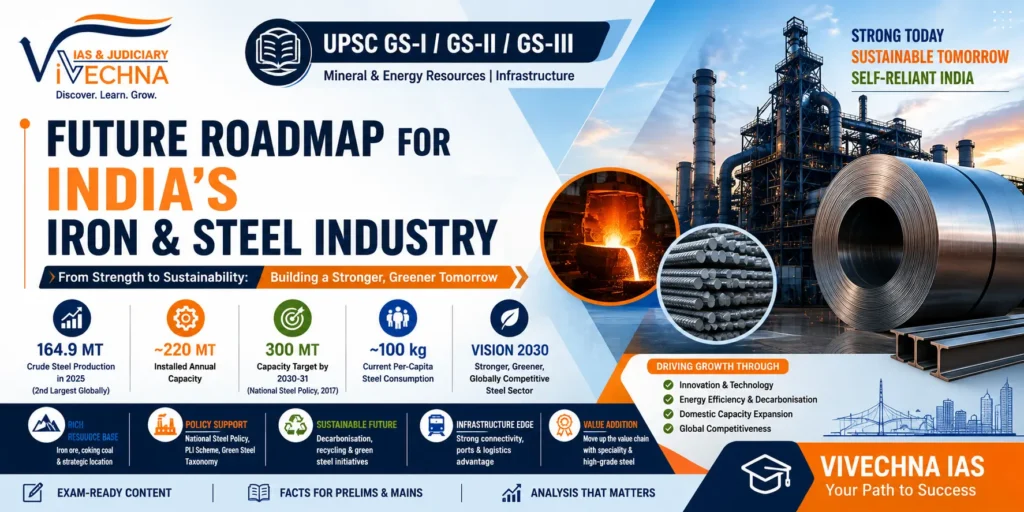
From a licence-controlled public-sector activity to the world's second-largest crude-steel industry, India's steel sector has become one of the clearest success stories of the post-1991 reforms. With crude-steel production touching 164.9 million tonnes (MT) in 2025 — a 10.4% jump over 2024 — the next phase of growth hinges on cutting import dependence on coking coal, decarbonising an emissions-heavy sector, and moving up the value chain into speciality steel. At Vivechna IAS & Judiciary Academy, we unpack this GS-I (Geography/locational factors), GS-II (government policy), and GS-III (growth & infrastructure) crossover topic in a complete, exam-ready format.
📌 Why This Topic Matters
Iron & steel is a rare topic that spans three GS papers at once — locational factors and resource geography (GS-I), policy interventions like the National Steel Policy and PLI scheme (GS-II), and industrial growth, infrastructure, and decarbonisation (GS-III). For aspirants at Vivechna IAS's UPSC Civil Services programme, mastering this topic offers cross-paper value rarely found in a single current-affairs theme.
📊 Present Status of India's Iron & Steel Industry
India has held the world's 2nd-largest crude-steel producer position since 2018, behind only China, whose 2025 output actually declined to 960.8 MT. The National Steel Policy, 2017 targets 300 MT capacity, 255 MT crude-steel production, and 230 MT finished-steel production by 2030-31, alongside raising per-capita consumption to roughly 158 kg. The industry itself is a mix of public-sector majors (SAIL, RINL, NMDC Steel), large private producers (Tata Steel, JSW Steel, Jindal Steel), and thousands of secondary/MSME producers using sponge iron, scrap, electric arc, and induction furnace routes.
📍 Location Factors of the Iron & Steel Industry
Iron and steel is a classic weight-losing (gross-material) industry — its raw material inputs (iron ore, coking coal, limestone, dolomite, manganese) are far bulkier than the finished output, so transport logistics heavily shape where plants are built.
⛰️ Raw Material Proximity
The primary factor — integrated plants cluster where iron ore and coking coal overlap, especially the Chota Nagpur Plateau (Jharkhand, Odisha, Chhattisgarh, West Bengal).
💧 Water for Cooling
Blast furnaces need massive water volumes, favouring sites near the Damodar, Subarnarekha, Brahmani, or Mahanadi river basins.
🚂 Transport & Infrastructure
Efficient rail links (e.g., Howrah-Nagpur line) and coastal port proximity are essential for moving both bulky inputs and finished steel.
🏭 Market Access
Rising transport costs and scrap-based production have pulled newer plants toward consuming markets like western and southern India's automotive hubs.
👷 Labour Supply
Dense hinterlands of semi-skilled and skilled labour have traditionally favoured eastern and central Indian locations.
Major Integrated Steel Plants of India
| Plant | State | Setup Backing | Water Source |
|---|---|---|---|
| TISCO (Tata Steel) | Jamshedpur, Jharkhand | Private (Jamshedji Tata, 1907) | Confluence of Subarnarekha & Kharkai rivers |
| IISCO Steel Plant | Burnpur, West Bengal | Martin Burn & Co., later nationalised under SAIL | Damodar River / DVC grid |
| Visvesvaraya Iron & Steel | Bhadravati, Karnataka | Started 1923; later under SAIL | Bhadra River / Sharavati Hydel Project |
| Bhilai Steel Plant | Bhilai, Chhattisgarh | USSR support (2nd Five-Year Plan) | Mahanadi Basin / Tandula Reservoir |
| Rourkela Steel Plant | Rourkela, Odisha | West Germany assistance | Brahmani River / Mandira Dam |
| Durgapur Steel Plant | Durgapur, West Bengal | United Kingdom assistance | Damodar River / DVC network |
| Bokaro Steel Plant | Bokaro Steel City, Jharkhand | USSR support | Bokaro & Damodar rivers |
| Visakhapatnam Steel Plant (RINL) | Visakhapatnam, Andhra Pradesh | Domestic public sector (4th/5th Plan) | Coastal — India's first shore-based integrated plant |
✅ Exam Tip
Notice the pattern: USSR backed Bhilai and Bokaro, West Germany backed Rourkela, and the UK backed Durgapur — a classic Cold War-era Prelims trap. Visakhapatnam stands out as India's first shore-based integrated plant, relying on coastal/seaport logistics rather than a river basin.
🎯 Why Is the Iron & Steel Industry Strategically Important for India?
🏗️ Infrastructure Foundation
Indispensable for highways, railways, ports, airports, housing, and power transmission — with strong backward links to mining and forward links to construction and automobiles.
💰 Manufacturing & Investment Driver
Large capital requirements crowd in private investment; the push to 300 MT capacity anchors India's private capex cycle.
🛡️ Strategic Autonomy
Advanced steel grades power submarines, missiles, nuclear plants, and EVs — key to Atmanirbhar Bharat in electrical steel, superalloys, and titanium alloys.
👥 Employment & Regional Development
Direct and indirect employment has historically driven urbanisation around Bhilai, Rourkela, Bokaro, Jamshedpur, and Hazira.
🌱 Energy Transition Support
Wind turbines, transmission towers, and railway electrification are steel-intensive — making the sector both an emitter and an enabler of decarbonisation.
⚠️ Major Challenges Confronting India's Steel Industry
⚠️ Key Challenges
- Coking coal import dependence: India imported over 58 MT of coking coal in 2023-24, exposing producers to price shocks and supply concentration (mainly Australia).
- High carbon intensity: Steel accounts for ~12% of India's CO₂ emissions, with intensity at ~2.54 tonnes CO₂/tonne of crude steel (2023-24) — still coal-dependent despite improvement from ~3.1 tonnes in 2005.
- MSME decarbonisation difficulty: Many MSME units use higher-emission coal-based DRI and induction furnaces; uniform mandates without support risk forcing closures.
- High-value steel import dependence: India still imports grain-oriented electrical steel, advanced automotive steel, and defence/aerospace-grade materials.
- Global overcapacity vulnerability: A 2025 DGTR probe found a sudden import surge in flat-steel products, prompting a recommended 12% provisional safeguard duty for 200 days.
- Environmental degradation: Particulate emissions, wastewater, slag, and mining-linked deforestation raise environmental-federalism concerns.
- Technological & skill gaps: Green hydrogen-DRI, carbon capture, and AI-assisted process control need specialised R&D India currently under-invests in.
✅ Encouraging Trends
- Emission intensity has declined meaningfully since 2005 despite continued coal dependence.
- A PLI Scheme worth ₹6,322 crore is actively boosting speciality-steel production.
- A Green Steel Taxonomy now formally rates low-emission steel, creating market incentives.
- Provisional safeguard duty recommendations show responsive trade-remedy mechanisms are functioning.
🏛️ Major Government Initiatives Supporting the Sector
| Initiative | Key Focus |
|---|---|
| National Steel Policy, 2017 | 300 MT capacity, 255 MT production, 230 MT finished steel, and 158 kg per-capita consumption by 2030-31. |
| PLI Scheme for Speciality Steel | ₹6,322 crore outlay to boost high-value steel for defence, power, automobiles, and aerospace. |
| DMI&SP Policy | Preference to domestically manufactured iron/steel in eligible government procurement. |
| Steel Scrap Recycling Policy, 2019 | Establishes organised metal-scrapping centres to boost quality domestic scrap supply. |
| Green Steel Taxonomy | Rates steel below 2.2 tonnes CO₂-equivalent/tonne on a "greenness" scale. |
| Green Steel Roadmap & Action Plan | Identifies energy efficiency, renewables, scrap, natural gas, hydrogen, and carbon capture as decarbonisation pathways. |
| National Green Hydrogen Mission | Positions green hydrogen as a future substitute for coal in direct-reduced-iron production. |
🛤️ How Can the Iron & Steel Industry Be Made More Robust?
- Demand-calibrated capacity targets — treat 300 MT as an enabling framework, not an end goal, with periodic independent reviews to avoid debt-driven overinvestment.
- Differentiated technology transition — existing blast furnaces focus on efficiency and waste-heat recovery; new capacity adopts scrap-based electric furnaces and hydrogen-ready DRI.
- Green public procurement — government agencies and PSUs progressively buy verified low-emission steel, permitting an initial green premium (as Sweden's HYBRIT initiative demonstrates for hydrogen-based ironmaking).
- Dedicated MSME transition fund — a Green Steel Technology Upgradation Fund offering concessional finance, common testing facilities, and energy audits for smaller producers.
- Reduce coking-coal vulnerability — improve domestic coal washing/beneficiation, diversify overseas sources, and expand scrap availability.
- Green industrial clusters — co-locate steel plants with renewable-energy parks, hydrogen production, and ports, enabling industrial symbiosis (as South Korea linked steel with shipbuilding and automobiles).
- Compete on quality, not just cost — following Japan's model of efficient coastal plants and high-value steel despite import dependence on raw materials.
✅ Exam Tip
For Mains answers on locational shifts, always contrast the raw-material-oriented era (Chota Nagpur Plateau plants) with the emerging market/coastal-oriented era (Visakhapatnam, scrap-based plants near consuming markets) — this evolution is a frequently tested Geography-Economy crossover theme.
🎯 Key Takeaways
- India is the world's 2nd-largest crude-steel producer, with 164.9 MT production in 2025 (10.4% growth over 2024).
- The National Steel Policy, 2017 targets 300 MT capacity and 158 kg per-capita consumption by 2030-31.
- Steel is a weight-losing industry — raw-material proximity, water for cooling, and transport/market access are the key locational factors.
- India imported over 58 MT of coking coal in 2023-24, its biggest raw-material vulnerability.
- The sector contributes ~12% of India's CO₂ emissions, with intensity at ~2.54 tonnes CO₂/tonne of crude steel.
- Key policy tools: PLI for Speciality Steel (₹6,322 crore), Green Steel Taxonomy, and the Steel Scrap Recycling Policy, 2019.
📚 Exam Relevance for UPSC, Judiciary, HCS & CLAT Aspirants
| Exam | Relevance |
|---|---|
| UPSC Prelims | Integrated steel plants, their locations/collaborators, steel-slag uses, and pollutant facts. |
| UPSC Mains (GS-I/II/III) | Locational factors of industry (GS-I), government policy analysis (GS-II), and growth/decarbonisation challenges (GS-III). |
| Judiciary Exams | General awareness on industrial policy and environmental regulation relevant to mining/industrial law contexts. |
| HCS / State PCS | State-specific relevance for steel-producing states like Jharkhand, Odisha, Chhattisgarh, and West Bengal. |
| CLAT / Law Entrance | Current-affairs MCQs on trade-remedy measures (safeguard duties) and industrial policy frameworks. |
📍 CLAT Preparation 2027 — For Aspirants in Gurugram & Delhi NCR
Industrial-policy current affairs like India's steel sector roadmap regularly appear in CLAT's GK and legal-reasoning sections — especially topics like safeguard duties and trade remedies. If you're searching for CLAT coaching in Gurugram or the best CLAT institute in Gurgaon, Vivechna IAS & Judiciary Academy offers structured CLAT preparation 2027 batches that build exactly this kind of current-affairs depth. This is why CLAT aspirants in Sector 14 Gurugram choose Vivechna IAS — our CLAT coaching near HUDA City Centre and best law entrance coaching near MG Road Gurugram combine updated CLAT study material with a rigorous CLAT mock test series, alongside CLAT coaching in Delhi and Judiciary coaching in Gurugram for aspirants targeting multiple exams.
Explore Vivechna IAS's UPSC Civil Services courses, Judiciary Exams coaching, State PCS/HCS batch, and the CLAT & Law Entrance programme for structured coverage of Geography, Economy, and Industrial Policy topics like this one.
📝 Previous Year Questions (PYQs)
In India, the steel production industry requires the import of:
(a) Saltpetre (b) Rock phosphate (c) Coking coal (d) All of the above
Answer: (c)
Which of the following are some important pollutants released by the steel industry in India?
- Oxides of sulphur
- Oxides of nitrogen
- Carbon monoxide
- Carbon dioxide
(a) 1, 3 and 4 only (b) 2 and 3 only (c) 1 and 4 only (d) 1, 2, 3 and 4
Answer: (d)
Steel slag can be the material for which of the following?
- Construction of base road
- Improvement of agricultural soil
- Production of cement
(a) 1 and 2 only (b) 2 and 3 only (c) 1 and 3 only (d) 1, 2 and 3
Answer: (d)
Account for the present location of iron and steel industries away from the source of raw material, by giving examples.
Account for the change in the spatial pattern of the Iron and Steel industry in the world.
🖊️ Practice Questions (New — For Self-Assessment)
Consider the following statements regarding India's iron and steel industry:
- India has been the world's second-largest crude-steel producer since 2018.
- India is fully self-sufficient in coking coal required for blast furnaces.
- The National Steel Policy, 2017 targets 300 MT of crude-steel capacity by 2030-31.
Which of the statements given above is/are correct?
(a) 1 and 3 only (b) 2 and 3 only (c) 1 only (d) 1, 2 and 3
Answer: (a) — India remains heavily dependent on imported coking coal (over 58 MT in 2023-24); Statement 2 is incorrect.
"India's steel industry faces a dual challenge of expanding capacity while decarbonising production." Discuss the key strategies needed to reconcile these two goals.
🚫 Common Mistakes Aspirants Make on This Topic
- Assuming India is self-sufficient in all raw materials — India has abundant iron ore but remains import-dependent on quality coking coal.
- Mixing up plant collaborators — Bhilai and Bokaro were USSR-backed; Rourkela was West German-backed; Durgapur was UK-backed. This is a classic Prelims trap.
- Treating high production as technological self-reliance — India still imports several high-value steel grades despite leading in aggregate tonnage.
- Ignoring the MSME angle — uniform decarbonisation mandates without financial support can hurt small secondary producers disproportionately.
- Writing purely descriptive Mains answers — strong answers must weigh capacity expansion against raw-material security and climate commitments together.
❓ Frequently Asked Questions (FAQs)
What is India's global rank and crude steel production capacity?
What is the target set by the National Steel Policy, 2017?
What is the emission intensity of India's steel industry?
Why do integrated steel plants cluster in the Chota Nagpur Plateau region?
Is this topic relevant for Judiciary and HCS exam preparation?
Which is the best CLAT coaching in Gurugram?
How to prepare for CLAT 2027 in Gurugram?
Does Vivechna IAS provide CLAT mock tests?
What are the benefits of weekend CLAT batches?
🏁 Conclusion
India's iron and steel industry has moved from a licence-controlled, public-sector-dominated sector to a globally significant, private-investment-led powerhouse — but the next phase of growth demands more than just adding tonnage. Reducing coking-coal dependence, decarbonising a high-emission sector, supporting MSMEs through the green transition, and climbing the value chain into speciality steel will determine whether India becomes a true technological leader rather than just a volume leader. For UPSC, Judiciary, HCS, and CLAT aspirants, this topic is a model example of how geography, policy, and sustainability intersect — precisely the analytical depth Vivechna IAS & Judiciary Academy builds into its Geography, Economy, and current-affairs curriculum.
Preparing for UPSC, Judiciary, HCS or CLAT 2027 in Gurugram or Delhi NCR?
Join Vivechna IAS & Judiciary Academy's expert-led Geography & Economy modules, daily current-affairs analysis, and CLAT mock test series — trusted by aspirants across Sector 14 Gurugram, HUDA City Centre, MG Road, and Delhi NCR.
Book a Free Demo Class →