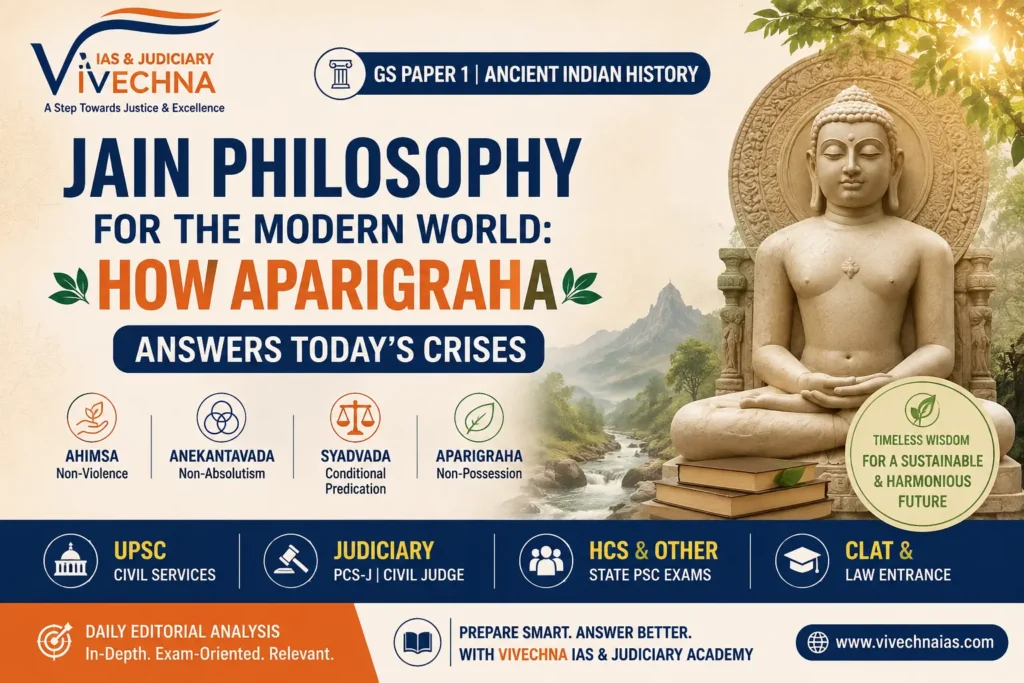
Daily Editorial Analysis | Updated 03 Aug 2026 | ~15 min read | By Vivechna IAS & Judiciary Academy
🪷 Jain Philosophy for the Modern World: How Aparigraha Answers Today's Crises
Long before "sustainability" and "minimalism" became buzzwords, one of India's oldest philosophical traditions had already worked out a rigorous ethical framework for restraint, non-violence, and coexistence. Jain philosophy — built on the twin pillars of Ahimsa (non-violence) and Aparigraha (non-possession) — offers a strikingly modern lens for examining ecological collapse, hyper-consumerism, political polarisation, and economic exploitation.
This article by Vivechna IAS & Judiciary Academy breaks down the core tenets of Jain philosophy, how their neglect fuels contemporary crises, and how their revival could inform policy — an important topic for UPSC GS Paper 1, Judiciary Services, HCS, and CLAT examinations covering Ancient Indian History and socio-cultural movements.
📖 What Is Jain Philosophy?
Jain Darshan is among the oldest indigenous philosophical traditions of India, centred on spiritual purity, self-control, and non-violence (Ahimsa) as the path to liberating the soul (Jiva) from the cycle of rebirth (Samsara). Unlike theistic traditions, Jainism is non-theistic — it does not posit a creator god, instead viewing the universe as eternal, uncreated, and governed by natural cosmic law.
Core Principles of Jain Philosophy
| 🔑 Principle | 📖 Meaning |
|---|---|
| Ahimsa (Non-Violence) | Non-injury to all living beings in thought, word, and deed — considered the highest moral duty (param dharma); underpins strict Jain vegetarianism |
| Anekantavada (Non-Absolutism) | Truth is multi-sided and perceived differently from different vantage points — illustrated by the parable of blind men describing an elephant |
| Syadvada (Conditioned Predication) | A logical extension of Anekantavada; every statement is conditionally true, qualified using "Syat" (in some respects) to avoid dogmatism |
| Aparigraha (Non-Possession) | Minimising attachment to material possessions and internal passions (greed, ego, anger) to free the soul from karmic bondage |
Jain Metaphysics: Jiva, Ajiva, and Karma
Jain ontology divides the universe into two eternal, independent categories: Jiva (the conscious, living soul, capable of infinite perception, knowledge, and bliss) and Ajiva (non-living substances — matter, space, time, motion, and rest). These interact through the mechanism of karma:
| ⚙️ Stage | 📖 Process |
|---|---|
| Asrava | Inflow of karmic particles into the soul, triggered by passions and actions |
| Bandha | Actual bonding of karmic matter to the soul, obscuring its natural purity |
| Samvara | Stoppage of new karmic inflow through disciplined self-control |
| Nirjara | Shedding of existing karma via ascetic practice, meditation, and repentance |
| Moksha | Final liberation — the soul reaches Siddhashila, existing in eternal, omnipotent bliss |
The Path to Liberation: Three Jewels and Five Great Vows
To attain Moksha, Jains follow the Three Jewels (Ratnatraya): Samyak Darshan (Right Faith), Samyak Jnana (Right Knowledge), and Samyak Charitra (Right Conduct). Right Conduct, in turn, is anchored by the Five Great Vows (Mahavratas):
- Ahimsa — non-violence in thought, word, and deed
- Satya — truthfulness
- Asteya — non-stealing
- Brahmacharya — chastity (fidelity for householders, celibacy for monastics)
- Aparigraha — non-attachment to material possessions
⚠️ How Neglecting Jain Principles Fuels Modern Problems
Our Mains answer-writing faculty at Vivechna IAS recommend linking each Jain concept to a specific contemporary crisis for high-scoring, example-driven answers.
1. Rejecting Anekantavada Fuels Polarisation
When groups treat their worldview as the sole absolute truth, compromise becomes impossible. Contemporary culture wars and hyper-partisan politics often collapse nuanced issues into binary "us versus them" battles — a direct consequence of ignoring the doctrine of many-sidedness.
2. Misreading Ahimsa Enables Ecological Degradation
Interpreting Ahimsa narrowly as avoiding harm only to humans — rather than extending reverence to entire ecosystems — enables utilitarian exploitation of nature. Large-scale deforestation and industrial river pollution reflect this narrowed, anthropocentric reading of non-violence.
3. Absence of Aparigraha Drives Hyper-Consumerism
Modern economies are built on endless growth — the direct opposite of Aparigraha. Jain epistemology links unchecked accumulation and hoarding directly to systemic violence and exploitation, visible today in industries like fast fashion, which depends on overconsumption and exploitative labour practices.
4. Absence of Syadvada Fuels Digital Echo Chambers
Social media algorithms reward outrage over nuance. Without Syadvada's insistence on conditional, context-aware truth, isolated clips get stripped of context and weaponised — a pattern behind much online disinformation and communal tension.
5. Anthropocentric Bias Neglects Interconnected Life
The Jain principle of Parasparopagraho Jivanam ("all life is bound by mutual support") is undermined when sentient beings are reduced to commodities. Intensive factory farming, for instance, not only causes animal suffering but is also a documented vector for zoonotic disease and greenhouse gas emissions.
6. Neglecting Kshama Sustains Conflict Cycles
Downplaying Kshama (supreme forgiveness) as a practical tool for conflict resolution entrenches generational grudges. Protracted geopolitical rivalries often remain deadlocked because state actors prioritise ego and retaliation over restorative dialogue.
7. Lack of Samyama Enables Structural Corruption
Abandoning Samyama (self-restraint) removes the internal moral check that prevents the powerful from exploiting systemic loopholes. Major corporate financial scandals frequently trace back to unchecked ambition overriding ethical restraint.
🌱 Applying Jain Philosophy to Solve Modern Problems
Beyond diagnosis, Jain philosophy offers constructive policy directions — valuable value-added points for Mains answer enrichment:
- Aparigraha-Driven Circular Economics: Move beyond GDP as the sole success metric; use progressive taxation on hoarding and luxury over-consumption to incentivise circular, durable manufacturing.
- Anekantavada-Based Deliberative Democracy: Institutionalise dissenting and minority perspectives through independent Multi-Perspective Consensus Panels reviewing high-stakes legislation.
- Ahimsa in Public Health Policy: Shift agricultural subsidies from intensive factory farming toward regenerative plant agriculture, with plant-forward guidelines in public institutions.
- Institutionalised Kshama in Diplomacy: Build "Truth, Reconciliation, and Restorative Justice" frameworks within international bodies to address historical grievances beyond punitive sanctions.
- Syadvada-Inspired Algorithm Regulation: Mandate "contextual metadata tags" on viral content before algorithmic amplification, curbing the virality of unverified, polarising material.
- Samyama in Governance: Encourage self-restraint as an ethical compass for those in power, reducing institutional corruption and abuse of authority.
- Wealth as Public Trust: Treat wealth circulation, not accumulation, as the ethical norm — echoing how historical Jain merchant communities prioritised trade stability and community welfare under successive political powers, including the Solankis, the Delhi Sultanate, and the Mughals.
- Core principles: Ahimsa, Anekantavada, Syadvada, Aparigraha
- Metaphysics: Jiva + Ajiva, connected via Asrava → Bandha → Samvara → Nirjara → Moksha
- Path to liberation: Ratnatraya (3 Jewels) + Mahavratas (5 Great Vows)
- Time cycle: Avasarpini (decline) and Utsarpini (ascent)
- Key modern application: Aparigraha as an antidote to hyper-consumerism and inequality
🎓 Exam Relevance for UPSC, Judiciary, HCS & CLAT Aspirants
- UPSC Prelims: Jainism is one of the most consistently tested topics in Ancient Indian History — covering core doctrines, sects (Digambara, Shvetambara, Sthanakvasi), and Jain texts. Core to our UPSC Foundation Course.
- UPSC Mains (GS Paper 1): Applied questions linking Jain ethics to contemporary governance, environment, and social reform themes.
- Judiciary & HCS Exams: Relevant to questions on personal laws, religious philosophy, and Indian cultural heritage, part of our Judiciary coaching programme.
- CLAT & Law Entrances: General knowledge and culture sections frequently test core Jain concepts and their historical context.
- Prelims 2026: Question on the four main forms of existence recognised in Jainism. (Answer: Yaksha/demi-gods is not included)
- Prelims 2023: Identifying the sect that believes souls exist in rocks, water, and natural objects, not just animal and plant life. (Answer: Jainism)
- Prelims 2022: Identifying Jaina texts among a list of ancient Indian texts. (Answer: Parishishtaparvan and Trishashtilakshana Mahapurana)
- Prelims 2018: The religious affiliation of the "Sthanakvasi" sect. (Answer: Jainism)
- Prelims 2017: Statement-based question on Sautrantika, Sammitiya, and Sarvastivadin sects. (Answer: Only statement 2 is correct)
- Prelims 2012: Common features between Buddhism and Jainism. (Answer: Indifference to Vedic authority and denial of ritual efficacy)
- Prelims 2009: Identifying which tradition Anekantavada belongs to. (Answer: Jainism)
- Mains 2022: Analyse the salience of 'sect' in Indian society vis-à-vis caste, region, and religion.
✍️ Practice Question (Vivechna IAS Mains Booster)
⚠️ Common Mistakes Aspirants Make
- Confusing Anekantavada (the philosophical doctrine of many-sidedness) with Syadvada (its logical/linguistic expression) — they are related but distinct concepts.
- Treating Jainism as theistic; it is explicitly non-theistic, viewing the universe as eternal and uncreated.
- Mixing up the Five Great Vows (Mahavratas, for ascetics) with the lighter version observed by householders (Anuvratas) — a frequent Prelims trap.
- Overlooking Jainism's applied, contemporary relevance in Mains answers — sticking only to definitions instead of linking concepts to modern issues like consumerism or polarisation.
🧾 Key Takeaways
- Jain philosophy is built on Ahimsa, Anekantavada, Syadvada, and Aparigraha — a non-theistic worldview rooted in self-restraint and interconnectedness.
- Its metaphysics divides existence into Jiva and Ajiva, linked through the karmic cycle of Asrava, Bandha, Samvara, Nirjara, and Moksha.
- The path to liberation follows the Three Jewels and Five Great Vows.
- Modern relevance: Aparigraha offers an ethical counter to hyper-consumerism; Anekantavada and Syadvada counter polarisation and digital echo chambers.
- This is one of the highest-yield Ancient Indian History topics for UPSC Prelims, tested almost every year.
❓ Frequently Asked Questions (FAQs)
📖 Prepare Smarter with Vivechna IAS & Judiciary Academy
Get daily editorial analysis, structured Ancient Indian History notes, and Mains answer-writing practice tailored for UPSC, Judiciary, HCS, and CLAT aspirants.
Visit Vivechna IAS & Judiciary Academy | Explore Daily Current Affairs | Join Our Test Series
🏁 Conclusion
Far from being merely an ancient ascetic tradition, Jain philosophy offers a remarkably practical toolkit for addressing today's most pressing crises — from ecological collapse and hyper-consumerism to political polarisation and structural corruption. Its emphasis on non-absolutism, non-violence, and non-possession challenges modern institutions to rethink growth, governance, and conflict resolution through the lens of restraint and interdependence. For aspirants, mastering this topic means going beyond rote definitions to understanding how Ahimsa, Anekantavada, Syadvada, and Aparigraha can be applied to real contemporary policy questions — precisely the analytical depth that UPSC, Judiciary, HCS, and CLAT examiners reward.
— Curated and edited by the faculty team at Vivechna IAS & Judiciary Academy, vivechnaias.com. For more daily editorials, quizzes, and Mains answer-writing practice, explore our Current Affairs section.