🌊 Centre Relaxes Construction Rules Along Ganga Floodplains | UPSC Environment Notes
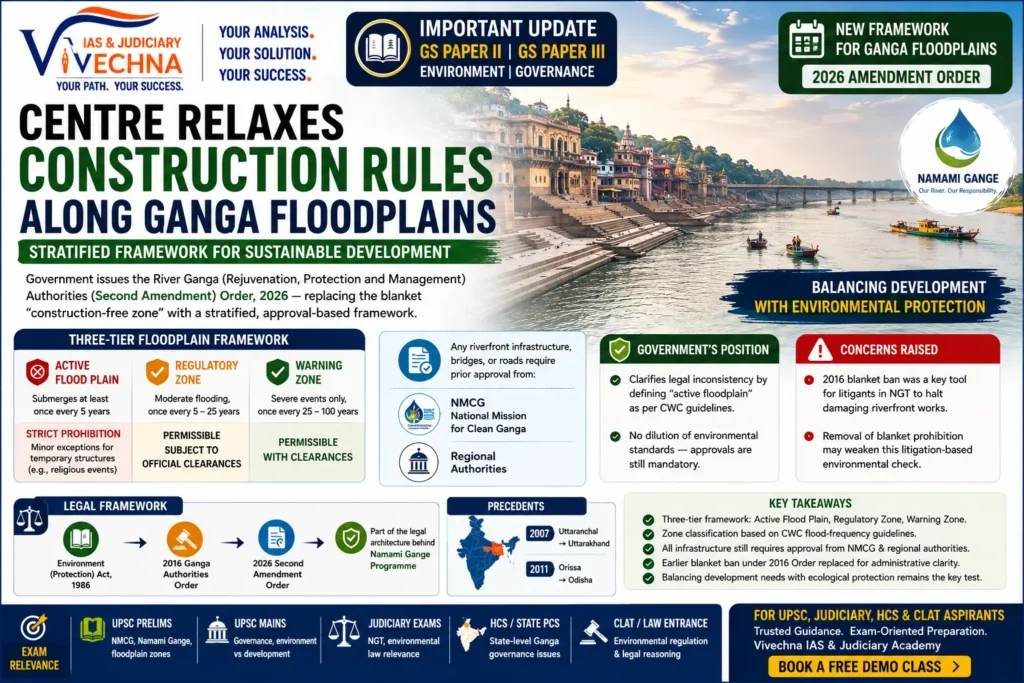
The Government has issued the River Ganga (Rejuvenation, Protection and Management) Authorities (Second Amendment) Order, 2026, replacing the earlier blanket "construction-free zone" with a stratified, approval-based framework for building along the Ganga's floodplains. At Vivechna IAS & Judiciary Academy, we break down this environmental-governance update and the concerns it raises.
📋 What Has Changed?
| Zone | Flood Frequency | Construction Rule |
|---|---|---|
| Active Flood Plain | Submerges at least once every 5 years | Strict prohibition, minor exceptions for temporary structures (e.g., religious events). |
| Regulatory Zone | Moderate flooding, once every 5–25 years | Permissible subject to official clearances. |
| Warning Zone | Severe events only, once every 25–100 years | Permissible with clearances. |
The stratification follows Central Water Commission (CWC) guidelines. Any riverfront infrastructure, bridges, or roads still require prior approval from the National Mission for Clean Ganga (NMCG) and regional authorities.
📌 Why This Matters
The amendment sits under the Environment (Protection) Act, 1986, forming part of the legal architecture behind the Namami Gange Programme — a recurring GS Paper III river-conservation theme covered at Vivechna IAS's UPSC Civil Services programme.
⚠️ Administrative Clarity vs. Environmental Concerns
✅ Government's Position
- Simply fixes a legal inconsistency by clearly defining "active floodplain," left undefined in 2016.
- Asserts there is no dilution of environmental standards — approvals are still required.
⚠️ Concerns Raised
- The 2016 blanket ban was routinely used by litigants in the National Green Tribunal (NGT) to halt potentially damaging riverfront works.
- Removing the blanket prohibition could weaken this litigation-based check, raising ecological-degradation risks.
✅ Exam Tip
Remember the legal chain: Environment (Protection) Act, 1986 → 2016 Ganga Authorities Order → 2026 Second Amendment Order — all feeding into the Namami Gange Programme's legal framework.
🎯 Key Takeaways
- The 2026 Order replaces the blanket construction-free zone with a 3-tier stratified framework: Active Flood Plain, Regulatory Zone, Warning Zone.
- Stratification follows Central Water Commission (CWC) flood-frequency guidelines.
- All development still needs approval from the NMCG and regional authorities.
- Critics note the earlier blanket ban was a key tool for NGT litigation against riverfront works.
📚 Exam Relevance for UPSC, Judiciary, HCS & CLAT Aspirants
| Exam | Relevance |
|---|---|
| UPSC Prelims | NMCG, Namami Gange legal framework, floodplain zone classifications. |
| UPSC Mains (GS-II/III) | River conservation governance and environment-vs-development trade-offs. |
| Judiciary Exams | NGT jurisdiction and environmental-law litigation relevance. |
| HCS / State PCS | State-specific Ganga-basin governance issues. |
| CLAT / Law Entrance | Current-affairs MCQs on environmental regulation changes. |
📍 CLAT Preparation 2027 — For Aspirants in Gurugram & Delhi NCR
Environmental-law updates like this are common CLAT current-affairs material. If you're looking for CLAT coaching in Gurugram or the best CLAT institute in Gurgaon, Vivechna IAS & Judiciary Academy's CLAT preparation 2027 batches track such regulatory changes closely. This is why CLAT aspirants in Sector 14 Gurugram choose Vivechna IAS — with CLAT coaching near HUDA City Centre and best law entrance coaching near MG Road Gurugram, backed by CLAT study material and a full CLAT mock test series, plus CLAT coaching in Delhi and Judiciary coaching in Gurugram.
🖊️ Practice Question (For Self-Assessment)
Consider the following statements regarding the River Ganga floodplain construction rules:
- The 2026 Amendment Order completely bans all construction along the Ganga floodplains.
- The floodplain zones are classified based on Central Water Commission flood-frequency guidelines.
- Approval from the National Mission for Clean Ganga is still required for riverfront infrastructure.
Which of the statements given above is/are correct?
(a) 2 and 3 only (b) 1 and 2 only (c) 1 and 3 only (d) 1, 2 and 3
Answer: (a) — The 2026 Order replaces the blanket ban with a stratified, approval-based system, not a complete ban; Statement 1 is incorrect.
❓ Frequently Asked Questions (FAQs)
What does the 2026 Ganga floodplain amendment change?
Which body must approve riverfront construction along the Ganga?
Why are environmentalists concerned about this amendment?
Which is the best CLAT coaching in Gurugram?
Does Vivechna IAS provide CLAT mock tests?
🏁 Conclusion
The stratified floodplain framework aims to balance administrative clarity with continued environmental safeguards — though its real-world impact will depend on how rigorously the approval process is enforced. For UPSC, Judiciary, HCS, and CLAT aspirants, this is a sharp example of environment-vs-development trade-offs — a theme Vivechna IAS & Judiciary Academy covers extensively in its GS Paper III current-affairs sessions.
Preparing for UPSC, Judiciary, HCS or CLAT 2027 in Gurugram or Delhi NCR?
Join Vivechna IAS & Judiciary Academy's daily current-affairs sessions and CLAT mock test series — trusted by aspirants across Sector 14 Gurugram, HUDA City Centre, MG Road, and Delhi NCR.
Book a Free Demo Class →