☀️ PM-KUSUM: Solar Irrigation and the Groundwater Dilemma | UPSC GS-II/III Notes
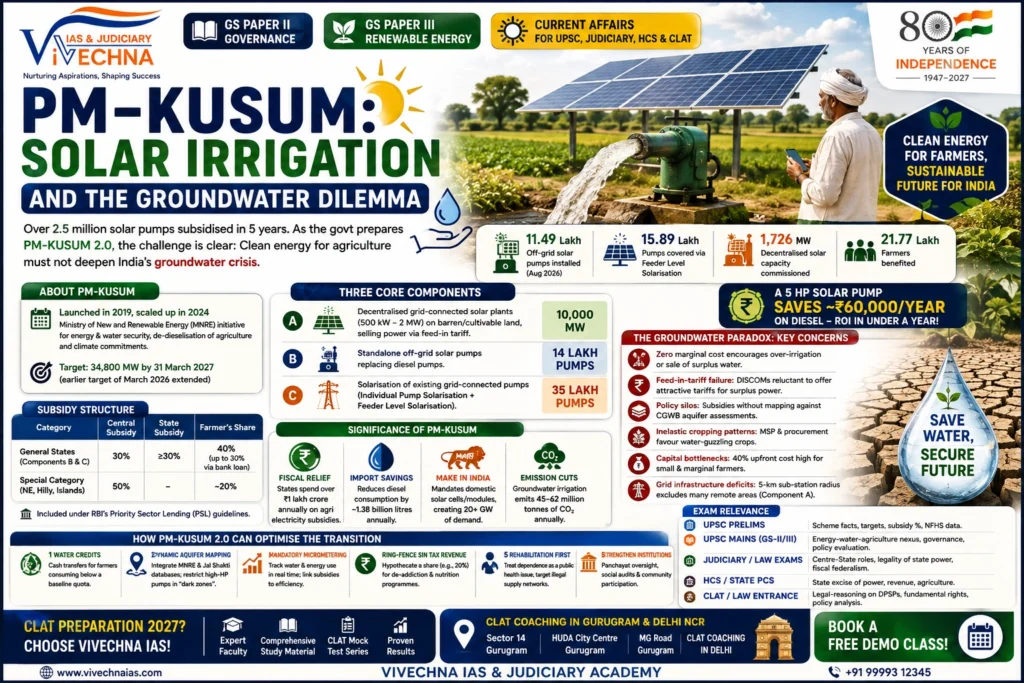
Over the past five years, PM-KUSUM — India's flagship agricultural solar programme — has subsidised over 2.5 million solar pumps. As the government prepares PM-KUSUM 2.0, a central question has emerged: can India's clean-energy transition in agriculture avoid worsening groundwater over-exploitation, given that solar power provides near-free energy to pump water? At Vivechna IAS & Judiciary Academy, we break down this GS Paper II/III crossover topic — a strong example of the energy-water-agriculture nexus.
📌 Why This Topic Matters
PM-KUSUM tests a rare policy paradox: a clean-energy success story that risks becoming an environmental liability. For aspirants at Vivechna IAS's UPSC Civil Services programme, this topic rewards nuanced analysis over uncritical praise of renewable-energy schemes.
📋 About PM-KUSUM
Launched in 2019 and scaled up in 2024, PM-KUSUM is a Ministry of New and Renewable Energy (MNRE) initiative aimed at energy/water security for farmers, de-dieselising agriculture, and supporting India's Paris Agreement commitments. The original target of 34,800 MW by March 2026 has been extended to 31 March 2027.
Three Core Components
| Component | Focus | Target |
|---|---|---|
| Component A | Decentralised grid-connected solar plants (500 kW–2 MW) on barren/cultivable land, selling power via feed-in tariff. | 10,000 MW |
| Component B | Standalone off-grid solar pumps replacing diesel pumps. | 14 lakh pumps |
| Component C | Solarisation of existing grid-connected pumps (Individual Pump Solarisation + Feeder Level Solarisation). | 35 lakh pumps |
✅ Exam Tip
A farmer using a 5 HP standalone solar pump (Component B) saves roughly ₹60,000/year on diesel — achieving return on investment in under a year. This concrete figure is a favourite Prelims-style fact.
💰 Subsidy Structure
| Category | Central Subsidy | State Subsidy | Farmer's Share |
|---|---|---|---|
| General States (Components B & C) | 30% | ≥30% | 40% (up to 30% via bank loan) |
| Special Category (NE, Hilly, Islands) | 50% | — | ~20% |
The scheme has also been included under RBI's Priority Sector Lending (PSL) guidelines to ease credit access.
🌟 Significance of PM-KUSUM
💵 Fiscal Relief
States spend over ₹1 lakh crore annually on agricultural electricity subsidies — PM-KUSUM cuts this outflow and aids DISCOM revival.
🛢️ Import Savings
Reduces diesel consumption by an estimated 1.38 billion litres annually.
🏭 Make in India
Mandates domestic solar cells/modules, creating 20+ GW of guaranteed demand.
🌍 Emission Cuts
Groundwater irrigation emits 45–62 million tonnes of CO₂ annually; solar pumps offer major mitigation potential.
⚠️ The Groundwater Paradox: Key Concerns
⚠️ Important Point — The "Zero Marginal Cost" Problem
Since pumping an extra litre of water costs the farmer nothing once a solar pump is installed, farmers are incentivised to over-irrigate or sell surplus water — severely threatening already-stressed aquifers in North-Western and Southern India.
- Feed-in-tariff failure: Financially distressed DISCOMs are reluctant to offer attractive tariffs for surplus power, nullifying the conservation incentive under Component C.
- Hydrological-energy policy silos: Subsidies are often distributed without mapping against Central Ground Water Board (CGWB) aquifer assessments.
- Inelastic cropping patterns: MSP and procurement policies favour water-guzzling crops (paddy, sugarcane) even in semi-arid regions.
- Capital bottlenecks: The mandatory 40% upfront contribution remains prohibitive for small/marginal farmers, skewing adoption toward wealthier landholders.
- Grid infrastructure deficits: Component A's 5-km sub-station radius requirement excludes many remote rural areas.
🛤️ How PM-KUSUM 2.0 Can Optimise the Transition
- Behavioural nudges — water credits: Direct cash transfers for farmers consuming below a baseline quota, modelled on Punjab's 'Pani Bachao, Paisa Kamao' initiative.
- Dynamic aquifer mapping: Integrate MNRE and Jal Shakti databases; restrict high-HP pumps in "dark zones."
- Mandatory micro-irrigation coupling: Link Component B deployment to drip/sprinkler adoption under Per Drop More Crop.
- Agro-climatic realignment: Shift MSP incentives from paddy/sugarcane toward millets, pulses, and oilseeds.
- Community ownership: Scale deployment via Water-User Associations and FPOs in fragmented/irrigation-deprived areas.
✅ Exam Tip
For Mains, frame PM-KUSUM answers as: Objectives → Three Components → Significance → The Groundwater Paradox → Region-Specific Way Forward. Emphasise that Eastern India (water-abundant) needs standalone pumps, while Punjab/Haryana (water-stressed) need grid-integration-only approaches — this regional nuance impresses examiners.
🎯 Key Takeaways
- PM-KUSUM has 3 components: decentralised plants (A), standalone pumps (B), and grid-connected solarisation (C).
- Deadline extended to 31 March 2027; target remains 34,800 MW.
- Near-zero marginal pumping cost creates a perverse incentive for over-irrigation, threatening stressed aquifers.
- Maharashtra set a Guinness World Record installing 49,500 solar pumps in one month.
- Way forward: dynamic aquifer mapping, water-saving credits, and mandatory micro-irrigation coupling.
📚 Exam Relevance for UPSC, Judiciary, HCS & CLAT Aspirants
| Exam | Relevance |
|---|---|
| UPSC Prelims | PM-KUSUM components, subsidy structure, and key statistics. |
| UPSC Mains (GS-II/III) | Renewable-energy policy, water-energy-agriculture nexus, and DISCOM finances. |
| Judiciary Exams | General awareness on renewable-energy governance frameworks. |
| HCS / State PCS | State-level implementation and groundwater regulation. |
| CLAT / Law Entrance | Current-affairs MCQs on renewable-energy schemes. |
📍 CLAT Preparation 2027 — For Aspirants in Gurugram & Delhi NCR
Energy and environment policy is a growing CLAT current-affairs theme. If you're looking for CLAT coaching in Gurugram or the best CLAT institute in Gurgaon, Vivechna IAS & Judiciary Academy's CLAT preparation 2027 batches cover such schemes in depth. This is why CLAT aspirants in Sector 14 Gurugram choose Vivechna IAS — with CLAT coaching near HUDA City Centre and best law entrance coaching near MG Road Gurugram, backed by CLAT study material and a full CLAT mock test series, plus CLAT coaching in Delhi and Judiciary coaching in Gurugram.
Explore Vivechna IAS's UPSC Civil Services courses and the CLAT & Law Entrance programme for structured coverage of Environment and Renewable Energy Policy topics like this one.
📝 Previous Year Questions (PYQs)
Consider the following statements about 'PM Surya Ghar Muft Bijli Yojana':
- It targets installation of one crore solar rooftop panels in the residential sector.
- The Ministry of New and Renewable Energy aims to impart training on installation, operation, maintenance and repairs of solar rooftop systems at grassroot levels.
- It aims to create more than three lakh skilled manpower through fresh skilling and upskilling, under scheme component of capacity building.
(a) I and II only (b) I and III only (c) II and III only (d) I, II and III
Answer: (d)
Consider the following statements:
- The International Solar Alliance was launched at the United Nations Climate Change Conference in 2015.
- The Alliance includes all the member countries of the United Nations.
(a) 1 only (b) 2 only (c) Both 1 and 2 (d) Neither 1 nor 2
Answer: (a)
India has immense potential of solar energy though there are regional variations in its developments. Elaborate.
🖊️ Practice Question (New — For Self-Assessment)
Consider the following statements regarding PM-KUSUM:
- Component A targets decentralised grid-connected solar plants of 500 kW to 2 MW.
- Component B involves solarising existing grid-connected agricultural pumps.
- The scheme has been included under RBI's Priority Sector Lending guidelines.
Which of the statements given above is/are correct?
(a) 1 and 3 only (b) 1 and 2 only (c) 2 and 3 only (d) 1, 2 and 3
Answer: (a) — Component C, not B, handles solarisation of existing grid-connected pumps; Component B covers standalone off-grid pumps; Statement 2 is incorrect.
🚫 Common Mistakes Aspirants Make on This Topic
- Confusing Components B and C — B is standalone off-grid pumps; C is solarisation of existing grid-connected pumps.
- Treating PM-KUSUM as an unqualified success — the groundwater over-extraction risk is a central, examiner-tested concern.
- Ignoring the MSP linkage — water-guzzling crop incentives undermine the water-saving potential of solar irrigation.
- Writing purely descriptive answers — strong Mains answers must analyse the energy-water-agriculture nexus, not just list scheme features.
❓ Frequently Asked Questions (FAQs)
What is the primary objective of PM-KUSUM?
What are the three components of PM-KUSUM?
How can PM-KUSUM contribute to groundwater depletion?
Which is the best CLAT coaching in Gurugram?
Does Vivechna IAS provide CLAT mock tests?
🏁 Conclusion
PM-KUSUM demonstrates both the promise and the peril of well-intentioned clean-energy policy — genuine gains in farmer income and emission reduction, shadowed by a real risk of accelerating groundwater depletion. PM-KUSUM 2.0's success will depend on integrating energy policy with hydrological science and agricultural reform, not treating solarisation as a standalone win. For UPSC, Judiciary, HCS, and CLAT aspirants, this topic is an excellent test of policy-analysis maturity — precisely what Vivechna IAS & Judiciary Academy builds into its Environment and Governance curriculum.
Preparing for UPSC, Judiciary, HCS or CLAT 2027 in Gurugram or Delhi NCR?
Join Vivechna IAS & Judiciary Academy's expert-led Environment & Economy modules and CLAT mock test series — trusted by aspirants across Sector 14 Gurugram, HUDA City Centre, MG Road, and Delhi NCR.
Book a Free Demo Class →