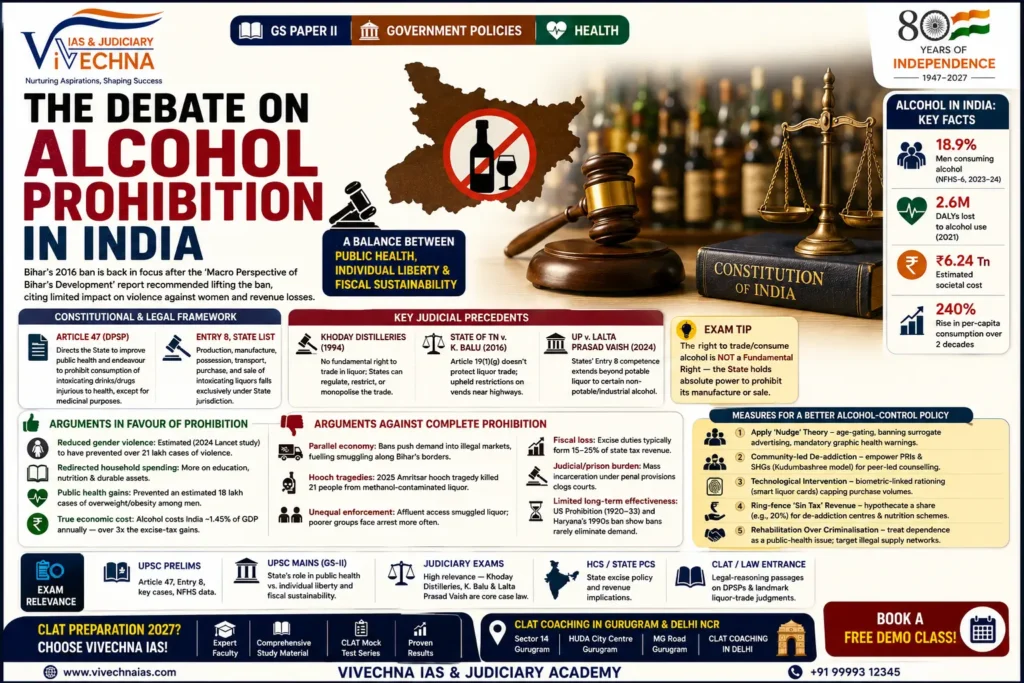
🍶 The Debate on Alcohol Prohibition in India | UPSC GS-II Notes
Bihar's 2016 alcohol prohibition is back in the spotlight after the 'Macro Perspective of Bihar's Development' report, presented at the India Policy Forum 2026, recommended lifting the ban — citing limited impact on violence against women and significant revenue losses. This reignites a classic GS Paper II debate: State power under Article 47, individual liberty, and fiscal sustainability. At Vivechna IAS & Judiciary Academy, we break down the constitutional basis, arguments on both sides, and the policy alternatives.
📌 Why This Topic Matters
Alcohol prohibition tests a rare combination of constitutional law (DPSPs, State List entries), public health policy, and fiscal federalism — a genuinely multidimensional Mains topic. Aspirants at Vivechna IAS's UPSC Civil Services programme should master both the legal framework and the Bihar case study for a complete answer.
⚖️ Constitutional and Legal Framework
| Provision | What It Says |
|---|---|
| Article 47 (DPSP) | Directs the State to improve public health and endeavour to prohibit consumption of intoxicating drinks/drugs injurious to health, except for medicinal purposes. |
| Entry 8, State List | Production, manufacture, possession, transport, purchase, and sale of intoxicating liquors falls exclusively under State jurisdiction. |
Key Judicial Precedents
Khoday Distilleries (1994)
No fundamental right to trade in liquor; States can regulate, restrict, or monopolise the trade.
State of TN v. K. Balu (2016)
Article 19(1)(g) doesn't protect liquor trade; upheld restrictions on vends near highways.
UP v. Lalta Prasad Vaish (2024)
States' Entry 8 competence extends beyond potable liquor to certain non-potable/industrial alcohol.
✅ Exam Tip
Remember: the right to trade/consume alcohol is not a Fundamental Right — the State holds an absolute right to fully prohibit its manufacture or sale, a settled position since Khoday Distilleries (1994).
📊 Alcohol Consumption in India: Key Data
⚖️ Arguments For and Against Prohibition
✅ Arguments in Favour
- Reduced gender violence: Bihar's ban is estimated (2024 Lancet study) to have prevented over 21 lakh cases of violence.
- Redirected household spending: Discretionary income shifts toward education, nutrition, and durable assets.
- Public health gains: Bihar's ban prevented an estimated 18 lakh cases of overweight/obesity among men.
- True economic cost: Alcohol costs India ~1.45% of GDP annually — over 3x the excise-tax gains.
⚠️ Arguments Against Complete Prohibition
- Parallel economy: Bans push demand into illegal markets, fuelling smuggling along Bihar's borders.
- Hooch tragedies: 2025's Amritsar hooch tragedy killed 21 people from methanol-contaminated liquor.
- Unequal enforcement: Affluent consumers access smuggled liquor; poorer groups face arrest more often.
- Fiscal loss: Excise duties typically form 15–25% of state tax revenue.
- Judicial/prison burden: Mass incarceration under penal provisions clogs courts.
- Limited long-term effectiveness: US Prohibition (1920–33) and Haryana's 1990s ban both show bans rarely eliminate demand.
⚠️ Important Point — Reading the NCRB Data Carefully
The report's reliance on NCRB crime data is debatable — rising reported crimes may reflect improved reporting, not an actual rise in violence. Notably, rape cases declined or stayed stable after Bihar's ban, suggesting policy impact should be judged using causally relevant indicators, not aggregate crime figures.
🛤️ Measures for More Effective Alcohol-Control Policy
- Apply 'Nudge' theory — age-gating, banning surrogate advertising, mandatory graphic health warnings.
- Community-led de-addiction — empower Panchayati Raj Institutions and SHGs (Kudumbashree model) for peer-led counselling.
- Technological intervention — biometric-linked rationing (smart liquor cards) capping purchase volumes.
- Ring-fence "sin tax" revenue — statutorily hypothecate a share (e.g., 20%) for de-addiction centres and nutrition schemes.
- Prioritise rehabilitation over criminalisation — treat dependence as a public-health issue while targeting illegal supply networks.
✅ Exam Tip
Structure Mains answers as: Constitutional Basis (Art. 47, Entry 8) → Case Study (Bihar) → Arguments For → Arguments Against → Regulation-not-Prohibition Way Forward. This balanced structure directly mirrors how examiners frame such "should the State ban X" questions.
🎯 Key Takeaways
- Alcohol regulation rests on Article 47 (DPSP) and Entry 8 of the State List.
- There is no Fundamental Right to trade in liquor — settled since Khoday Distilleries (1994).
- Bihar's ban is credited with preventing 21 lakh+ violence cases and 18 lakh obesity cases, per a 2024 Lancet study.
- Counter-concerns: hooch tragedies (21 deaths in Amritsar, 2025), 15–25% state revenue loss, and unequal enforcement.
- Way forward: regulation (nudge theory, ring-fenced sin tax, rehabilitation) rather than blanket prohibition.
📚 Exam Relevance for UPSC, Judiciary, HCS & CLAT Aspirants
| Exam | Relevance |
|---|---|
| UPSC Prelims | Article 47, Entry 8, key case names, NFHS data. |
| UPSC Mains (GS-II) | State's role in public health vs. individual liberty and fiscal sustainability. |
| Judiciary Exams | High relevance — Khoday Distilleries, K. Balu, and Lalta Prasad Vaish are core constitutional-law case law. |
| HCS / State PCS | State excise policy and revenue implications. |
| CLAT / Law Entrance | Legal-reasoning passages on DPSPs and landmark liquor-trade judgments. |
📍 CLAT Preparation 2027 — For Aspirants in Gurugram & Delhi NCR
Case law on Fundamental Rights and DPSPs is core CLAT legal-reasoning material. If you're looking for CLAT coaching in Gurugram or the best CLAT institute in Gurgaon, Vivechna IAS & Judiciary Academy's CLAT preparation 2027 batches build exactly this constitutional-law depth. This is why CLAT aspirants in Sector 14 Gurugram choose Vivechna IAS — with CLAT coaching near HUDA City Centre and best law entrance coaching near MG Road Gurugram, backed by CLAT study material and a full CLAT mock test series, plus CLAT coaching in Delhi and Judiciary coaching in Gurugram.
Explore Vivechna IAS's UPSC Civil Services courses, Judiciary Exams coaching, and the CLAT & Law Entrance programme for structured coverage of Constitutional Law and Governance topics like this one.
🖊️ Practice Questions (New — For Self-Assessment)
Consider the following statements regarding alcohol regulation in India:
- Trade in liquor is protected as a Fundamental Right under Article 19(1)(g).
- Entry 8 of the State List gives States legislative authority over intoxicating liquors.
- Article 47 is a Directive Principle of State Policy directing prohibition of injurious intoxicants.
Which of the statements given above is/are correct?
(a) 2 and 3 only (b) 1 and 2 only (c) 1 and 3 only (d) 1, 2 and 3
Answer: (a) — The Supreme Court has held trade in liquor is NOT a Fundamental Right; Statement 1 is incorrect.
"Prohibition addresses the symptom of alcohol abuse but not its underlying socio-economic causes." Critically examine this statement with reference to Bihar's experience since 2016.
🚫 Common Mistakes Aspirants Make on This Topic
- Assuming liquor trade is a Fundamental Right — settled case law confirms it is not; States hold absolute regulatory power.
- Treating NCRB crime data as conclusive proof of a policy's impact — rising reported crime can reflect better reporting, not worse outcomes.
- Writing one-sided answers — both prohibition's public-health gains and its fiscal/enforcement costs must be weighed together.
- Confusing DPSP with a justiciable right — Article 47 is a directive principle guiding policy, not independently enforceable in court.
❓ Frequently Asked Questions (FAQs)
What does Article 47 say about alcohol prohibition?
Which constitutional provision gives States power over liquor?
Is there a Fundamental Right to trade in liquor?
What are the major challenges of complete alcohol prohibition?
Which is the best CLAT coaching in Gurugram?
Does Vivechna IAS provide CLAT mock tests?
🏁 Conclusion
The alcohol prohibition debate captures a genuinely difficult policy tension — public health gains against fiscal loss, black-market risk, and enforcement inequity. Rather than a binary "ban or don't ban" choice, the evidence points toward regulation: taxation, community-led de-addiction, and technology-based monitoring that address the harms without abandoning the fiscal capacity to fund welfare programmes. For UPSC, Judiciary, HCS, and CLAT aspirants, this is a model topic for balanced, evidence-based Mains writing — exactly what Vivechna IAS & Judiciary Academy trains students to deliver.
Preparing for UPSC, Judiciary, HCS or CLAT 2027 in Gurugram or Delhi NCR?
Join Vivechna IAS & Judiciary Academy's expert-led Polity & Governance modules and CLAT mock test series — trusted by aspirants across Sector 14 Gurugram, HUDA City Centre, MG Road, and Delhi NCR.
Book a Free Demo Class →