⚛️ India's 100 GW Nuclear Power Ambition by 2047 | UPSC Science & Technology Notes
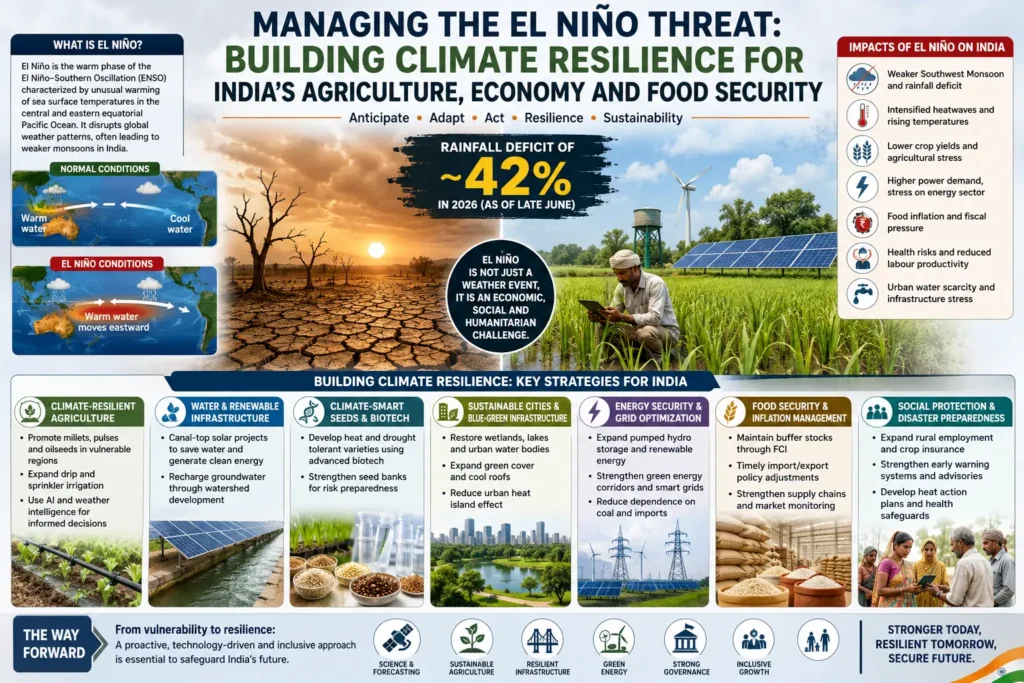
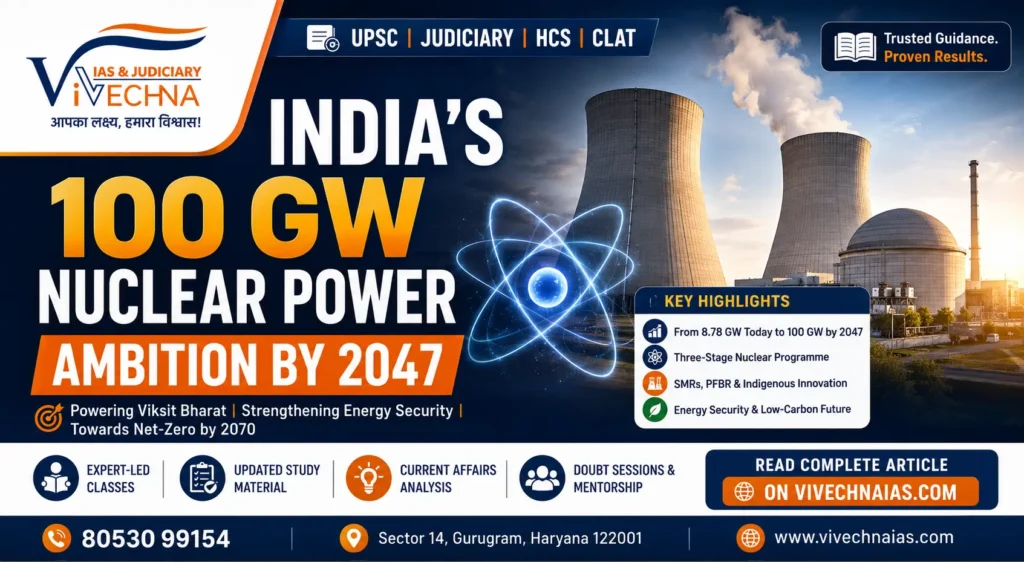
India aims to scale its nuclear power capacity from a modest 8.78 GW to 100 GW by 2047 — a target that could deliver round-the-clock, low-carbon electricity for Viksit Bharat while supporting India's 2070 net-zero commitment. Yet this ambition raises a critical strategic question: will fossil-fuel import dependence simply be replaced by dependence on imported uranium and foreign reactor technology? With the SHANTI Act, 2025, the PFBR's first criticality in April 2026, and mounting geopolitical supply risks, this is one of the richest GS Paper I/III crossover topics on the current syllabus. At Vivechna IAS & Judiciary Academy, we break down India's nuclear roadmap, the three-stage programme, and the real challenges standing between today's capacity and the 2047 target.
📌 Why This Topic Matters
Nuclear energy sits at the intersection of energy security, industrial policy, and climate commitments — a genuinely cross-cutting theme for GS Paper III. For aspirants at Vivechna IAS's UPSC Civil Services programme, mastering the three-stage nuclear programme and the 100 GW roadmap offers strong returns across both Prelims facts and Mains analytical questions.
📊 Present Status of Nuclear Power in India
The Roadmap to 100 GW
| Component | Envisaged Capacity |
|---|---|
| Present capacity | 8.78 GW |
| Expected capacity by 2031–32 | ~22 GW |
| Additional NPCIL capacity beyond 2032 (indigenous PHWRs & LWRs) | 32 GW |
| Additional Fast Breeder Reactors (two 500 MW units initially) | 1 GW |
| Capacity from other PSUs, private companies & JVs | ~45 GW |
| National target for 2047 | 100 GW |
📝 Quick Revision — Nuclear Energy Mission
Announced in the Union Budget 2025–26, the Nuclear Energy Mission includes: a 100 GW target by 2047; ₹20,000 crore for Small Modular Reactor (SMR) R&D; a target of 5 indigenously designed SMRs operational by 2033; development of the 200/220 MWe Bharat Small Modular Reactor and the 55 MWe SMR-55; and a high-temperature gas-cooled reactor for hydrogen production.
🎯 Why India Needs to Expand Nuclear Power
📈 Rising Electricity Demand
CEA projects peak demand rising from ~250 GW (2024–25) to 459 GW by 2035–36, driven by industrialisation, EVs, data centres, and green hydrogen.
🔋 Round-the-Clock Power
Despite 274 GW of renewable capacity (March 2026), non-fossil sources contributed only 29.2% of generation — nuclear fills the reliability gap solar/wind cannot.
⛏️ Reducing Coal Dependence
CEA projects ~315 GW of coal capacity may still be needed in 2035–36 even with major renewable expansion — nuclear can displace some of this.
🌍 Net-Zero by 2070
Nuclear's lifecycle emissions average just 5.5 gCO₂e/kWh — among the lowest of any generation source, across the full mining-to-decommissioning cycle.
🛡️ Energy Security
Uranium's high energy density means small physical volumes; fuel can be stockpiled for years, unlike petroleum or LNG.
💻 Powering Data Centres
AI, semiconductor fabs, and automated manufacturing need firm, uninterrupted power — SMRs could be sited near industrial clusters.
✅ Exam Tip
India's Pressurised Heavy Water Reactors (PHWRs) use natural uranium, not enriched uranium — a key distinction from imported Light Water Reactor (LWR) designs, and a frequently tested Prelims fact.
⚛️ India's Three-Stage Nuclear Power Programme
Designed by Homi J. Bhabha to overcome limited high-grade uranium availability and eventually harness India's large thorium reserves:
| Stage | Technology | Key Detail |
|---|---|---|
| Stage I | Pressurised Heavy Water Reactors (PHWRs) | Use natural uranium as fuel, heavy water as moderator/coolant; spent fuel yields Plutonium-239 via reprocessing. |
| Stage II | Fast Breeder Reactors (FBRs) | Convert fertile Uranium-238 into fissile Plutonium-239; India's 500 MWe PFBR (uranium-plutonium mixed oxide fuel) achieved first criticality on 6 April 2026. |
| Stage III | Thorium & Uranium-233 | Thorium-232 is fertile but not fissile — must absorb a neutron to form fissile Uranium-233; not an immediate uranium substitute, but the long-term fuel-autonomy pathway. |
⚠️ Important Point
The PFBR achieving first criticality in April 2026 is not the same as commercial operation. Low-power testing, turbine work, grid synchronisation, and power-ascension tests must still follow — a nuance frequently tested to catch overconfident answers.
⚖️ Nuclear vs. Crude Oil: India's Comparative Advantage
| Factor | Nuclear (Uranium) | Crude Oil |
|---|---|---|
| Quantity Required | Small physical volume (high energy density) | Very large continuous volumes needed |
| Storage | Several years' fuel storable relatively easily | Expensive, space-intensive storage |
| Cost Stability | Raw uranium is a small share of generation cost | Crude price swings directly affect final cost |
| Disruption Resilience | Existing inventories + refuelling cycles buy time | Supply disruptions quickly hit transport & prices |
⚠️ Major Challenges to the 100 GW Target
⚠️ Key Challenges
- Massive scale-up needed: Over 91 GW must be added in ~2 decades — several times India's historical build rate.
- Long project timelines: Site selection through commercial operation involves many sequential, time-consuming stages.
- Cost escalation: Kudankulam Units 3–4 costs rose ~73% above sanctioned amount; RAPP-7/8 rose ~86%. Total scale-up needs ~₹15 lakh crore.
- Uranium import dependence: A 100 GW conventional-reactor fleet could need 20,000+ tonnes of uranium annually, versus 1,884 tonnes for 7.94 GW in 2025.
- Limited domestic uranium production: Low-grade ore, high mining costs, and community/environmental opposition constrain expansion.
- Foreign reactor-technology dependence: Imported LWR designs need foreign tech/enriched uranium; Kudankulam has faced Russia-linked supply delays.
- Radioactive waste management: India lacks an operational permanent deep geological repository for high-level waste.
✅ Structural Advantages
- PHWRs run on natural uranium, reducing enrichment dependence for Stage I capacity.
- India has uranium-supply arrangements with Kazakhstan, Canada, Uzbekistan, Russia, and Australia.
- Fleet-mode 700 MWe PHWR construction can generate assured demand for domestic manufacturers (L&T, BHEL, Bharat Forge).
- Existing non-power applications (medical isotopes, food irradiation) already demonstrate mature nuclear-technology capability.
🛤️ Strengthening India's Nuclear Ecosystem
- Prioritise fleet-mode PHWR construction — standardised 700 MWe designs shorten build time and strengthen domestic vendors.
- Ring-fence the breeder and thorium programme — protect long-term R&D funding from being diverted to near-term targets.
- Establish an independent nuclear safety regulator — with dedicated budget, whistleblower protection, and mandatory safety disclosures.
- Develop sustainable financing — sovereign green bonds, blended finance, regulated asset-base models, and milestone-linked funding.
- Create a national radioactive-waste strategy — covering interim storage, reprocessing, and long-term repositories.
- Strengthen local participation — transparent disclosure on radiation baselines, emergency plans, and compensation.
- Build a skilled nuclear workforce — coordinated DAE-IIT-industry training for engineers, welders, and regulatory inspectors.
- Integrate with a diversified energy strategy — nuclear should complement, not replace, solar, wind, storage, and green hydrogen investment.
✅ Exam Tip
For Mains, frame nuclear energy answers as: Why Expand → Three-Stage Programme → Advantages over Fossil Imports → Challenges (financial/technological/fuel security) → Way Forward. This captures nearly every dimension examiners test on this topic.
🎯 Key Takeaways
- India targets 100 GW nuclear capacity by 2047, up from 8.78 GW today (24 reactors, 3.1% of generation).
- The Nuclear Energy Mission (Budget 2025–26) allocates ₹20,000 crore for SMRs, targeting 5 operational indigenous SMRs by 2033.
- India's three-stage programme (Bhabha's design) moves from natural-uranium PHWRs → Fast Breeder Reactors → Thorium-based Uranium-233 reactors.
- The 500 MWe PFBR at Kalpakkam achieved first criticality on 6 April 2026 — a Stage II milestone, not yet commercial operation.
- Major challenges: cost escalation (~₹15 lakh crore needed), uranium import dependence, and the absence of a permanent waste repository.
📚 Exam Relevance for UPSC, Judiciary, HCS & CLAT Aspirants
| Exam | Relevance |
|---|---|
| UPSC Prelims | Three-stage programme, SHANTI Act, PFBR, SMR facts, IAEA safeguards distinctions. |
| UPSC Mains (GS-I/III) | Energy security, net-zero strategy, and industrial-policy linkages. |
| Judiciary Exams | General awareness on energy legislation like the SHANTI Act, 2025. |
| HCS / State PCS | State-level nuclear/energy infrastructure current affairs. |
| CLAT / Law Entrance | Current-affairs MCQs on energy policy and regulatory frameworks. |
📍 CLAT Preparation 2027 — For Aspirants in Gurugram & Delhi NCR
Energy-policy current affairs like India's nuclear roadmap are regular CLAT GK material. If you're looking for CLAT coaching in Gurugram or the best CLAT institute in Gurgaon, Vivechna IAS & Judiciary Academy's CLAT preparation 2027 batches cover exactly this kind of science-and-policy current affairs. This is why CLAT aspirants in Sector 14 Gurugram choose Vivechna IAS — with CLAT coaching near HUDA City Centre and best law entrance coaching near MG Road Gurugram, backed by structured CLAT study material and a full CLAT mock test series, plus CLAT coaching in Delhi and Judiciary coaching in Gurugram for aspirants preparing across multiple exams.
Explore Vivechna IAS's UPSC Civil Services courses, Judiciary Exams coaching, and the CLAT & Law Entrance programme for structured coverage of Science & Technology and Energy Policy topics like this one.
📝 Previous Year Questions (PYQs)
In India, why are some nuclear reactors kept under "IAEA safeguards" while others are not?
(a) Some use uranium and others use thorium (b) Some use imported uranium and others use domestic supplies (c) Some are operated by foreign enterprises and others are operated by domestic enterprises (d) Some are State-owned and others are privately owned
Answer: (b)
Consider the following statements:
- The Nuclear Security Summits are periodically held under the aegis of the United Nations.
- The International Panel on Fissile Materials is an organ of the International Atomic Energy Agency.
(a) 1 only (b) 2 only (c) Both 1 and 2 (d) Neither 1 nor 2
Answer: (d)
With growing energy needs should India keep on expanding its nuclear energy programme? Discuss the facts and fears associated with nuclear energy.
Give an account of the growth and development of nuclear science and technology in India. What is the advantage of the fast breeder reactor programme in India?
🖊️ Practice Questions (New — For Self-Assessment)
Consider the following statements regarding India's nuclear power programme:
- India's Pressurised Heavy Water Reactors use enriched uranium as their principal fuel.
- The Prototype Fast Breeder Reactor achieved first criticality in April 2026.
- Thorium-232 is directly fissile and can be used in conventional reactors without transformation.
Which of the statements given above is/are correct?
(a) 2 only (b) 1 and 2 only (c) 2 and 3 only (d) 1, 2 and 3
Answer: (a) — PHWRs use natural, not enriched, uranium (Statement 1 wrong); thorium is fertile, not fissile, and must first transform into Uranium-233 (Statement 3 wrong).
"India's 100 GW nuclear target by 2047 risks substituting fossil-fuel import dependence with uranium import dependence." Critically examine this statement and suggest measures to strengthen fuel-supply security.
🚫 Common Mistakes Aspirants Make on This Topic
- Confusing "first criticality" with "commercial operation" — the PFBR's April 2026 milestone still requires further testing before generating commercial power.
- Assuming thorium is an immediate uranium substitute — thorium-232 is fertile, not fissile, and requires conversion to Uranium-233 first.
- Believing PHWRs need enriched uranium — India's PHWRs specifically use natural uranium, reducing enrichment dependence.
- Treating the three stages as sequential replacements — Stage I, II, and III are designed to build on each other's spent fuel/byproducts, not replace one another outright.
- Writing one-sided Mains answers — balance nuclear's energy-security benefits against genuine cost-escalation and waste-management challenges.
❓ Frequently Asked Questions (FAQs)
What is India's national nuclear capacity target for 2047?
What is the significance of the 500 MWe Prototype Fast Breeder Reactor (PFBR)?
How do Small Modular Reactors (SMRs) fit into India's nuclear roadmap?
Why is India's three-stage nuclear programme significant?
Is this topic relevant for Judiciary and HCS exam preparation?
Which is the best CLAT coaching in Gurugram?
How to prepare for CLAT 2027 in Gurugram?
Does Vivechna IAS provide CLAT mock tests?
What are the benefits of weekend CLAT batches?
🏁 Conclusion
India's 100 GW nuclear ambition is a bold, necessary bet on firm, low-carbon power — but as this editorial makes clear, gigawatt targets alone won't guarantee true energy security. Diversified uranium sourcing, a closed fuel cycle, credible waste management, and disciplined financing will determine whether India achieves genuine self-reliance or simply trades one import dependency for another. For UPSC, Judiciary, HCS, and CLAT aspirants, this topic rewards balanced, structured analysis — precisely the depth Vivechna IAS & Judiciary Academy builds into its Science & Technology and current-affairs curriculum.
Preparing for UPSC, Judiciary, HCS or CLAT 2027 in Gurugram or Delhi NCR?
Join Vivechna IAS & Judiciary Academy's expert-led Science & Technology modules, daily current-affairs analysis, and CLAT mock test series — trusted by aspirants across Sector 14 Gurugram, HUDA City Centre, MG Road, and Delhi NCR.
Book a Free Demo Class →