🌑 Total Solar Eclipse 2026: Studying the Sun's Corona | UPSC Geophysical Phenomena Notes
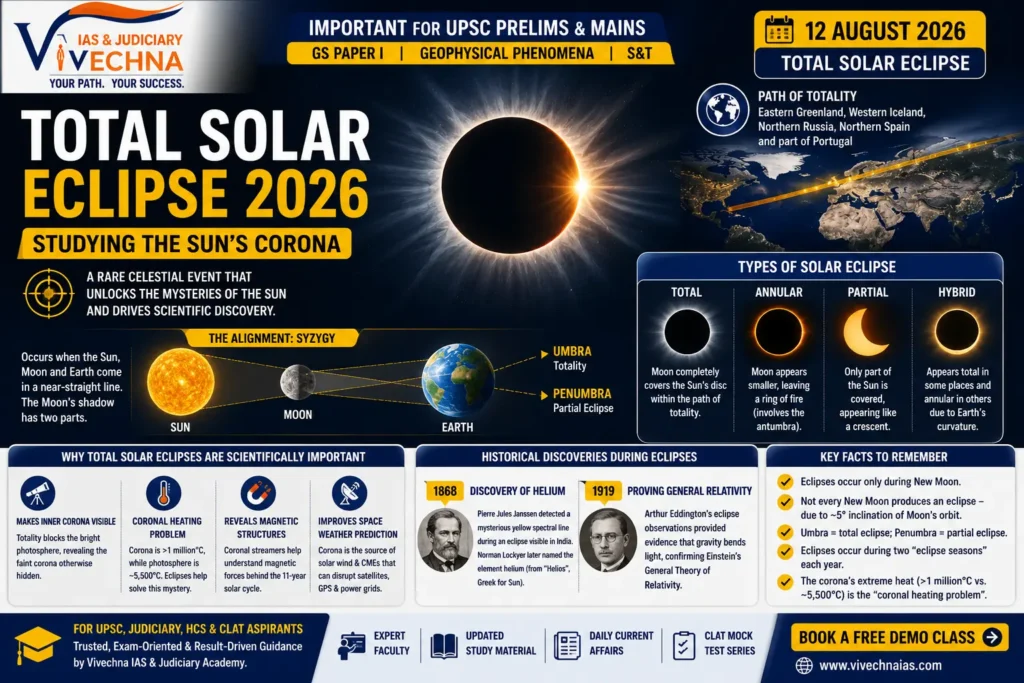
On 12 August 2026, a total solar eclipse swept across eastern Greenland, western Iceland, northern Russia, northern Spain, and part of Portugal, giving astronomers a rare window to study the Sun's faint corona. This is a high-value GS Paper I topic combining astronomy fundamentals with the history of scientific discovery. At Vivechna IAS & Judiciary Academy, we cover the mechanics of solar eclipses and their scientific significance in full exam-ready detail.
🌒 What Is a Total Solar Eclipse?
A total solar eclipse occurs when the Sun, Moon, and Earth align in a near-straight line — a configuration called syzygy. The Moon's shadow has two parts: the umbra (where sunlight is completely blocked, producing totality) and the penumbra (where sunlight is only partially blocked, producing a partial eclipse). Since the umbra is much narrower than the penumbra, totality is visible over a small area and usually lasts only a few minutes.
✅ Exam Tip
Solar eclipses occur only during a New Moon, but not every New Moon produces one — the Moon's orbit is inclined about 5° to the ecliptic plane, so eclipses happen only during two "eclipse seasons" each year when the New Moon crosses that plane.
Types of Solar Eclipse
| Type | Description |
|---|---|
| Total | The Moon completely covers the Sun's disc within the path of totality, revealing the corona. |
| Annular | The Moon is near its farthest point from Earth and appears smaller than the Sun, leaving a "ring of fire" (involves the antumbra). |
| Partial | Imperfect alignment means only part of the Sun is covered, giving a crescent appearance. |
| Hybrid | A rare eclipse that appears total from some locations and annular from others, due to Earth's curvature. |
🔬 Significance of a Total Solar Eclipse for Studying the Solar Corona
👁️ Makes the Inner Corona Visible
The photosphere's brightness normally hides the faint corona; totality blocks it, allowing direct study of regions coronagraphs struggle to observe.
🌡️ The Coronal Heating Problem
The corona exceeds 1 million°C while the photosphere is only ~5,500°C — eclipse data helps investigate this puzzling energy-transfer mechanism.
🧲 Reveals Magnetic Structures
Visible coronal streamers help scientists understand the magnetic forces driving the 11-year solar cycle.
🛰️ Improves Space Weather Prediction
The corona is the source of solar wind and Coronal Mass Ejections (CMEs), which can disrupt satellites, GPS, and power grids.
📌 Why This Matters
Understanding space weather has real governance implications — CMEs can disrupt satellite communication and power infrastructure, connecting this astronomy topic to GS Paper III's disaster-preparedness themes covered at Vivechna IAS's UPSC Civil Services programme.
🕰️ Historical Discoveries During Total Solar Eclipses
🎯 Key Takeaways
- A total solar eclipse requires syzygy — Sun, Moon, and Earth in near-perfect alignment.
- The umbra produces totality; the penumbra produces a partial eclipse.
- Eclipses occur only during two "eclipse seasons" a year due to the Moon's ~5° orbital inclination.
- Eclipse observations helped discover helium (1868) and confirm General Relativity (1919).
- The corona's extreme heat (over 1 million°C vs. the photosphere's ~5,500°C) remains an active research puzzle — the "coronal heating problem."
📚 Exam Relevance for UPSC, Judiciary, HCS & CLAT Aspirants
| Exam | Relevance |
|---|---|
| UPSC Prelims | Eclipse types, umbra/penumbra, historical discoveries, space-weather basics. |
| UPSC Mains (GS-I/III) | Scientific temper themes and disaster-preparedness linkage to space weather. |
| Judiciary Exams | General science awareness sections. |
| HCS / State PCS | Static GK on astronomy and geophysical phenomena. |
| CLAT / Law Entrance | Current-affairs GK MCQs on science events like eclipses. |
📍 CLAT Preparation 2027 — For Aspirants in Gurugram & Delhi NCR
Science GK, including astronomy events, is a reliable CLAT scoring area. If you're looking for CLAT coaching in Gurugram or the best CLAT institute in Gurgaon, Vivechna IAS & Judiciary Academy's CLAT preparation 2027 batches cover such static-plus-current GK combinations closely. This is why CLAT aspirants in Sector 14 Gurugram choose Vivechna IAS — with CLAT coaching near HUDA City Centre and best law entrance coaching near MG Road Gurugram, backed by CLAT study material and a full CLAT mock test series, plus CLAT coaching in Delhi and Judiciary coaching in Gurugram.
📝 Previous Year Questions (PYQs)
In order of their distance from the Sun, which of the following planets lie between Mars and Uranus?
(a) Earth and Jupiter (b) Jupiter and Saturn (c) Saturn and Earth (d) Saturn and Neptune
Answer: (b)
The increasing amount of carbon dioxide in the air is slowly raising the temperature of the atmosphere, because it absorbs:
(a) the water vapour of the air and retains its heat (b) the ultraviolet part of the solar radiation (c) all the solar radiations (d) the infrared part of the solar radiation
Answer: (d)
The terms 'Event Horizon', 'Singularity', 'String Theory' and 'Standard Model' are sometimes seen in the news in the context of:
(a) Observation and understanding of the Universe (b) Study of the solar and the lunar eclipses (c) Placing satellites in the orbit of the Earth (d) Origin and evolution of living organisms on the Earth
Answer: (a)
🖊️ Practice Question (New — For Self-Assessment)
Consider the following statements regarding solar eclipses:
- A total solar eclipse can only occur during a New Moon.
- Every New Moon results in a solar eclipse somewhere on Earth.
- An annular eclipse involves the antumbra, the continuation of the shadow beyond the umbra's tip.
Which of the statements given above is/are correct?
(a) 1 and 3 only (b) 1 and 2 only (c) 2 and 3 only (d) 1, 2 and 3
Answer: (a) — Because the Moon's orbit is inclined ~5° to the ecliptic, most New Moons do NOT produce an eclipse; Statement 2 is incorrect.
❓ Frequently Asked Questions (FAQs)
Why does a total solar eclipse allow scientists to study the solar corona?
Why do solar eclipses not occur every New Moon?
What are the main types of solar eclipses?
How did solar eclipses contribute to scientific discoveries?
Which is the best CLAT coaching in Gurugram?
Does Vivechna IAS provide CLAT mock tests?
🏁 Conclusion
The 12 August 2026 total solar eclipse offered scientists another rare opportunity to probe the Sun's corona — continuing a scientific tradition that has already given the world the discovery of helium and observational proof of General Relativity. For UPSC, Judiciary, HCS, and CLAT aspirants, this topic blends static astronomy knowledge with genuine current-affairs relevance — precisely the kind of layered GK Vivechna IAS & Judiciary Academy builds into its Science & Technology coverage.
Preparing for UPSC, Judiciary, HCS or CLAT 2027 in Gurugram or Delhi NCR?
Join Vivechna IAS & Judiciary Academy's daily current-affairs sessions and CLAT mock test series — trusted by aspirants across Sector 14 Gurugram, HUDA City Centre, MG Road, and Delhi NCR.
Book a Free Demo Class →