🗳️ Delimitation in India: The North-South Divide, Women's Reservation & the Road to 2029 | UPSC Polity Notes
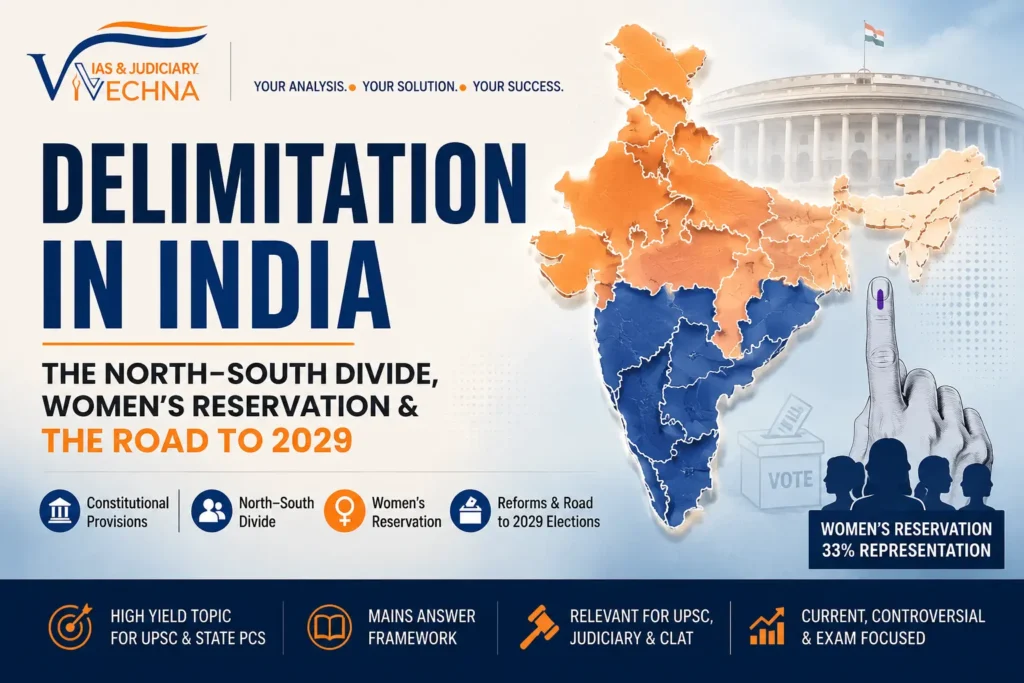
Delimitation — the redrawing of electoral constituency boundaries — has resurfaced as one of the most consequential federalism debates in Indian polity, as the Centre looks to revive electoral reforms ahead of the 2029 Lok Sabha elections. With the 2027 Census expected to trigger fresh delimitation under Articles 81 and 82, the exercise threatens to shift Lok Sabha representation toward populous northern states, unsettling southern states that succeeded in stabilising their populations. At Vivechna IAS & Judiciary Academy, we unpack this high-value GS Paper II topic — covering the constitutional framework, the North-South tension, its link to women's reservation, and the reform pathways being debated.
📌 Why This Topic Matters
Delimitation sits at the heart of India's federal bargain — balancing "one person, one vote, one value" against the political rights of states. For aspirants at Vivechna IAS's UPSC Civil Services programme, this topic is a recurring favourite because it connects constitutional provisions, recent legislative attempts, Supreme Court interpretation, and live political controversy — exactly the kind of layered current-affairs theme that scores well in Mains.
📖 What Is Delimitation?
Delimitation is the process of fixing or redrawing territorial constituency boundaries for the Lok Sabha and State Assemblies so each seat represents a roughly equal number of voters — operationalising the principle of "one person, one vote, one value." It also determines which constituencies are reserved for Scheduled Castes and Scheduled Tribes.
Constitutional Mandate
| Provision | What It Covers |
|---|---|
| Article 82 | Mandates Parliament to enact a Delimitation Act after each Census, readjusting Lok Sabha seat allocation among states and dividing states into constituencies. |
| Article 170 | Provides for similar readjustment of seats and constituencies in State Legislative Assemblies. |
| Article 81 | Caps the elected Lok Sabha strength at 550 seats (currently 543 elected). |
| Article 329(a) | Bars courts from questioning the validity of any law relating to delimitation of constituencies. |
The Delimitation Commission
The Delimitation Commission is a high-powered, independent 3-member body: a Chairperson (a serving or retired Supreme Court Judge), the Chief Election Commissioner (or a nominated Election Commissioner), and the State Election Commissioners of concerned states. Its orders generally enjoy statutory finality — though in Kishorchandra Chhanganlal Rathod (2024), the Supreme Court held that a Commission order may face limited judicial review if it is manifestly arbitrary or violates constitutional values.
✅ Exam Tip
Currently, 5 Lok Sabha MPs and 5 MLAs from each state sit as "Associate Members" on the Commission — but they have no voting rights. This is a favourite Prelims trap: Associate Members participate but cannot vote.
🕰️ The Freeze on Delimitation: A Timeline
⚠️ Key Challenges Associated with Delimitation
1. The Federal vs. Demographic Dilemma (North-South Divide)
Strictly applying "one person, one vote, one value" to current population data would significantly benefit high-growth Hindi-heartland states (Uttar Pradesh, Bihar, Madhya Pradesh, Rajasthan) while penalising southern states (Kerala, Tamil Nadu, Karnataka, Andhra Pradesh) that successfully stabilised their populations — potentially shifting political power northward.
2. Linkage to Women's Reservation
The Nari Shakti Vandan Adhiniyam, 2023 provides 33% reservation for women in the Lok Sabha and State Assemblies, but implementation is linked to the next delimitation exercise — meaning stalled consensus on delimitation could delay a widely supported reform.
3. Delays and Ambiguity in Census Data
Delimitation is contingent on the first Census after 2026, but the decadal 2021 Census was delayed indefinitely due to COVID-19. The 2026 attempt to use outdated 2011 data triggered intense political mistrust. Encouragingly, the 2027 Census is fully digitalised, which could allow faster completion than the 2002 Commission's six-year timeline (2002–2008).
4. Logistics of a Larger Parliament
The defeated 131st Amendment Bill proposed raising the seat ceiling to 850 — a much larger Lok Sabha could accommodate population growth but would compress individual MPs' speaking time and complicate order and deliberation.
5. Gerrymandering and Sub-Nationalism
✂️ Cracking
Spreading an opposing party's supporters across constituencies so they remain a minority everywhere, reducing their winning chances.
📦 Packing
Concentrating opposing supporters into a few constituencies, wasting their excess votes while a rival wins more seats elsewhere.
Because delimitation directly alters political destinies, any perceived unfairness in boundary-drawing can inflame regional grievances and sub-nationalism.
⚠️ Important Point
Article 329(a) bars courts from questioning delimitation laws — but the 2024 Kishorchandra Chhanganlal Rathod ruling carved out a narrow exception for manifestly arbitrary orders. This tension between statutory finality and judicial review is a strong Mains discussion point.
🛤️ Reforms for a Fair, Consensus-Based Delimitation
| Reform Proposal | How It Works |
|---|---|
| Pro-Rata Seat Augmentation | A flat percentage increase (e.g., 50%, taking the House from 543 to ~815) while retaining existing 1971 state-wise ratios — expands representation without shifting relative voting power. |
| Weighted Representation Formula | Finance Commission-style weights: Population (~50%), Demographic/TFR Performance (~25%), Economic Contribution/HDI (~15%), Geographic Area (~10%) — though this needs a constitutional amendment since Article 81 is population-based. |
| Decoupling Women's Reservation | A separate constitutional amendment to roll out the Nari Shakti Vandan Adhiniyam on the existing 543-seat matrix, so it isn't held hostage by delimitation disputes. |
| Bicameral Rebalancing | Strengthening the Rajya Sabha's role — potentially moving toward equal state representation (like the US/Australian Senate) and greater say over Money Bills — as a federal check on Lok Sabha majoritarianism. |
| Empowering Associate Members | Giving the 5 MP + 5 MLA Associate Members binding input (not just consultation) on internal boundary-drawing. |
| Inter-State Council Consultation | Convening the Inter-State Council (Article 263) with all Chief Ministers before finalising the Commission's terms of reference. |
| Algorithmic, Open-Source Mapping | Using open-source GIS algorithms to draw compact, contiguous constituencies, subject to public hearings and civil-society audits — reducing scope for gerrymandering. |
✅ Exam Tip
The "pro-rata" model is the most frequently cited compromise in current editorials — it satisfies southern states (no loss of relative voting power) while still expanding total seats to reflect population growth. Understanding this trade-off well can anchor a strong Mains answer.
🎯 Key Takeaways
- Delimitation's constitutional basis lies in Articles 81, 82, and 170; Article 329(a) ordinarily bars judicial review of delimitation laws.
- Lok Sabha seat allocation among states has been frozen since the 1971 Census (42nd Amendment) — extended until the first Census after 2026 (84th Amendment).
- The 2027 Census could trigger fresh delimitation, risking a shift of political power toward northern states.
- Women's reservation under the Nari Shakti Vandan Adhiniyam, 2023 is tied to the next delimitation exercise.
- The Delimitation Commission has been constituted 4 times (1952, 1963, 1973, 2002); the 2026 Bills to revise the process failed to pass.
- Proposed reforms include pro-rata seat augmentation, weighted representation, and strengthening the Rajya Sabha as a federal check.
📚 Exam Relevance for UPSC, Judiciary, HCS & CLAT Aspirants
| Exam | Relevance |
|---|---|
| UPSC Prelims | Articles 81/82/170/329(a), Delimitation Commission composition, freeze amendments, and PYQ-tested facts on commission count. |
| UPSC Mains (GS-II) | Federalism vs. demographic representation, women's reservation linkage, and electoral reform proposals. |
| Judiciary Exams | Constitutional law relevance — Article 329(a)'s ouster clause and its judicial exceptions (Kishorchandra Chhanganlal Rathod, 2024). |
| HCS / State PCS | State-specific implications of delimitation, especially for states facing seat-share changes. |
| CLAT / Law Entrance | Legal-reasoning passages on constitutional ouster clauses and current-affairs MCQs on electoral reform bills. |
📍 CLAT Preparation 2027 — For Aspirants in Gurugram & Delhi NCR
Constitutional and electoral-law topics like delimitation are a CLAT current-affairs staple. If you're looking for CLAT coaching in Gurugram or the best CLAT institute in Gurgaon, Vivechna IAS & Judiciary Academy runs focused CLAT preparation 2027 batches built around exactly this kind of constitutional-law current affairs. This is why CLAT aspirants in Sector 14 Gurugram choose Vivechna IAS — with CLAT coaching near HUDA City Centre and best law entrance coaching near MG Road Gurugram, supported by structured CLAT study material and a comprehensive CLAT mock test series. We also offer CLAT coaching in Delhi and Judiciary coaching in Gurugram for aspirants targeting multiple exams.
Explore Vivechna IAS's UPSC Civil Services courses, Judiciary Exams coaching, State PCS/HCS batch, and the CLAT & Law Entrance programme for structured coverage of Indian Polity and electoral-reform topics like this one.
📝 Previous Year Questions (PYQs)
How many Delimitation Commissions have been constituted by the Government of India till December 2023?
(a) One (b) Two (c) Three (d) Four
Answer: (d)
With reference to the Delimitation Commission, consider the following statements:
- The orders of the Delimitation Commission cannot be challenged in a Court of Law.
- When the orders of the Delimitation Commission are laid before the Lok Sabha or State Legislative Assembly, they cannot effect any modification in the orders.
Which of the statements given above is/are correct?
(a) 1 only (b) 2 only (c) Both 1 and 2 (d) Neither 1 nor 2
Answer: (c)
"Demographic Dividend in India will remain only theoretical unless our manpower becomes more educated, aware, skilled and creative." What measures have been taken by the government to enhance the capacity of our population to be more productive and employable?
"While we flaunt India's demographic dividend, we ignore the dropping rates of employability." What are we missing while doing so? Where will the jobs that India desperately needs come from? Explain.
🖊️ Practice Questions (New — For Self-Assessment)
Consider the following statements regarding delimitation in India:
- The 42nd Constitutional Amendment Act froze Lok Sabha seat allocation among states based on the 1971 Census.
- The 84th Constitutional Amendment Act extended this freeze until the first Census after 2026.
- Article 329(a) permits courts to review any delimitation order without restriction.
Which of the statements given above is/are correct?
(a) 1 and 2 only (b) 2 and 3 only (c) 1 and 3 only (d) 1, 2 and 3
Answer: (a) — Article 329(a) ordinarily bars judicial review of delimitation laws, with only a narrow exception carved out in 2024 for manifestly arbitrary orders; Statement 3 is incorrect.
"Delimitation based purely on population risks penalising states that succeeded in population stabilisation." Examine this statement and discuss the reform proposals suggested to reconcile demographic representation with federal equity.
🚫 Common Mistakes Aspirants Make on This Topic
- Confusing delimitation with reservation of seats generally — delimitation determines which specific constituencies are reserved for SC/ST, not the overall reservation policy.
- Assuming Article 329(a) is an absolute bar — the 2024 Kishorchandra Chhanganlal Rathod ruling created a narrow exception for manifestly arbitrary Commission orders.
- Forgetting Associate Members lack voting rights — the 5 MP + 5 MLA associate members can participate in Commission proceedings but cannot vote.
- Mixing up the freeze amendments — the 42nd Amendment (1976) froze seats to the 1971 Census; the 84th Amendment (2001) extended that freeze until the first Census after 2026.
- Writing one-sided Mains answers — strong answers must weigh democratic "one person, one vote" against genuine federal equity concerns, not dismiss either side.
❓ Frequently Asked Questions (FAQs)
What is delimitation and what is its constitutional basis?
How has the Constitution addressed the population-representation dilemma?
Why is the 2027 Census significant for delimitation?
What is gerrymandering, and how does it relate to delimitation?
What reforms can ensure fair delimitation?
Which is the best CLAT coaching in Gurugram?
How to prepare for CLAT 2027 in Gurugram?
Does Vivechna IAS provide CLAT mock tests?
What are the benefits of weekend CLAT batches?
🏁 Conclusion
Delimitation is far more than a technical exercise in redrawing lines on a map — it is a test of whether India's federal union can reconcile the democratic ideal of equal representation with the political trust of states that delivered on national development goals. As the 2027 Census approaches, the choices made — pro-rata augmentation, weighted formulas, or a straightforward population-based reallocation — will shape Centre-state relations for decades. For UPSC, Judiciary, HCS, and CLAT aspirants, this topic rewards those who can hold both sides of the federalism argument in view — precisely the balanced, analytical approach Vivechna IAS & Judiciary Academy builds into its Polity and current-affairs curriculum.
Preparing for UPSC, Judiciary, HCS or CLAT 2027 in Gurugram or Delhi NCR?
Join Vivechna IAS & Judiciary Academy's expert-led Polity & Constitutional Law modules, daily current-affairs analysis, and CLAT mock test series — trusted by aspirants across Sector 14 Gurugram, HUDA City Centre, MG Road, and Delhi NCR.
Book a Free Demo Class →