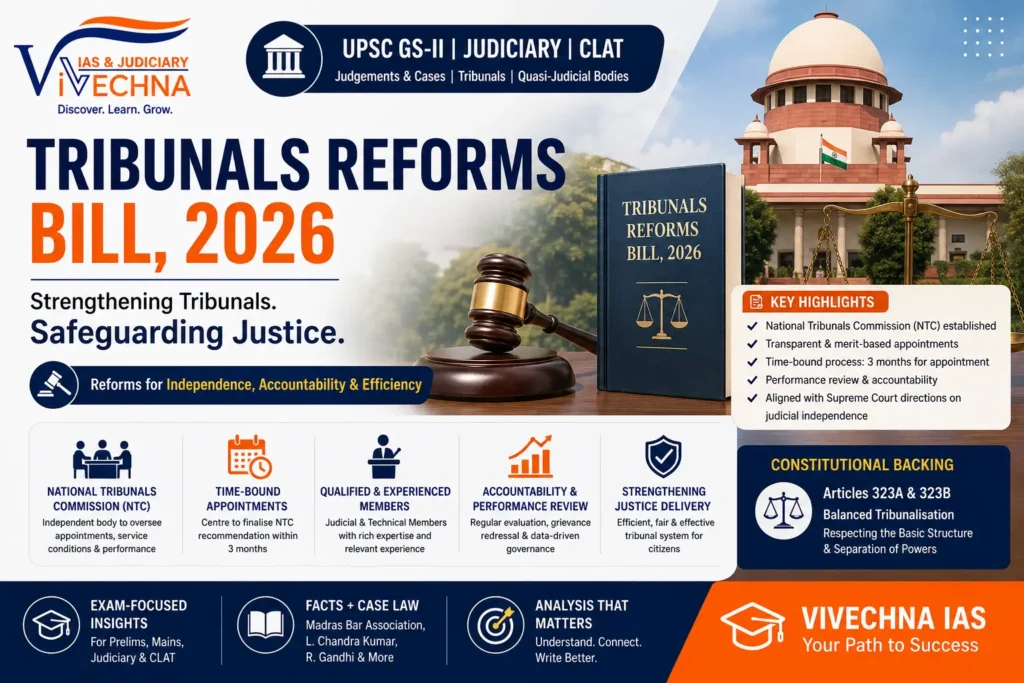
⚖️ Tribunals Reforms Bill, 2026 | UPSC, Judiciary & CLAT Notes on Tribunalisation of Justice
Parliament has passed the Tribunals Reforms Bill, 2026 — replacing the Tribunals Reforms Act, 2021 and creating a National Tribunals Commission (NTC) to oversee appointments, service conditions, and performance across India's tribunal system. This is one of the most important recent developments in India's "tribunalisation of justice" debate, and a natural fit for GS Paper II's Judiciary and Constitutional Bodies syllabus. At Vivechna IAS & Judiciary Academy, we break down the Bill's provisions, the Supreme Court rulings that shaped it, and the structural issues still facing tribunals — especially relevant for Judiciary exam aspirants given its direct constitutional-law content.
📌 Why This Topic Matters
Tribunals sit at the intersection of judicial independence, separation of powers, and administrative efficiency — a combination examiners love to test. For aspirants at Vivechna IAS's Judiciary Exams programme, this topic is doubly important: it is both a current-affairs update and a constitutional-law fundamental (Articles 323A, 323B, and the tribunal case-law lineage).
📋 Key Provisions of the Tribunals Reforms Bill, 2026
1. Repeal of the 2021 Act
The Bill repeals the Tribunals Reforms Act, 2021, aligning tribunal appointments and service conditions with Supreme Court directions on separation of powers and judicial independence — directions that trace back to the Madras Bar Association v. Union of India line of rulings (2010–2025), which have consistently curbed executive overreach in tribunal administration.
2. Establishment of the National Tribunals Commission (NTC)
| Feature | Detail |
|---|---|
| Composition | 1 Chairperson (former SC Judge or HC Chief Justice) + 2 Judicial Members (HC Chief Justice/Judge) + 2 Technical Members. |
| Technical Member Eligibility | Minimum 25 years of relevant experience. |
| Age Limit | 70 years (Chairperson), 67 years (Members) — or a 5-year term, whichever comes first. |
| Appointing Authority | Central Government, with CJI consultation for the Chairperson and Judicial Members. |
| Secretariat | Headed by a Central Government Secretary. |
| Functions | Conducts appointments, reviews tribunal performance, oversees member complaints, maintains the National Tribunals Data Grid. |
3. Selection, Reappointment & Removal
- Selection: The NTC's search-cum-selection committee recommends one name per vacancy plus one waitlisted name; the Centre must finalise the appointment within 3 months.
- Reappointment: Based on past performance, with consultation with the concerned Tribunal Chairperson.
- Removal: Permitted on grounds of insolvency, moral-turpitude conviction, incapacity, abuse of position, or conflict of interest — with tribunal members additionally removable for incompetence, inefficiency, or undertaking paid outside assignments.
📝 Quick Revision
The Central Government prescribes Rules governing qualifications, selection, salaries, allowances, resignation, and removal — meaning service-condition details will largely sit in subordinate legislation, not the Bill itself.
🚫 What Did the Supreme Court Strike Down in the 2021 Act?
| Struck-Down Provision | Why |
|---|---|
| 50-year minimum age | Arbitrary — excluded younger advocates/experts despite meeting the 10-years'-practice eligibility. |
| 4-year tenure | Undermined judicial independence and institutional continuity; Court restored a minimum 5-year tenure. |
| Two names per vacancy | Increased executive discretion; Court directed only one name to be recommended per post. |
| Re-enactment of struck-down provisions | Held unconstitutional — Parliament cannot re-enact invalidated provisions without curing the underlying defect, since judicial review is part of the Basic Structure. |
⚠️ Important Point
The "cannot simply re-enact struck-down provisions" principle is a significant constitutional-law point tying tribunal reform directly to Basic Structure doctrine — a favourite cross-topic link for both UPSC Mains and Judiciary exam answers.
🕰️ Background: How Tribunals Evolved in India
Articles 323A and 323B at a Glance
| Article | Scope |
|---|---|
| Article 323A | Empowers Parliament (only) to establish Administrative Tribunals for service-related disputes of public servants. |
| Article 323B | Empowers both Parliament and State Legislatures to establish tribunals for taxation, foreign exchange, industrial/labour disputes, land reforms, and more. |
⚠️ Major Issues Plaguing India's Tribunal System
⚠️ Structural Problems
- Executive dominance: The government — often a major litigant — has historically controlled appointments, salaries, and removals (flagged in Rojer Mathew v. South Indian Bank, 2019).
- Vacancies & pendency: Chronic vacancies swell backlogs — the ITAT alone had ₹6.7 trillion stuck in disputes as of 2024.
- Short tenures: Limit adjudicatory experience; reappointment possibilities risk executive dependence.
- Administrative dependence: Reliance on parent ministries for finance, infrastructure, and staff undermines autonomy.
- Additional litigation layer: Since L. Chandra Kumar (1997) preserved High Court writ jurisdiction, tribunal orders can still be challenged, adding a further appellate layer.
- Inadequate infrastructure: Weak digital facilities and non-uniform procedures persist across tribunals.
✅ What FC-16-style Reform Offers
- A single, centralised NTC replaces fragmented, ministry-wise tribunal administration.
- One-name selection (not two) directly reduces executive discretion, per SC direction.
- A National Tribunals Data Grid could finally enable performance transparency.
- CJI consultation for the Chairperson/Judicial Members builds in a judicial check.
🛤️ Reforms That Can Strengthen Tribunal Independence & Efficiency
- Decouple parent ministries — shift administrative/financial control to an independent nodal authority with its own budget.
- Streamline appellate mechanisms — dedicated Tribunal Appellate Benches within High Courts, or a UK-style two-tier First-tier/Upper Tribunal system with subject-specific Chambers.
- Mandatory Judicial Impact Assessment (JIA) — before expanding tribunal jurisdiction, formally assess infrastructure, judge strength, and resource needs.
- Capacity building — cross-training at the National Judicial Academy so technical members gain legal grounding and judicial members gain domain expertise.
- Pre-institution mediation — mandatory pre-litigation mediation for suitable tribunal-dispute categories to cut frivolous filings.
- Performance audits — independent annual audits on disposal rates, adjournments, and pendency, published transparently.
✅ Exam Tip
Structure Mains answers on tribunals as: Origin (Swaran Singh Committee) → Constitutional Basis (Art. 323A/B) → Judicial Evolution (Sampath Kumar → L. Chandra Kumar → Madras Bar Association line) → Current Reform (NTC) → Persisting Gaps → Way Forward. This sequence covers nearly every angle examiners test.
🎯 Key Takeaways
- The Tribunals Reforms Bill, 2026 repeals the 2021 Act and creates the National Tribunals Commission (NTC).
- The NTC recommends one name per vacancy (not two), directly implementing a Supreme Court direction.
- The Court had struck down the 2021 Act's 50-year minimum age, 4-year tenure, and two-name selection provisions.
- Tribunals trace their constitutional basis to Articles 323A and 323B, inserted by the 42nd Amendment Act, 1976.
- L. Chandra Kumar v. Union of India (1997) preserved High Court writ jurisdiction over tribunal decisions.
- Persisting issues include executive dominance, chronic vacancies (₹6.7 trillion stuck at ITAT alone), and administrative dependence on parent ministries.
📚 Exam Relevance for UPSC, Judiciary, HCS & CLAT Aspirants
| Exam | Relevance |
|---|---|
| UPSC Prelims | Articles 323A/323B, 42nd Amendment, NTC composition and age limits. |
| UPSC Mains (GS-II) | Tribunalisation of justice, judicial independence vs. accountability, separation of powers. |
| Judiciary Exams | Direct constitutional-law relevance — Basic Structure doctrine, writ jurisdiction, and the full tribunal case-law lineage are core viva/mains topics. |
| HCS / State PCS | General Studies sections testing recent constitutional-body reforms and landmark case law. |
| CLAT / Law Entrance | Legal-reasoning passages on tribunal case law and current-affairs MCQs on the NTC. |
📍 CLAT Preparation 2027 — For Aspirants in Gurugram & Delhi NCR
Landmark judgments and tribunal case law — like the Madras Bar Association lineage and L. Chandra Kumar — are exactly the kind of legal-reasoning content CLAT tests heavily. If you're looking for CLAT coaching in Gurugram or the best CLAT institute in Gurgaon, Vivechna IAS & Judiciary Academy runs dedicated CLAT preparation 2027 batches built around real constitutional-law current affairs like this Bill. This is why CLAT aspirants in Sector 14 Gurugram choose Vivechna IAS — with CLAT coaching near HUDA City Centre and best law entrance coaching near MG Road Gurugram, backed by structured CLAT study material and a full CLAT mock test series. We also offer CLAT coaching in Delhi and Judiciary coaching in Gurugram for aspirants preparing for multiple law entrance and judicial-service exams together.
Vivechna IAS's UPSC Civil Services programme, Judiciary Exams coaching, and CLAT & Law Entrance course all cover constitutional bodies and tribunal case law in structured, answer-writing-focused modules.
📝 Previous Year Questions (PYQs)
The National Green Tribunal Act, 2010 was enacted in consonance with which of the following provisions of the Constitution of India?
- Right to healthy environment, construed as a part of Right to life under Article 21
- Provision of grants for raising the level of administration in the Scheduled Areas for the welfare of Scheduled Tribes under Article 275(1)
- Powers and functions of Gram Sabha as mentioned under Article 243(A)
(a) 1 only (b) 2 and 3 only (c) 1 and 3 only (d) 1, 2 and 3
Answer: (a)
How far do you agree with the view that tribunals curtail the jurisdiction of ordinary courts? In view of the above, discuss the constitutional validity and competency of the tribunals in India.
🖊️ Practice Questions (New — For Self-Assessment)
Consider the following statements regarding the Tribunals Reforms Bill, 2026:
- It establishes the National Tribunals Commission to oversee appointments and service conditions of tribunal members.
- The search-cum-selection committee recommends two names per vacancy, in line with the 2021 Act.
- The National Tribunals Commission's Secretariat is headed by a Central Government Secretary.
Which of the statements given above is/are correct?
(a) 1 and 3 only (b) 1 and 2 only (c) 2 and 3 only (d) 1, 2 and 3
Answer: (a) — The Bill recommends only one name per vacancy (plus a waitlisted name), reversing the 2021 Act's two-name provision that the Supreme Court struck down; Statement 2 is incorrect.
"Legislation can redesign the architecture of tribunals but cannot by itself guarantee their independence." Examine this statement with reference to the Tribunals Reforms Bill, 2026 and the persistent issue of executive dominance.
🚫 Common Mistakes Aspirants Make on This Topic
- Confusing Article 323A and 323B — only Parliament can legislate under 323A (Administrative Tribunals); both Parliament and State Legislatures can act under 323B.
- Assuming tribunals fully replace High Courts — L. Chandra Kumar (1997) confirmed tribunal decisions remain subject to writ jurisdiction under Articles 226/227.
- Forgetting the "re-enactment" ruling — Parliament cannot simply re-pass a struck-down provision without curing its defect, since judicial review is part of the Basic Structure.
- Treating the NTC as fully independent — appointments are still made by the Central Government, with CJI consultation only for the Chairperson and Judicial Members — a nuance worth flagging in critical Mains answers.
- Writing one-sided answers — strong answers must weigh the NTC's institutional improvements against still-unresolved issues like ministry-level administrative dependence.
❓ Frequently Asked Questions (FAQs)
What is the Tribunals Reforms Bill, 2026?
What are Articles 323A and 323B related to?
What did L. Chandra Kumar v. Union of India (1997) establish?
Why is the National Tribunals Commission significant?
What is a Judicial Impact Assessment?
Which is the best CLAT coaching in Gurugram?
How to prepare for CLAT 2027 in Gurugram?
Does Vivechna IAS provide CLAT mock tests?
What are the benefits of weekend CLAT batches?
🏁 Conclusion
The Tribunals Reforms Bill, 2026 represents a genuine institutional course-correction — folding in nearly two decades of Supreme Court direction into a single, centralised National Tribunals Commission. Yet as the conclusion of the source editorial rightly notes, legislation can redesign architecture, but institutional culture — executive habits of control, financial dependence, and administrative fragmentation — takes longer to change. For UPSC, Judiciary, HCS, and CLAT aspirants, this topic is a superb example of how constitutional doctrine, judicial precedent, and legislative reform interact — precisely the analytical depth Vivechna IAS & Judiciary Academy builds into its Polity and Law curriculum.
Preparing for UPSC, Judiciary, HCS or CLAT 2027 in Gurugram or Delhi NCR?
Join Vivechna IAS & Judiciary Academy's expert-led Polity & Constitutional Law modules, daily current-affairs analysis, and CLAT mock test series — trusted by aspirants across Sector 14 Gurugram, HUDA City Centre, MG Road, and Delhi NCR.
Book a Free Demo Class →