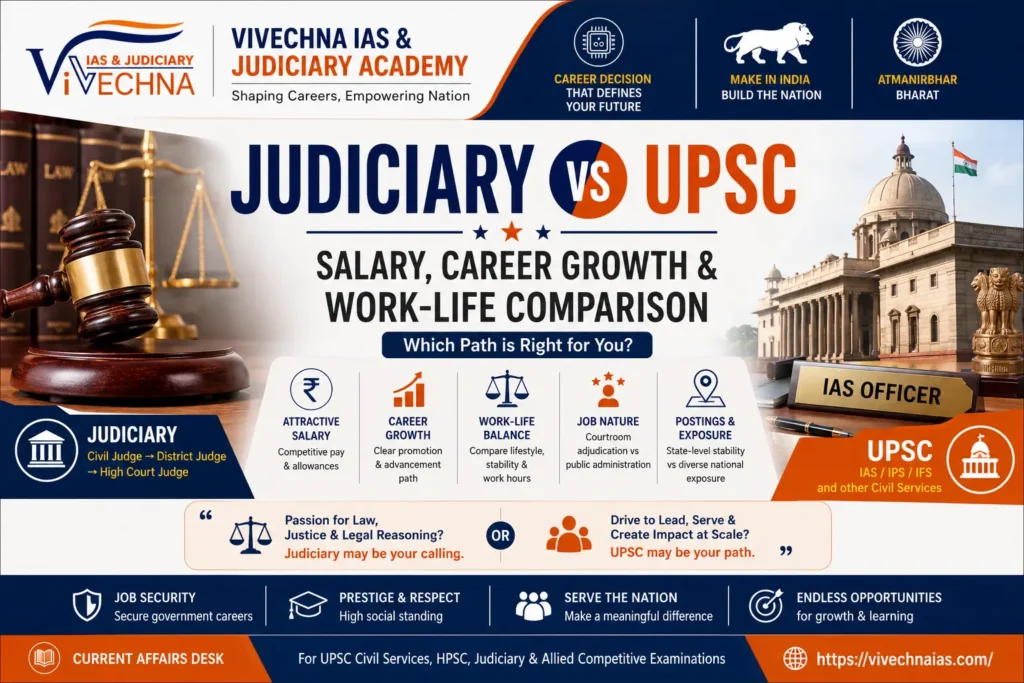
Judiciary vs UPSC: Salary, Career Growth & Work-Life Comparison
Category: Career Guidance | Judiciary & UPSC Relevance: For law graduates and aspirants deciding between Civil Services and Judicial Services Prepared by: Vivechna IAS & Judiciary Academy
This is a common dilemma for law graduates: should you prepare for the Civil Judge / Judicial Services exam or the UPSC Civil Services Examination? Both are prestigious, secure government careers, but they differ significantly in nature of work, career trajectory, and compensation. This article extends our earlier pieces, “Can You Prepare for IAS and Judiciary Together?” and “Judiciary After Law or UPSC After Graduation?”, by comparing the two career tracks directly.
1. Nature of Work
| Aspect | Judiciary (Civil Judge → District Judge → HC Judge) | UPSC Civil Services (IAS/IPS/IFS) |
|---|---|---|
| Core role | Adjudicating disputes, delivering judgments, interpreting law | Policy implementation, public administration, law & order, welfare scheme execution |
| Daily work | Courtroom hearings, judgment writing, case management | Field postings, office administration, inter-departmental coordination, public interaction |
| Autonomy | High judicial independence; decisions not subject to political direction | Works within the executive hierarchy; subject to transfers and political/administrative oversight |
| Skillset rewarded | Legal reasoning, drafting, patience, procedural rigor | Leadership, decision-making under pressure, coordination, general administration |
Judicial work is intellectually focused and procedural; civil services work is more varied, people-facing, and often involves crisis management (law and order, disaster response, elections).
2. Entry Process
- Judiciary: State-wise Judicial Services Examinations (e.g., HJS, RJS, UP PCS-J, DJS) — Prelims (objective) + Mains (descriptive, law-heavy) + Interview. Requires an LLB degree; many states allow fresh law graduates to apply directly.
- UPSC: Prelims (GS + CSAT) + Mains (9 papers including an optional subject) + Interview (275 marks). Open to graduates of any discipline; Law is a popular optional subject for law graduates.
Judicial service exams test deep subject-matter (law) expertise, while UPSC tests a much broader general studies base.
3. Salary Comparison (Entry Level — Indicative, Varies by State)
Figures below are broad, approximate ranges based on current judicial and civil pay structures; actual pay varies by state, pay commission implementation, and allowances (DA, HRA, etc.). Please verify current figures from official state judiciary or DoPT notifications before making decisions.
| Stage | Judicial Services (Civil Judge, Jr. Division) | UPSC Civil Services (IAS, entry level) |
|---|---|---|
| Entry-level basic pay | Roughly ₹56,000–₹78,000/month depending on state pay scale | Roughly ₹56,100/month (Pay Level 10, 7th CPC) at training/probation stage |
| Approx. gross with allowances | Roughly ₹85,000–₹1,35,000/month depending on state and city | Roughly ₹80,000–₹1,00,000+/month at entry, rising quickly with postings |
| Senior stage (District Judge / Senior IAS) | Roughly ₹1,45,000–₹2,20,000+/month | Cabinet Secretary-level pay can reach ₹2,50,000/month; senior IAS officers in Apex Scale earn similarly high fixed pay |
| Non-salary perks | Official residence, judicial staff, vehicle (varies by state and seniority) | Official residence, vehicle, staff, and significant administrative perks especially at senior levels |
Both career tracks converge toward similarly high compensation at senior levels, but civil services roles often carry more discretionary perks tied to postings (districts/departments), while judicial pay is more uniformly structured by pay commission.
4. Career Growth & Promotion Path
Judiciary: Civil Judge (Junior Division) → Civil Judge (Senior Division) → District Judge (via promotion or Higher Judicial Services exam) → potential elevation to High Court Judge (based on seniority/merit, a smaller subset) → rare elevation to Supreme Court.
- Promotions are largely seniority and performance based within a defined cadre; transitions to High Court are selective and not guaranteed.
- Judicial officers largely stay within one state’s judicial hierarchy for most of their career.
UPSC (IAS): Sub-Divisional Magistrate/Assistant Collector → District Magistrate/Collector → Divisional Commissioner → Secretary-level postings in state government → Joint Secretary/Additional Secretary/Secretary at the Centre → possible Cabinet Secretary (extremely rare, apex post).
- Wider variety of postings across districts, departments, and deputations to central ministries, PSUs, or international bodies.
- Greater exposure to policymaking, especially at Joint Secretary level and above at the Centre.
5. Work-Life Balance
- Judiciary: Generally more structured working hours (court timings), though judgment-writing and case backlog pressure can extend work into evenings. Postings are usually within a single state, offering more geographic stability for families.
- UPSC: Frequent transfers, especially in the first several years, often across districts within a state or across ministries at the Centre. Field postings (District Magistrate, SP-level roles) can involve unpredictable hours, especially during law-and-order situations, elections, or disasters. Career offers wider exposure but at some cost to routine stability.
6. Which Should You Choose?
| If you value… | Judiciary may suit you better | UPSC may suit you better |
|---|---|---|
| Deep engagement with law and legal reasoning | ✔ | |
| Broader administrative and policy exposure | ✔ | |
| More predictable working hours | ✔ | |
| Variety of postings and departments | ✔ | |
| Judicial independence from political hierarchy | ✔ | |
| Faster/broader career diversification (Centre deputation, PSUs, international bodies) | ✔ |
There is no universally “better” option — the right choice depends on whether your genuine interest lies in legal adjudication or public administration. Many law graduates successfully prepare for both simultaneously in the early stages, given the overlap in GS and current affairs, before specializing their final year of preparation toward one exam.
If you’re a law graduate weighing both options, our dedicated guidance for law graduates may help you decide faster.
Vivechna IAS & Judiciary Academy offers dedicated coaching tracks for both UPSC Civil Services and Judiciary (PCS-J/HJS) aspirants, including guidance for law graduates deciding between the two paths. Book a free demo session to discuss which track fits your profile.