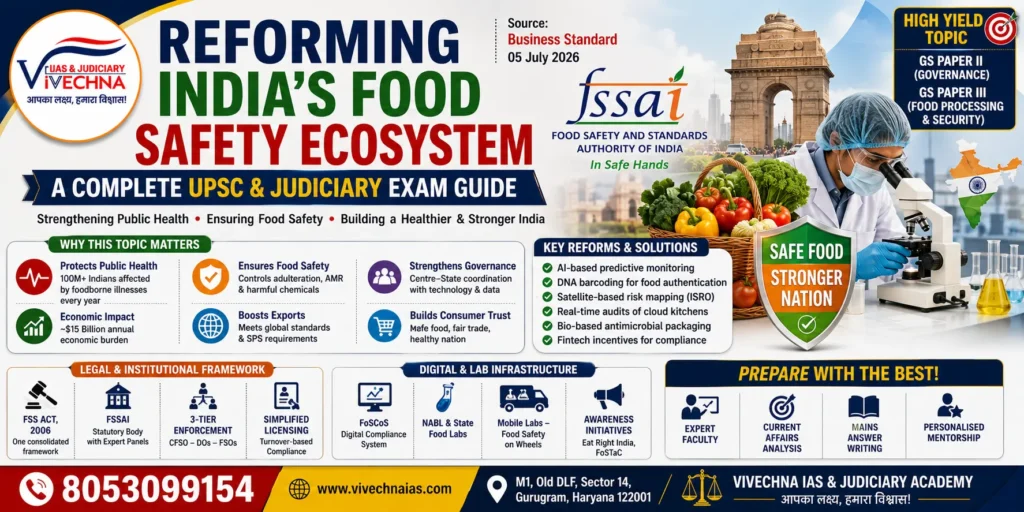
Prepared by the current affairs desk at Vivechna IAS & Judiciary Academy, this analysis is designed for aspirants preparing for the UPSC Civil Services Examination, State Judiciary exams, and other competitive tests that draw on GS Paper 2 (Governance) and GS Paper 3 (Food Processing & Security) themes.
Why This Topic Matters for Your Exam
Trade tensions between India and the European Union over antibiotic traces in animal products have pushed food regulation back into the headlines — and onto examiners’ radars. For an aspirant, this isn’t just a trade story. It touches public health economics, statutory bodies, centre-state enforcement, and emerging technology policy, making it a high-yield topic for Prelims fact-recall and Mains analytical writing alike.
If you’re building a broader governance current affairs base, browse our UPSC Governance current affairs archive, or reach out to our faculty through the Vivechna IAS & Judiciary Academy contact page to get these topics integrated into your personalised mentorship plan.
Why India Needs a Stronger Food Safety Net
A well-functioning food safety system does far more than satisfy export paperwork — it is a public health and economic necessity in its own right.
-
The hidden economic cost of unsafe food
Foodborne illness in India affects roughly 100 million people every year, imposing an annual economic burden of around $15 billion — a toll comparable to malaria, HIV/AIDS, and tuberculosis. This could climb toward 150–177 million cases annually by 2030. The World Health Organisation ranks India among the highest globally in Years of Life Lost due to unsafe food.
-
A hidden driver of malnutrition and stunting
Recurrent infections from pathogens such as Salmonella and E. coli damage the gut's ability to absorb nutrients, helping explain why child stunting (29.3%) and severe wasting (5.2%) remain high per NFHS-6 data, even as POSHAN Abhiyaan pumps resources into child nutrition.
-
Curbing adulteration and counterfeit food rackets
Between 2024 and 2026, enforcement agencies uncovered industrial chemicals such as ethylene glycol entering milk supply chains, alongside organised production of synthetic milk and counterfeit paneer across several northern states.
-
Protecting India's export reputation
As a major exporter of spices, marine products, and rice, India must meet Sanitary and Phytosanitary norms recognised under the World Trade Organisation framework, yet shipments are periodically rejected abroad over ethylene oxide traces, aflatoxins, or heavy metals like arsenic and lead in basmati rice.
-
Antimicrobial resistance: a slow-burning crisis
Unchecked pesticide use is linked to long-term endocrine and cancer risks, while routine antibiotic use in poultry and livestock farming accelerates antimicrobial resistance (AMR), eroding medicines humans rely on to treat infections.
-
The street food and informal sector challenge
India's packaging industry is now the world's third largest, valued above $86 billion, and the packaged food sector is expected to more than double by 2029 — yet millions of daily wage earners depend on street vendors who often lack clean water or proper waste disposal.
-
Trust in e-commerce and nutraceuticals
Deceptive "health-washing" claims remain common. FSSAI now requires e-commerce platforms to display valid licence numbers and match online claims to physical labels, while nutraceutical makers face tighter dosage and shelf-life testing rules.
The Legal and Institutional Backbone of Food Safety in India
India's food safety framework is built upon a comprehensive legal and institutional structure that ensures safe, nutritious, and high-quality food reaches consumers. The Food Safety and Standards Act, 2006 established a unified regulatory system by integrating multiple food laws under one science-based framework covering the entire food supply chain—from farm to plate.
📜 Food Safety and Standards Act, 2006
The Food Safety and Standards Act, 2006 serves as India's primary food safety legislation. It consolidated eight earlier food laws, including the Prevention of Food Adulteration Act, 1954, into a single preventive and science-based legal framework governing every stage of food production, processing, distribution, and consumption.
🏛 FSSAI: Structure & Role
The Food Safety and Standards Authority of India (FSSAI) is the statutory regulator responsible for implementing the Act. It consists of a Chairperson and 22 members representing government departments, food industries, consumer organisations, and scientific institutions. Scientific Panels establish Maximum Residue Limits (MRLs) for pesticides and antibiotics while aligning Indian regulations with Codex Alimentarius standards.
⚖ How Enforcement Actually Works
- Commissioner of Food Safety – Provides overall state-level supervision and enforcement.
- Designated Officers (DOs) – Responsible for district-level licensing, monitoring, and prosecution.
- Food Safety Officers (FSOs) – Conduct inspections, collect food samples, and ensure field-level compliance.
📋 Simplified Licensing Framework
| Business Category | Compliance Requirement |
|---|---|
| Turnover up to ₹1.5 Crore | Simple FSSAI Registration |
| ₹1.5 Crore – ₹50 Crore | State Licence |
| Above ₹50 Crore | Central Licence |
| All Categories | Perpetual Licence (Annual Self-Declaration Required) |
💻 Digital & Laboratory Infrastructure
The Food Safety Compliance System (FoSCoS) digitises licensing, inspections, and compliance records across India. Food quality testing is supported through State Food Laboratories, NABL-accredited private laboratories, National Reference Laboratories, and mobile Food Safety on Wheels units, ensuring wider testing coverage in urban as well as rural markets.
🍎 Public Awareness Initiatives
- Eat Right India promotes healthier lifestyles by encouraging reduced consumption of salt, sugar, and unhealthy fats.
- FoSTaC (Food Safety Training & Certification) makes certified Food Safety Supervisors mandatory in food establishments to improve hygiene and compliance standards.
🚀 The Road Ahead: Technology-Led Reform
India's food safety ecosystem is rapidly evolving from a reactive inspection model to a predictive, technology-driven governance framework. Emerging technologies such as Artificial Intelligence, satellite monitoring, biotechnology, and fintech have the potential to strengthen food quality, improve regulatory compliance, and enhance public health outcomes.
AI-Based Predictive Modelling
Artificial Intelligence can identify likely adulteration hotspots before contaminated products reach consumers, enabling preventive rather than reactive enforcement.
Portable DNA Barcoding
Instant verification of premium commodities such as saffron, spices, and seafood helps eliminate counterfeit products from the market.
Satellite Risk Mapping
Using ISRO satellite data, authorities can predict crop diseases and toxin outbreaks like aflatoxin before harvest.
Computer Vision Audits
AI-powered cameras can monitor hygiene standards inside cloud kitchens and food factories in real time.
Bio-Based Packaging
Natural antimicrobial packaging made from neem, turmeric, and mustard extracts can extend shelf life while reducing chemical preservatives.
FinTech Compliance Incentives
Food businesses with better hygiene ratings could receive easier loans and lower interest rates through digital credit scoring.
📖 Conclusion: An Exam & Policy Perspective
Food safety reform sits at the intersection of public health, trade policy, and technology governance precisely the kind of interdisciplinary theme UPSC Mains examiners favour. Aspirants should be ready to connect FSSAI's institutional design with broader debates on AMR, nutrition security, and India's export competitiveness.
For structured, mentor-led preparation on governance and economy current affairs like this one, connect with Vivechna IAS & Judiciary Academy — our faculty help you convert editorials into exam-ready answers.
For structured preparation on Governance, Economy and Current Affairs, Vivechna IAS & Judiciary Academy helps students transform newspaper editorials into exam-ready answers through expert mentorship and answer writing practice.
📝 Practice Questions
Discuss the multifaceted significance of a robust food safety system for India's public health, economy, and international trade.
Consider the following statements:
- 1. The Food Safety and Standards Act, 2006 replaced the Prevention of Food Adulteration Act, 1954.
- 2. FSSAI is under the charge of the Director General of Health Services in the Union Ministry of Health and Family Welfare.
Which of the statements is/are correct?
- (a) 1 only
- (b) 2 only
- (c) Both 1 and 2
- (d) Neither 1 nor 2
❓ Frequently Asked Questions
Based on reporting published in Business Standard (05 July 2026) along with official information from FSSAI, WHO and NFHS-6.