Category: Science & Technology | GS Paper III — Growth & Development, IT & Computers, Artificial Intelligence, Infrastructure, E-Governance
For Prelims: Artificial Intelligence, Sarvam AI, LPG reforms, Digital Public Infrastructure, Unified Payments Interface, BharatNet
For Mains: Artificial Intelligence as an emerging pillar of India’s Digital Public Infrastructure (DPI); the case for sovereign AI infrastructure and technological self-reliance in India’s digital economy
Why This Topic Matters
A group of policy experts has put forward a “Reforms 3.0” blueprint that reimagines Artificial Intelligence not merely as a technology but as public digital infrastructure — something the state should build, subsidise, and scale the same way it once did for roads, electricity, and mobile data. The central claim is bold: if AI adoption is backed by the right policies and infrastructure, India could sustain a “Bharat Rate of Growth” exceeding 8% annually over the coming decade.
For aspirants preparing for the UPSC Civil Services Examination and judiciary exams, this theme sits at the intersection of economics, technology governance, and public policy — making it a high-value topic for both Prelims and Mains. If you’d like structured guidance on how to weave such current affairs themes into your GS answers and essays, you can connect with our faculty at Vivechna IAS & Judiciary Academy for personalised mentorship.
Summary of the Proposal
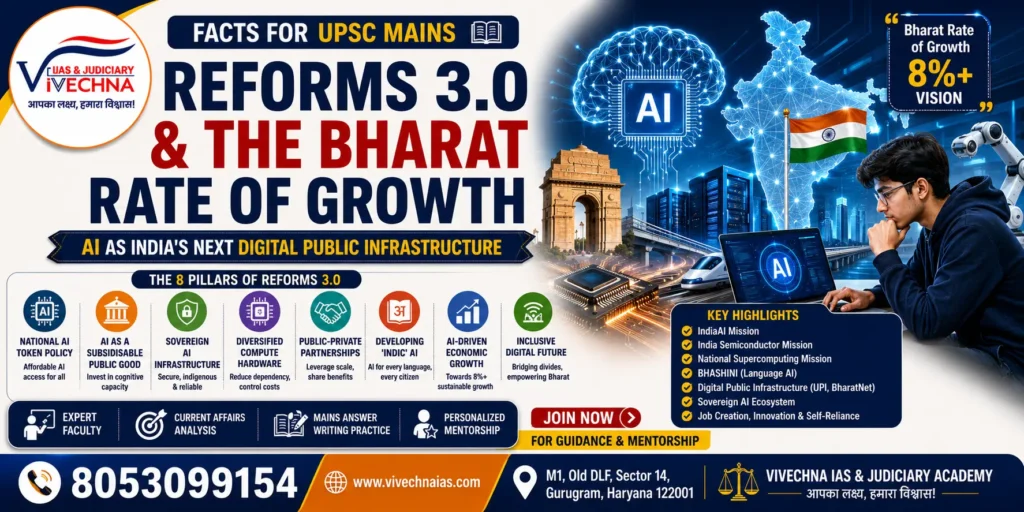
The Reforms 3.0 framework treats AI as a form of national infrastructure, resting on four pillars: a National AI Token Policy, sovereign AI infrastructure, diversified compute hardware, and Public-Private Partnerships (PPPs). The underlying logic is to make AI tools affordable and widely accessible while simultaneously building indigenous capability — so that India moves from being a passive consumer of foreign AI software to an active, self-reliant producer within a sovereign AI ecosystem.
Key Pillars of AI-Driven Reforms 3.0
1. A National AI Token Policy
The proposal calls for India to roll out a National AI Token Policy within the next two years, built through partnerships with global cloud providers such as AWS, Google, and Microsoft. The intent is to recreate the kind of disruption Reliance Jio brought to mobile data — but this time for “cognitive computing.” Concretely, this would mean offering free AI compute credits to premier institutions like the IITs and IISc, creating API sandboxes where startups can experiment without heavy upfront cost, and rolling out AI literacy modules in school curricula.
2. Treating AI Access as a Subsidisable Public Good
India currently allocates only about 0.65% of its GDP to research and development — far below Israel (5.4%), South Korea (4.9%), the United States (3.5%), and China (2.4%). The experts argue that even a small reallocation from India’s roughly USD 49 billion annual spend on traditional physical subsidies could transform this picture. Extending free AI access to the top 100 universities, major national R&D bodies, and 5,000 senior secondary schools is estimated to cost around USD 2 billion a year — just 0.06% of GDP, or roughly a fourteenth of the food subsidy bill and a tenth of the fertiliser subsidy bill. The argument is essentially that India already spends comparable sums elsewhere, so redirecting a slice of it toward “cognitive capacity” is well within fiscal reach.
3. Building Sovereign AI Infrastructure
To avoid dependence on foreign APIs that could be cut off with little warning, the proposal recommends hosting both open-source models (such as Llama) and home-grown models (such as Sarvam) on Indian soil. AI infrastructure, in this vision, deserves the same strategic priority currently given to India’s space and nuclear programmes. Achieving this at national scale would require multi-region redundancy with near-total uptime, low-latency connectivity reaching Tier-2 and Tier-3 towns, and robust data-residency safeguards.
4. Diversifying Compute Hardware
Over-reliance on a single dominant chipmaker like NVIDIA, the proposal warns, would make a nationwide AI rollout prohibitively expensive. It suggests a balanced hardware mix of roughly 40% AWS Trainium chips for everyday domestic inference tasks, 30% Google TPUs for academic research and model training, and 30% NVIDIA GPUs reserved for specialised training and legacy compatibility. The goal is to reduce vendor lock-in while keeping costs manageable.
5. Public-Private Partnerships and Market Leverage
India’s scale — a market of 1.4 billion users — is itself a bargaining chip. The state could negotiate favourable cloud and compute capacity from global hyperscalers in exchange for land access, power supply, and accommodating data-residency rules. Revenue from enterprise-tier AI usage could then cross-subsidise free access for schools, universities, and public institutions.
6. Developing 'Indic' AI
A separate but connected priority is building foundation models fine-tuned across all 22 Scheduled Languages, so that AI’s benefits reach Tier-2 and Tier-3 cities, local courts, rural health clinics, and farming communities — not just English-speaking urban users.
Understanding the "Bharat Rate of Growth"
From the Hindu Rate to the Bharat Rate
For nearly 45 years after Independence, India’s economy grew at what economists dubbed the
“Hindu rate of growth” — a modest 3.5% to 4% annually.
- Reforms 0 (1991): Prompted by a balance-of-payments crisis, this phase introduced liberalisation, privatisation, and globalisation (LPG), unlocking a faster growth trajectory.
- Reforms 2.0 (post-2010s): This era built world-class Digital Public Infrastructure (DPI) — biometric identity systems, the Unified Payments Interface (UPI), which now processes roughly half of all real-time digital payments worldwide, and the Jio-led democratisation of affordable mobile data.
- The Bharat Rate (proposed): Reforms 3.0 would shift the frontier once again — this time from physical and basic digital infrastructure to cognitive infrastructure — with the explicit aim of sustaining 8%-plus GDP growth by turning India into a genuine Sovereign AI Ecosystem rather than a mere importer of global software.
Challenges Facing the AI-Driven Growth Model
The Compute-Energy-Climate Trilemma:
National-scale AI data centres consume 5 to 10 times more power than conventional cloud infrastructure, and their cooling needs put further strain on India's largely thermal power grid — complicating its Panchamrit pledge of Net Zero emissions by 2070.
Silicon Supply Chain Vulnerability
Despite the India Semiconductor Mission, India still cannot fabricate advanced sub-5nm chips needed for cutting-edge AI training, leaving it dependent on a supply chain dominated by Taiwan's TSMC and exposed to geopolitical shocks and export controls.
The Political Economy of Subsidy Reallocation:
Shifting money away from established physical subsidies toward "cognitive subsidies" sounds rational on paper but is politically sensitive, carrying real risk of agrarian and social backlash.
Tokenization Bias
Current large language models need disproportionately more computing power — and cost — to process Indic languages compared to English, risking a new kind of digital divide.
Gaps in Algorithmic Governance
Population-scale AI deployment is outpacing India's law-making capacity. Enforcing the Digital Personal Data Protection (DPDP) Act, 2023 against opaque AI systems, tackling embedded bias, assigning liability for AI-generated deepfakes or misinformation, and resolving IPR disputes over training data all remain unresolved.
Last-Mile Latency
Delivering real-time AI services beyond big metros needs a dense edge-computing network, but uneven 5G and BharatNet fibre coverage in rural India continues to hold this back.
Existing Government Initiatives Supporting This Vision
- IndiaAI Mission
- India Semiconductor Mission 2.0
- National Supercomputing Mission (NSM)
- BHASHINI (National Language Translation Mission)
- Digital Public Infrastructure (DPI) programme
Conclusion
Proponents describe India’s AI leapfrog as a sine qua non — an essential, non-negotiable condition — for the country’s next phase of transformation. The state’s job, in this framing, is not to write direct cheques but to set the right regulatory tone, much as spectrum auctions and
net-neutrality rules once shaped telecom growth, so that markets can build abundance on top of that foundation. With macroeconomic stability, a deep pool of tech talent, and sustained policy commitment, this ecosystem could give rise to thousands of AI-native startups over the next decade — cementing what experts are calling the “Bharat rate of growth.”
Mains Practice Question
“Artificial Intelligence has the potential to become the next Digital Public Infrastructure in India.” Discuss.
Aspirants looking to practise structured Mains answers on emerging technology themes like this one can reach out to the Vivechna IAS & Judiciary Academy team for one-on-one answer evaluation and guidance.
Mains Practice Question
“Artificial Intelligence has the potential to become the next Digital Public Infrastructure in India.” Discuss.
Aspirants looking to practise structured Mains answers on emerging technology themes like this one can reach out to the Vivechna IAS & Judiciary Academy team for one-on-one answer evaluation and guidance.
Frequently Asked Questions
- Bring down electricity consumption in industrial units
- Create meaningful short stories and songs
- Disease diagnosis
- Text-to-Speech Conversion
- Wireless transmission of electrical energy
Select the correct answer using the code given below:
- (a) 1, 2, 3 and 5 only
- (b) 1, 3 and 4 only
- (c) 2, 4 and 5 only
- (d) 1, 2, 3, 4 and 5
For daily current affairs analysis, GS mains answer writing practice, and personalised mentorship for UPSC Civil Services and Judiciary examinations, visit Vivechna IAS & Judiciary Academy and get in touch with our academic team today.