Introduction
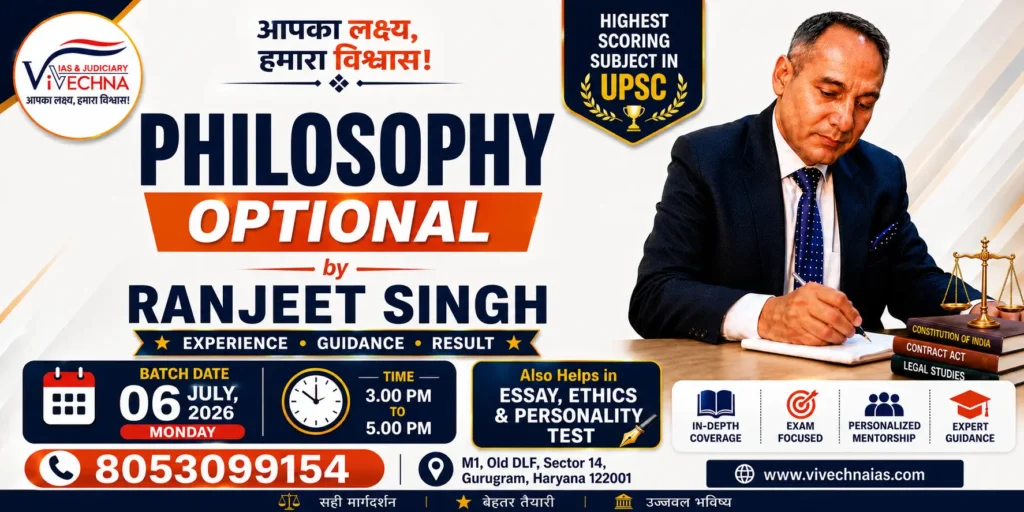
Vivechna IAS & Judiciary Academy is proud to announce the launch of its new Philosophy Optional batch for UPSC Civil Services aspirants, starting Monday, 6th July 2026. Classes will run daily from 3:00 PM to 5:00 PM, led by renowned faculty Ranjeet Singh, known for his in-depth conceptual clarity and result-oriented teaching methodology.
This new batch is designed for aspirants who want a structured, exam-focused approach to one of the most rewarding optional subjects in the UPSC syllabus. Whether you’re a beginner exploring UPSC optional subjects for the first time or a repeater looking to strengthen your Philosophy foundation, this batch offers the guidance, mentorship, and study material needed to excel.
Philosophy is widely regarded as one of the highest-scoring optional subjects in the UPSC Civil Services Examination. Its impact goes far beyond the optional paper — it strengthens your Essay preparation, sharpens your understanding for Ethics (GS Paper IV), and builds the analytical depth examiners look for in the UPSC Interview. This makes Philosophy a strategic, multi-dimensional choice rather than a standalone subject.
Complete Guide to UPSC Philosophy Optional
What is Philosophy Optional in UPSC?
Philosophy Optional is one of the optional subjects offered in UPSC Mains, consisting of two papers (Paper I and Paper II) worth 250 marks each, totaling 500 marks. Paper I covers core philosophical concepts from both Indian and Western traditions, while Paper II focuses on Socio-Political Philosophy and the philosophical study of religion, along with thinkers across both classical traditions. It tests conceptual clarity, logical reasoning, and the ability to write structured, analytical answers.
Why Choose Philosophy as an Optional Subject?
Aspirants choose Philosophy for several practical reasons:
- Compact and static syllabus — unlike current-affairs-heavy optionals, Philosophy doesn’t change yearly, making revision easier.
- High scoring potential — well-structured, logical answers consistently fetch good
- Cross-utility — concepts overlap directly with Essay, Ethics, and Interview
- No prior background required — students from any academic stream (engineering, commerce, science, arts) can take it up and do well with the right guidance.
- Language-friendly — can be attempted in Hindi or English with equal scoring
Advantages of Philosophy Optional
- Short and manageable syllabus compared to subjects like History or Public
- Improves overall answer-writing and analytical thinking across all GS
- Builds a strong ethical and philosophical vocabulary useful in the interview
- Encourages original thinking, which examiners reward
- High optional-subject success ratio when prepared with the right strategy and
UPSC Philosophy Optional Syllabus
Indian Philosophy
This section covers the six orthodox schools (Nyaya, Vaisheshika, Sankhya, Yoga, Mimamsa, Vedanta) along with Charvaka, Jaina, and Buddhist philosophy. Aspirants must understand core concepts like Pramana (means of knowledge), the nature of self (Atman), causation theories (Satkaryavada), and liberation (Moksha) across schools.
Western Philosophy
This covers the evolution of Western thought from Plato and Aristotle through Descartes, Spinoza, Leibniz, Locke, Berkeley, Hume, Kant, Hegel, and into contemporary thinkers like Russell, Moore, Wittgenstein, and existentialists such as Sartre and Kierkegaard.
Understanding the progression of epistemology and metaphysics across eras is key.
Socio-Political Philosophy
This section examines political concepts such as liberty, equality, justice, democracy, and the state, along with thinkers like Plato, Marx, Rawls, and Gandhi. It builds a strong foundation for GS Paper II and Essay writing on governance-related themes.
Philosophy of Religion
This covers the nature of religious experience, the problem of evil, arguments for and against the existence of God, the relationship between religion and morality, and the concept of afterlife across traditions.
Ethics and Moral Philosophy
This portion deals with ethical theories — deontology, consequentialism, virtue ethics — along with Indian ethical thought. It directly strengthens preparation for Ethics GS Paper IV, since many theoretical frameworks overlap.
Previous Year Question Paper Trends
Analysis of past UPSC Philosophy papers shows a consistent pattern: direct conceptual questions, comparative analysis between thinkers, and application-based questions linking philosophy to contemporary issues. Regular practice with UPSC answer writing sessions helps aspirants identify recurring themes and predict likely question patterns.
Answer Writing Strategy
Successful Philosophy answers follow a clear structure: a precise introduction defining the concept, a well-organized body with sub-headings and thinker references, use of diagrams or flowcharts where relevant, and a balanced conclusion. Precision and clarity matter more than lengthy writing — examiners reward conceptual accuracy over word count.
Booklist for Philosophy Optional
A focused booklist typically includes standard reference texts for Indian and Western Philosophy, along with concise notes for revision. Rather than reading multiple books for the same topic, aspirants are advised to master a few reliable sources thoroughly — a strategy emphasized in Vivechna’s study material approach.
Best Study Material
Quality study material should be concise, updated, and aligned with the current UPSC syllabus. Handwritten-style notes, thinker-wise summaries, and comparative charts are especially useful for quick revision before the exam.
Common Mistakes Students Make
- Memorizing without understanding core
- Ignoring answer writing practice until the last few
- Ignoring Philosophy of Religion or Socio-Political sections due to
- Not linking Philosophy concepts with Essay and Ethics
- Poor time management during the actual
Time Management Strategy
A well-planned schedule dedicates specific weekly hours to each syllabus section, follows structured revision cycles, and integrates weekly answer writing practice to avoid last-minute cramming.
How Philosophy Helps in Essay Writing
Philosophical concepts on ethics, justice, human nature, and society provide ready-made frameworks for essay introductions, arguments, and conclusions — helping aspirants write more original and thought-provoking essays. Explore Essay preparation resources to see this connection in practice.
How Philosophy Improves Ethics (GS Paper IV)
Many ethical theories studied in Philosophy Optional — utilitarianism, deontology, virtue ethics appear directly in Ethics GS Paper IV. This overlap gives Philosophy students a natural edge in both papers.
How Philosophy Helps in the UPSC Personality Test (Interview)
A background in Philosophy helps candidates articulate balanced, well-reasoned opinions during the UPSC Interview, especially on questions involving ethics, governance, and social issues — areas where philosophical grounding builds confidence and depth.
Preparation Strategy for Beginners
Beginners should start with basic conceptual clarity before moving to comparative and analytical study. Building a strong foundation in Indian and Western Philosophy early on makes advanced topics significantly easier to grasp.
Revision Strategy
Multiple structured revision cycles, supported by concise notes and thinker-wise summary charts, ensure better retention. Regular mock tests help identify weak areas before the final exam.
Test Series and Answer Evaluation
Consistent practice through a well-designed test series with detailed answer evaluation helps aspirants refine their writing style, structure, and time management under exam-like conditions.
Career Benefits of Studying Philosophy
Beyond UPSC, Philosophy builds critical thinking, ethical reasoning, and communication skills
- qualities valuable for a career in civil services, judiciary, academia, and public
Why Choose Vivechna IAS & Judiciary Academy?
Vivechna IAS & Judiciary Academy stands out as a trusted name for UPSC preparation in Gurugram, offering:
- Expert faculty led by Ranjeet Singh, bringing years of teaching experience and a proven track record in Philosophy Optional.
- In-depth conceptual teaching that builds a strong foundation rather than rote
- Exam-oriented classroom sessions designed around actual UPSC question
- Personalized mentorship through the academy’s dedicated mentorship program.
- Regular answer-writing practice with detailed feedback on structure and
- Comprehensive study material covering the entire Philosophy Optional syllabus.
- Mock tests and performance analysis to track progress throughout
- Individual doubt-solving sessions for personalized
- Integrated guidance for Essay, Ethics, and Interview preparation alongside the optional
- Offline classroom coaching at the academy’s Gurugram center, located at M1, Old DLF, Sector 14, Gurugram, Haryana 122001.
Vivechna also offers a complete UPSC Foundation Course, regular current affairs updates, and a well-defined UPSC strategy framework to support aspirants at every stage of their journey.
Batch Details at a Glance
Detail | Information |
Batch Start Date | 6th July 2026 (Monday) |
Class Timing | 3:00 PM – 5:00 PM |
Faculty | Ranjeet Singh |
Mode | Offline Classroom Coaching |
Location | M1, Old DLF, Sector 14, Gurugram, Haryana 122001 |
Contact | 8053099154 |
Frequently Asked Questions (FAQ)
Q1. When does the new Philosophy Optional batch at Vivechna IAS start? The batch begins on 6th July 2026 (Monday), with classes from 3:00 PM to 5:00 PM.
Q2. Who is the faculty for the Philosophy Optional batch? The batch is taught by Ranjeet Singh, an experienced Philosophy Optional mentor.
Q3. Is Philosophy a good optional subject for UPSC? Yes, Philosophy is considered one of the highest-scoring optional subjects due to its compact syllabus and strong overlap with Essay and Ethics (GS Paper IV).
Q4. Where is Vivechna IAS & Judiciary Academy located? The academy is located at M1, Old DLF, Sector 14, Gurugram, Haryana 122001.
Q5. Does Philosophy Optional help with the UPSC Interview? Yes, the analytical and ethical reasoning developed through Philosophy preparation helps candidates perform confidently in the Personality Test.
Q6. How can I enroll in the Philosophy Optional batch? You can call 8053099154 or visit the Vivechna IAS & Judiciary Academy center in Gurugram to enroll.
Enroll Today
Seats for the Philosophy Optional Batch 2026 are limited. Take the first step toward mastering one of UPSC’s most rewarding optional subjects with expert guidance from Ranjeet Singh at Vivechna IAS & Judiciary Academy.
📞 Call now: 8053099154
📍 Visit us at: M1, Old DLF, Sector 14, Gurugram, Haryana 122001
🌐 Explore more: vivechnaias.com
Secure your seat today and take a confident step toward your UPSC journey with Vivechna IAS & Judiciary Academy.