Philosophy Optional for UPSC: A Smart Choice for Civil Services Aspirants
Among the many decisions that shape a UPSC Civil Services journey, the choice of optional subject is one of the most consequential. It directly influences your Mains score, your revision strategy, and — in many cases — your final rank. Choose well, and it becomes an asset that rewards consistent effort. Choose poorly, and even a diligent candidate can find themselves struggling with material that drains more energy than it returns.
Philosophy Optional has, over the past several years, established itself as one of the most strategic and rewarding choices available. Its compact syllabus, deep overlap with General Studies, and inherent alignment with analytical thinking have made it a favourite among serious aspirants — including those from non-humanities backgrounds.
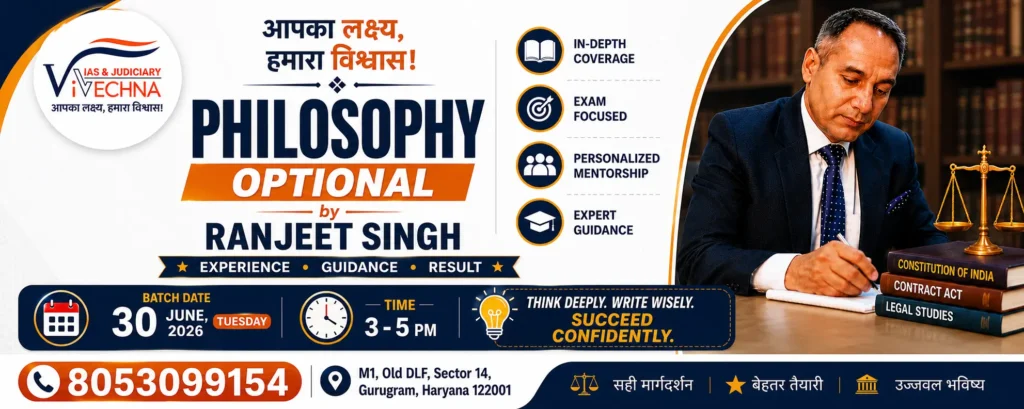
To help candidates master this high-scoring subject, Vivechna IAS & Judiciary Academy, Gurugram, has launched a dedicated Philosophy Optional Batch under the expert guidance of Ranjeet Singh. The course is designed to build genuine conceptual understanding, develop answer-writing excellence, and prepare students for every dimension of the UPSC Mains examination where Philosophy plays a role.
Why Philosophy Optional Is a Strong Strategic Choice
The decision to choose Philosophy Optional is, for many aspirants, less about prior interest and more about strategic positioning. Here is why it makes sense across multiple dimensions of UPSC preparation.
A Manageable and Concise Syllabus
Compared to many optional subjects — particularly those drawn from technical, scientific, or heavily factual domains — the Philosophy syllabus is compact. Students who plan their preparation carefully can complete the syllabus in considerably less time and still have room for multiple rounds of revision before the examination. This is a practical advantage that directly affects performance under the time constraints of UPSC preparation.
Concept Over Memorisation
Philosophy does not reward rote learning. It rewards the ability to understand an idea, articulate it clearly, situate it within a tradition of thought, and apply it to a question. For aspirants who find memory-intensive subjects exhausting, this shift in what is being tested is genuinely liberating — and strategically valuable.
Direct Contribution to Ethics (GS Paper IV)
The overlap between Philosophy Optional and GS Paper IV is not incidental — it is substantial. Topics like morality, duty, justice, integrity, human values, and ethical decision-making appear in both papers. Aspirants who study Philosophy seriously often find Ethics preparation significantly easier and their answers in GS Paper IV noticeably more mature and well-argued.
Strengthening the Essay Paper
The UPSC Essay paper consistently features themes rooted in philosophical territory: human values, freedom, justice, equality, individual and society, happiness, and ethical governance. A candidate with a Philosophy background does not merely write about these themes — they analyse them with depth, balance, and intellectual precision. This quality is clearly visible to evaluators and consistently rewarded.
Interview Preparation
The UPSC Personality Test evaluates critical thinking, rational analysis, ethical judgment, and clarity of expression. Philosophy preparation develops all of these qualities as a natural by-product of engaging seriously with the subject. Many aspirants find that their interview performance improves meaningfully after a rigorous engagement with philosophical reasoning.
Accessible to All Academic Backgrounds
Philosophy requires no prior specialist knowledge. Students from engineering, medicine, commerce, law, and humanities have all achieved excellent results with this optional. What matters is the quality of preparation, not the undergraduate background.
Understanding the UPSC Philosophy Optional Syllabus
The Philosophy Optional syllabus is divided into two papers, each with a distinct focus.
Indian Philosophy
Paper I begins with the major schools of Indian philosophical thought. Students engage with the full breadth of India's classical philosophical tradition, including:
- Charvaka — the materialist school and its critique of transcendence
- Jain Philosophy — the doctrine of anekantavada and non-absolutism
- Buddhist Philosophy — the four noble truths, dependent origination, and schools of Buddhist thought
- Nyaya and Vaisheshika — theories of knowledge, categories, and atomism
- Samkhya and Yoga — the metaphysics of consciousness and matter
- Mimamsa — the philosophy of Vedic interpretation
- Vedanta — the diverse schools from Advaita to Dvaita
Western Philosophy
The western tradition is covered through its major historical figures and movements:
- Plato and Aristotle — foundational metaphysics, epistemology, and political philosophy
- Descartes, Spinoza, Leibniz — rationalism and the structure of reality
- Locke, Berkeley, Hume — empiricism, perception, and the limits of knowledge
- Kant — the critical philosophy and its synthesis of rationalism and empiricism
Students learn not just what each thinker argued but why — the philosophical problems they were responding to and the traditions their work initiated.
Social and Political Philosophy
Paper II shifts focus to the philosophical foundations of social and political life. Key topics include equality, justice, liberty, rights, democracy, secularism, feminism, and humanism. Many of these themes overlap directly with General Studies Paper II and the Essay paper, creating natural preparation synergies.
Philosophy of Religion
This section covers the nature and scope of religion, the classical arguments for the existence of God, the nature of religious experience, the relationship between faith and reason, the problem of evil, and religious pluralism. Beyond its examination relevance, this section develops the critical argumentation skills that strengthen answers across multiple UPSC papers.
Common Myths About Philosophy Optional — Addressed
Despite its strategic advantages, several misconceptions deter aspirants from considering Philosophy Optional seriously. These deserve direct examination.
Philosophy is concept-based, not memory-based. The challenge lies in understanding ideas, not in memorising large volumes of content. With proper guidance and a structured approach, the subject becomes highly accessible — and most students find that their comfort with the material grows quickly once they have the conceptual foundations in place.
This is simply not supported by the evidence. Engineering graduates, medical students, commerce graduates, and law graduates have consistently performed well in Philosophy Optional. Logical and analytical thinking — which students from technical and legal backgrounds often possess in abundance — is precisely what the subject rewards.
Aspirants today have access to standard reference books, coaching notes, test series, previous year question papers, and online resources. At Vivechna IAS & Judiciary Academy, students receive comprehensive study material covering the entire syllabus, with faculty guidance on which resources are most examination-relevant.
Complex philosophical concepts, when taught correctly, are grounded through examples, comparative analysis, and practical applications. What appears abstract on a first reading typically becomes clear and manageable with good instruction and consistent engagement.
Reality at a Glance
-
✓Concept-based learning instead of rote memorisation.
-
✓Suitable for engineering, medicine, commerce, law and humanities graduates.
-
✓Comprehensive study material and structured faculty guidance.
-
✓Abstract ideas become simple through examples, comparison and practice.
-
✓A strategic optional with excellent scoring potential when prepared correctly.
Teaching Methodology at Vivechna IAS & Judiciary Academy
The Philosophy Optional programme at Vivechna is structured around a clear pedagogical progression that takes students from foundational understanding to examination readiness.
Stage 1 — Concept Building
Every topic begins with conceptual clarity. Students learn philosophical terminology, the core arguments of major thinkers, and the internal logic of each school of thought before engaging with examination-style questions. This foundation is essential — without it, even well-memorised notes produce weak answers.
Stage 2 — Comparative Analysis
Philosophy examinations frequently reward the ability to compare — Buddhist thought against Vedanta, Locke against Hume, rationalism against empiricism. Students are trained to identify similarities, differences, and the intellectual tensions between schools and thinkers. This analytical dimension significantly improves answer quality and examiner perception of the candidate's depth.
Stage 3 — Answer Writing Practice
This is where preparation is converted into marks. Special attention is given to the structure of strong Philosophy answers: a clear introduction that identifies the issue, conceptual explanation of the relevant principle, critical evaluation that acknowledges counterarguments, contemporary relevance, and a purposeful conclusion. Daily writing practice builds the fluency and precision that examination conditions demand.
Stage 4 — Revision and Mock Testing
The course includes topic-wise tests, full-length mock examinations, answer evaluation, and performance feedback. Regular testing identifies gaps, builds confidence, and ensures that the quality of preparation holds under timed conditions. The structured revision programme — aligned with the compact nature of the syllabus — allows students to revisit the entire material multiple times before the examination.
Why Answer Writing Is the Key to Philosophy Optional Success
Knowledge of Philosophy is necessary but not sufficient. The candidates who score exceptionally well are those who translate their understanding into structured, well-argued written answers — consistently and under time pressure.
Evaluators in Philosophy Optional reward candidates who demonstrate clarity, precision, and analytical depth rather than simply reproducing information. Strong answers present philosophical ideas logically, critically evaluate arguments, and establish contemporary relevance wherever appropriate.
Practice Makes the Difference
These are learnable skills. They improve with deliberate practice, expert feedback, and a clear understanding of what evaluators are looking for. At Vivechna, answer writing is treated as a central component of preparation, not an afterthought.
Evaluators Reward
- ✓ Clarity of thought and expression
- ✓ Precise use of philosophical terminology
- ✓ Logical coherence from introduction to conclusion
- ✓ Evidence of critical engagement — not just exposition
- ✓ Awareness of contemporary relevance
Personalized Mentorship and Individual Support
Every UPSC aspirant brings a different academic background, a different schedule, and a different set of strengths and weaknesses. Generic instruction rarely addresses individual needs effectively. At Vivechna, personalised mentorship is built into the programme structure.
Students receive one-on-one guidance, dedicated doubt resolution sessions, personalised feedback on written answers, and study planning support tailored to their timeline and circumstances. This level of individual engagement helps aspirants stay focused, make consistent progress, and address problems before they compound.
What You Receive
- ✓ One-on-one mentorship and academic guidance
- ✓ Dedicated doubt resolution sessions
- ✓ Personalised evaluation of answer writing
- ✓ Individual study planning based on your preparation timeline
- ✓ Continuous monitoring to ensure consistent progress
Who Should Join This Course?
The Philosophy Optional Batch is designed for a wide range of aspirants, whether you are beginning your preparation, changing your optional subject, or balancing UPSC studies alongside professional commitments.
Ideal Candidates
-
✓First-time UPSC students beginning their optional subject preparation from scratch.
-
✓Working professionals who need a manageable syllabus that can be prepared alongside professional responsibilities.
-
✓Engineering and science graduates who are drawn to the analytical, argument-based nature of the subject.
-
✓Humanities and social science graduates who can build on existing familiarity with social and political concepts.
-
✓Law graduates for whom the relationship between legal and philosophical reasoning is a natural connection.
-
✓Repeater candidates seeking to change or strengthen their optional subject for a subsequent attempt.
No Prior Philosophy Background Required
The course begins from foundational concepts and builds systematically toward advanced examination-level mastery. No prior exposure to Philosophy is required, making it suitable for aspirants from every academic background.
Batch Details
M1, Old DLF Colony, Sector 14,
Gurugram, Haryana – 122001
Conclusion
The right optional subject does not just contribute marks — it shapes how a candidate thinks, writes, and reasons across the entire UPSC examination. Philosophy Optional, chosen and prepared well, does precisely this. It builds the analytical depth that strengthens Essays. It provides the conceptual vocabulary that elevates Ethics answers. It develops the structured argumentation that impresses interviewers.
Its concise syllabus makes thorough preparation genuinely achievable. Its scoring potential, demonstrated consistently by successful candidates across years, is real. And its intellectual rewards — the habit of clear thinking, careful argument, and reasoned judgment — extend well beyond the examination hall.
At Vivechna IAS & Judiciary Academy, the Philosophy Optional Batch is designed to help you capture all of these advantages — through expert teaching, structured preparation, consistent writing practice, and mentorship that keeps you focused on what matters.
Whether you are beginning your UPSC journey or looking to strengthen your optional subject performance, this course provides the foundation, the guidance, and the preparation framework to take you where you want to go.