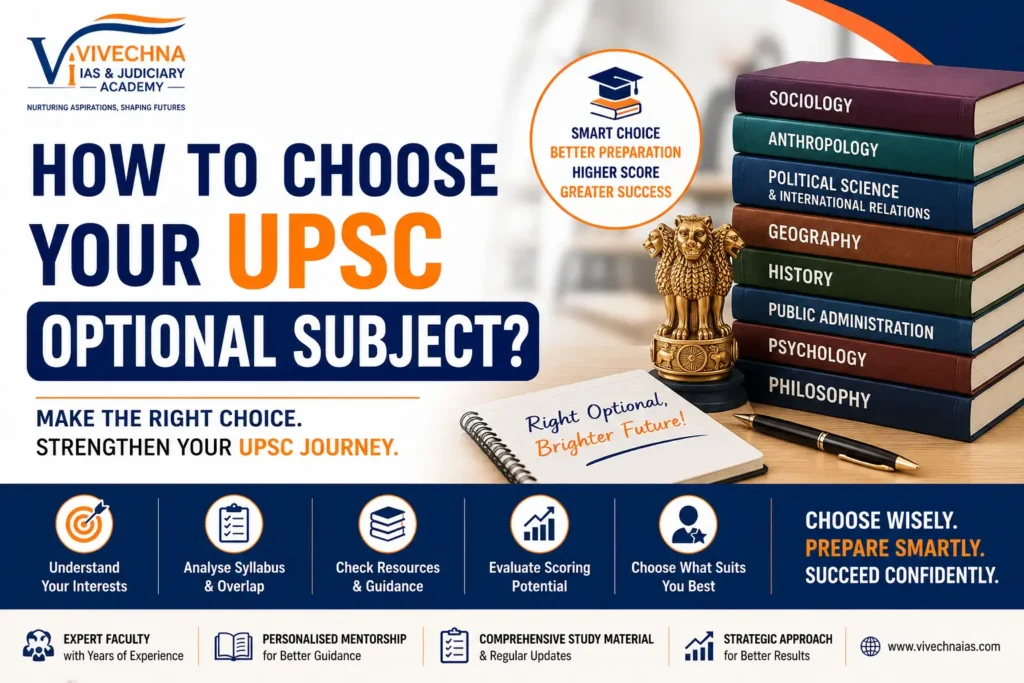
How to Choose Your UPSC Optional Subject: The Most Important Decision in UPSC Preparation
Every year, thousands of UPSC aspirants begin their Civil Services Examination (CSE) journey with enthusiasm and determination. However, one question creates more confusion than almost any other:
“How do I choose my UPSC optional subject?”
The optional subject carries 500 marks in the UPSC Mains Examination and often becomes the deciding factor between selection and rejection. A well-chosen optional can significantly boost your rank, while a poorly chosen one can create unnecessary challenges throughout your preparation journey.
This guide will help you understand how to choose your UPSC optional subject strategically and confidently.
Why is the Optional Subject So Important?
The UPSC Mains Examination consists of nine papers, but the optional subject contributes:
Paper I – 250 Marks
Paper II – 250 Marks
Total: 500 Marks
These marks can dramatically influence your final ranking and service allocation.
Unlike General Studies papers, the optional subject allows candidates to develop specialization and score exceptionally well through focused preparation.
Common Myths About UPSC Optional Subjects
Before selecting an optional, let’s clear some misconceptions.
Myth 1: There Is a “Best” Optional Subject
There is no universally best optional subject.
Every year, successful candidates come from diverse optional backgrounds including:
Sociology
Political Science
Geography
Anthropology
History
Public Administration
Psychology
Philosophy
Literature Subjects
Success depends more on preparation than the subject itself.
Myth 2: Choose the Subject with the Highest Success Rate
Success rates fluctuate every year.
A subject that performed exceptionally well one year may not produce similar results the next year.
Choosing solely based on trends is risky.
Myth 3: Graduation Subject is Always the Best Choice
Many toppers have cleared UPSC with optional subjects different from their academic backgrounds.
Your graduation subject can be an advantage, but it should not be the only factor.
Factors to Consider While Choosing an Optional Subject
1. Personal Interest
Interest should be your first consideration.
You will spend hundreds of hours studying your optional subject.
Ask yourself:
Do I enjoy reading this subject?
Can I study it for a year or more?
Am I genuinely curious about the topics?
A subject that interests you will feel less burdensome and easier to revise repeatedly.
2. Syllabus Size
Some optional subjects have vast syllabi, while others are relatively concise.
Generally Considered Compact
Philosophy
Anthropology
Psychology
Sociology
Generally Considered Extensive
History
Geography
Political Science
Public Administration
A manageable syllabus can help candidates balance optional preparation with General Studies.
3. Availability of Study Material
Choose a subject with:
Good standard books
Coaching support
Previous year question analysis
Test series availability
Quality online resources
Availability of guidance can significantly reduce preparation time.
4. Overlap with General Studies
A subject with GS overlap can improve efficiency.
High Overlap Subjects
Political Science & International Relations
Overlap with:
GS II
International Relations
Essay
Geography
Overlap with:
GS I
Environment
Disaster Management
Sociology
Overlap with:
Society
Essay
Ethics
History
Overlap with:
GS I
Culture
The greater the overlap, the more efficient your preparation becomes.
5. Previous Year Question Papers
Before finalizing any optional:
Download the last 5–10 years’ papers.
Read the questions carefully.
Assess your comfort level.
This exercise often provides more clarity than syllabus comparisons.
Popular UPSC Optional Subjects
Sociology
Why Students Choose It
Compact syllabus
Easy concepts
Strong overlap with GS and Essay
Good scoring potential
Best For
Beginners
Working professionals
Candidates from non-humanities backgrounds
Anthropology
Why Students Choose It
Short syllabus
Scientific approach
Consistent popularity among toppers
Best For
Science graduates
Medical background students
Political Science & International Relations (PSIR)
Why Students Choose It
Strong GS overlap
Useful for interviews
Helps in current affairs understanding
Best For
Humanities students
Candidates interested in politics and governance
Geography
Why Students Choose It
Scientific and analytical
Good overlap with GS
Best For
Engineering students
Science graduates
History
Why Students Choose It
Extensive resources available
Significant GS overlap
Best For
Students who enjoy historical reading
Questions to Ask Before Finalizing an Optional
Can I Read This Subject Every Day?
If the answer is no, reconsider.
Can I Complete the Syllabus in 6–8 Months?
A realistic timeline is essential.
Are Resources Easily Available?
Lack of quality guidance can create preparation difficulties.
Do I Understand the Previous Year Questions?
Understanding UPSC’s questioning style is crucial.
Mistakes to Avoid While Choosing an Optional
Following Friends Blindly
What works for someone else may not work for you.
Chasing Trends
Popularity changes every year.
Ignoring Personal Interest
Interest sustains long-term preparation.
Focusing Only on Success Rates
Success rates alone never tell the complete story.
Taking Too Long to Decide
Many aspirants waste months deciding.
Aim to finalize your optional within the first few weeks of preparation.
How Vivechna IAS Helps Aspirants Choose the Right Optional
At Vivechna IAS & Judiciary Academy, we guide aspirants through a structured optional selection process based on:
Academic background
Personal interests
Career goals
Strengths and weaknesses
Syllabus analysis
UPSC trends
Our mentors help students make informed decisions instead of relying on myths or social media opinions.
Final Thoughts
Choosing an optional subject is one of the most important decisions in UPSC preparation.
The ideal optional subject is not the most popular one or the one with the highest success rate. It is the subject that matches your interests, strengths, preparation style, and long-term commitment.
Remember:
Interest matters.
Consistency matters.
Answer writing matters.
Revision matters.
Choose wisely, prepare systematically, and your optional subject can become one of your greatest strengths in the UPSC Civil Services Examination.
The right optional won’t guarantee success—but the wrong optional can make success much harder.