Space Technology in the Service of Humanity: India's Journey from Earth to the Stars
Space Technology in the Service of Humanity
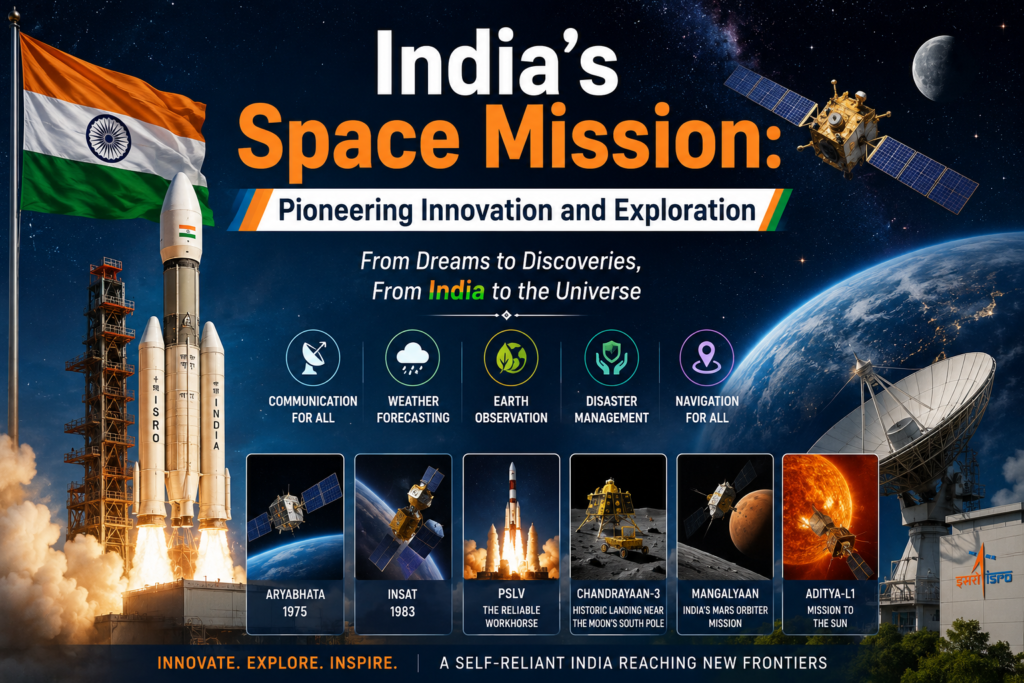
India’s space programme stands as one of the greatest examples of how science and technology can be used for national development and the welfare of humanity. From launching modest sounding rockets in the 1960s to becoming the first nation to successfully land near the Moon’s south pole through Chandrayaan-3, India’s achievements have inspired the world and transformed the country’s technological landscape.
For UPSC aspirants, Space Technology is a highly important topic in General Studies, Current Affairs, Science & Technology, and Internal Security. Understanding India’s space missions, policies, and technological advancements is essential for success in the Civil Services Examination.
India's Space Journey: From Humble Beginnings to Global Leadership
India’s connection with rocketry can be traced back to the 18th century when Tipu Sultan used advanced rockets during the Mysore Wars against British forces. These innovations later influenced the development of modern military rockets across Europe.
The modern era of India’s space programme began under the visionary leadership of Dr. Vikram Sarabhai, often called the Father of the Indian Space Programme. His belief that space technology should directly contribute to national development became the foundation of India’s space policy.
A memorable symbol of India’s determination was seen in 1981 when the APPLE communication satellite was transported on a bullock cart during launch preparations. Today, India is recognized as one of the world’s leading space powers, capable of conducting complex lunar, solar, and interplanetary missions.
Formation of ISRO: Building India's Space Future
The Indian Space Research Organisation (ISRO) is India’s premier space agency responsible for developing and applying space technology for national development.
Important Timeline
- 1962: Establishment of the Indian National Committee for Space Research (INCOSPAR)
- 1963: First sounding rocket launched from Thumba Equatorial Rocket Launching Station
- 1969: Formation of ISRO
- 1972: Creation of the Department of Space (DoS)
- 1975: Launch of Aryabhata, India’s first satellite
Since its inception, ISRO has played a critical role in communication, navigation, weather forecasting, disaster management, resource mapping, and scientific research.
Objectives of India's Space Programme
India’s space programme aims to leverage space technology for socio-economic development and scientific advancement.
Key Objectives
- Satellite Communication
- Television Broadcasting
- Weather Forecasting and Meteorology
- Natural Resource Monitoring
- Disaster Management Support
- Navigation and Positioning Services
- Space Science Research
- Planetary Exploration
To achieve these goals, ISRO developed world-class launch vehicles such as:
- PSLV (Polar Satellite Launch Vehicle)
- GSLV (Geosynchronous Satellite Launch Vehicle)
- LVM3 (Launch Vehicle Mark-3)
These launch systems have enabled India to independently place satellites into various orbits and conduct deep-space missions.
Major Milestones in India's Space Programme
Aryabhata (1975)
India’s first satellite marked the country’s entry into the global space community and laid the foundation for future advancements.
SITE Programme
The Satellite Instructional Television Experiment demonstrated how satellite communication could support education and rural development.
Rakesh Sharma’s Space Mission (1984)
Wing Commander Rakesh Sharma became the first Indian to travel into space, creating a historic moment for the nation.
INSAT and IRS Satellites
The INSAT communication system and Indian Remote Sensing satellites transformed telecommunications, weather forecasting, agriculture monitoring, and disaster management.
Chandrayaan-1 (2008)
India’s first lunar mission discovered evidence of water molecules on the Moon, a breakthrough finding for global lunar research.
Mars Orbiter Mission (Mangalyaan) (2013)
India became the first country in the world to successfully reach Mars orbit on its maiden attempt, demonstrating exceptional cost-effective engineering.
Record Satellite Launch (2017)
ISRO launched 104 satellites in a single mission, setting a world record and showcasing India’s launch capabilities.
NavIC: India's Indigenous Navigation System
NavIC (Navigation with Indian Constellation) is India’s regional satellite navigation system developed to provide accurate positioning services across India and surrounding regions.
Key Features
- Indigenous technology
- Strategic independence
- Accurate navigation services
- Support for transportation, disaster management, and defense operations
NavIC is increasingly being integrated into smartphones, vehicles, and national infrastructure systems.
Recent Landmark Missions of India
Chandrayaan-3
Chandrayaan-3 achieved a historic soft landing near the Moon’s south pole, making India the first nation to accomplish this feat.
Significance
- Demonstrated advanced landing technology
- Expanded lunar exploration capabilities
- Enhanced India’s global scientific reputation
Aditya-L1
India’s first dedicated solar mission is studying the Sun from the Lagrange Point L1.
Objectives
- Study solar storms
- Understand solar wind dynamics
- Improve space weather forecasting
Gaganyaan Mission
Gaganyaan aims to send Indian astronauts into space using an indigenous spacecraft.
Importance
- Strengthening human spaceflight capability
- Promoting advanced research
- Encouraging innovation and STEM education
Mission Shakti
Mission Shakti demonstrated India’s Anti-Satellite (ASAT) capability and established the country as a major space-security power.
Indian Space Policy 2023: Opening New Opportunities
Recognizing the growing importance of the global space economy, the Government of India introduced the Indian Space Policy 2023.
Key Highlights
- Greater private sector participation
- Promotion of space startups
- Enhanced satellite manufacturing
- Commercial launch opportunities
- International collaboration
Organizations such as IN-SPACe and NSIL are helping private companies contribute to India’s rapidly growing space ecosystem.
Why Space Technology is Important for UPSC Aspirants
Space technology is a recurring topic in UPSC Prelims, Mains, and Interviews.
Important UPSC Areas
- Science and Technology
- Current Affairs
- Internal Security
- Disaster Management
- Governance
- International Relations
Questions related to ISRO missions, satellite technology, space policy, and international cooperation frequently appear in UPSC examinations.
At Vivechna IAS Academy, students receive comprehensive coverage of Science & Technology through updated current affairs, expert mentorship, answer-writing practice, and concept-based learning designed for UPSC 2027 and future examinations.
The Future of India's Space Sector
India’s space ambitions continue to grow rapidly. Upcoming projects include:
- Bharatiya Antariksha Station
- Chandrayaan-4
- Venus Mission (Shukrayaan)
- Expanded Human Spaceflight Missions
- Advanced Earth Observation Satellites
With increasing private-sector participation and supportive government policies, India is poised to become a major contributor to the global space economy.
Conclusion
India’s space programme is more than a scientific success story—it is a powerful example of how innovation can serve humanity. From Aryabhata to Chandrayaan-3 and from satellite communication to future human spaceflight missions, India’s achievements continue to inspire the world.
For UPSC aspirants, understanding space technology is essential not only for examination success but also for appreciating how science drives governance, development, and national progress. As India moves toward becoming a leading space power, the opportunities for learning, innovation, and exploration are truly limitless.