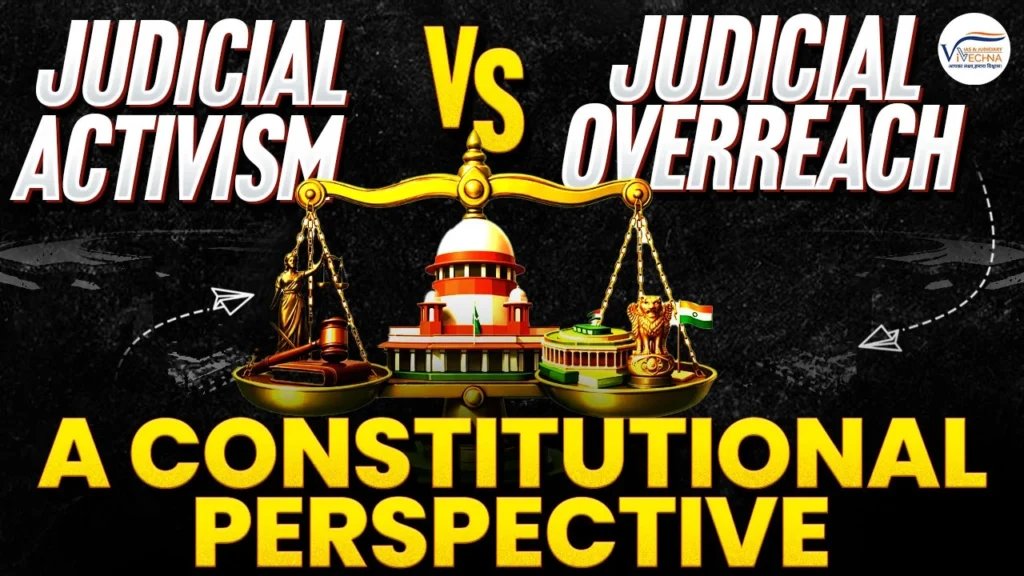
Judicial Activism and Judicial Overreach are really connected. They are not the same thing. Judicial Activism has been very important for making our democracy stronger and for protecting the rights of people in India. On the other hand, Judicial Overreach is a big problem because it can interfere with the way our government is supposed to work, with the different parts having separate powers.
In the last few years, courts have gotten involved in things like environmental regulation, governance, public administration, and policy-making. This has started a discussion about when courts are doing their job and when they are doing too much.
This article looks at environmental regulation, governance, public administration, and policy-making from a constitutional point of view. It uses court decisions and current examples to make its points.
Role of the Judiciary in a Constitutional Democracy
The Indian Constitution believes in a balance of power among the Legislature, the Executive, and the Judiciary. The Judiciary acts as:
- Guardian of the Constitution
- Protector of Fundamental Rights
- Interpreter of laws
- Check on arbitrariness and misuse of power
The judiciary is not a policy-making body. It gets its power from the rules set out in the Constitution and from people believing in it. The judiciary has to follow these rules and make sure people trust it.
Judicial Activism, Judicial Overreach and Judicial Restraint
Judicial Activism
Judicial Activism is when the courts take an active part in saying what the laws and the Constitution really mean. This means the judiciary plays a role to make sure people’s rights are protected and justice is served. The courts also fill in the gaps that the legislative or executive branches may have missed.
The term was created by Arthur Schlesinger Jr. in 1947.
In India, judicial activism became important due to judges like:
- Justice V.R. Krishna Iyer
- Justice P.N. Bhagwati
- Justice O. Chinnappa Reddy
- Justice D.A. Desai
Judicial activism in India is most visible through:
- Expansion of Article 21
- Growth of Public Interest Litigation (PIL)
- Relaxation of locus standi
- Judicial guidelines in the absence of legislation
Judicial Overreach
Judicial Overreach happens when courts do more than they are supposed to do. They go beyond what the Constitution allows and start doing things meant for the Legislature or Executive.
Former Prime Minister Dr. Manmohan Singh said:
“The line between judicial activism and judicial overreach is a thin one.”
Judicial overreach undermines:
- Separation of powers
- Democratic accountability
- Institutional competence
Judicial Restraint
Judicial Restraint means courts should use self-discipline and limit interference in policy matters. Courts should respect the legislature unless there is a clear constitutional violation.
Courts following restraint rely on:
- Law
- Constitutional text
- Original intent of framers
- Precedents
- Institutional boundaries
Why Judicial Activism Became Necessary in India
Judicial activism became necessary because the legislature and executive often failed to perform their duties. Courts had to step in to ensure fairness and protect rights.
Judicial activism is necessary because:
- Government actions are not always fair
- Marginalised groups often lack access to justice
- Environmental and social issues need protection
Judicial activism keeps the government in check and ensures people’s rights are protected.
1. Failure of Legislature and Executive
- Delay in law-making
- Executive apathy
- Corruption and inefficiency
- Inability to respond to social change
Courts had to intervene to protect democratic values.
2. Protection of Fundamental Rights
Courts intervened when:
- State actions violated basic rights
- Marginalised groups lacked access to justice
Article 21 was expanded to include:
- Dignity
- Livelihood
- Legal aid
- Speedy trial
3. Legislative Vacuum
When laws did not exist, courts issued temporary guidelines, such as:
- Vishaka v. State of Rajasthan (1997) – Sexual harassment at workplace
These guidelines were followed as law until Parliament legislated.
4. Public Confidence in Judiciary
The judiciary enjoys greater public trust compared to other institutions and acts as the last protector of rights.
Early and Landmark Cases of Judicial Activism in India
- A.K. Gopalan v. State of Madras (1950)
- R.C. Cooper v. Union of India (1970)
- Golaknath v. State of Punjab (1971)
- Kesavananda Bharati v. State of Kerala (1973)
- Hussainara Khatoon v. State of Bihar (1979)
- Bhagalpur Blinding Case (1980)
- PUDR v. Union of India (1982)
These cases reshaped constitutional interpretation in India.
Judicial Overreach: When Judges Get Too Powerful
Judicial overreach occurs when judges start making laws instead of interpreting them. This undermines fairness and public trust.
Judicial overreach includes courts:
- Entering policy formulation
- Issuing executive-style directions
- Deciding technical or economic matters beyond expertise
Instances of Judicial Overreach in India
1. National Anthem Case (2018)
Mandatory playing of the anthem in cinema halls raised concerns about individual freedom.
2. NJAC Case (2015)
Striking down the amendment raised concerns about judicial monopoly in appointments.
3. Liquor Ban on Highways Case
Economic and federal implications without empirical backing.
4. Jolly LLB II Case (2021)
Judicial interference in film certification.
Criticisms of Judicial Overreach
Violation of Separation of Powers
Judiciary cannot compel the legislature to create laws beyond existing frameworks.
Lack of Accountability
Judiciary is not directly answerable to the people.
Lack of Expertise
Courts may lack expertise in economic, environmental, and administrative matters.
Erosion of Public Trust
Arbitrary decisions reduce institutional legitimacy.
Judicial Restraint: The Constitutional Necessity
Judicial restraint ensures:
- Institutional balance
- Democratic legitimacy
- Predictability in law
Key Judgments Emphasising Restraint
- Aravali Golf Club v. Chander Hass (2007)
- Indian Medical Association v. Union of India (2011)
- Ram Janmabhoomi Case (2019)
Former CJI Justice A.S. Anand warned against judicial “adventurism”.
Steps to Ensure Judicial Restraint
- Strong judicial ethics and codes of conduct
- Transparency in reasoning
- Respect for institutional competence
- Balanced judicial appointments
Conclusion
Judicial activism has played a major role in achieving social justice in India, but excessive judicial intervention can disturb the balance of power.
A healthy democracy requires:
- A proactive yet restrained judiciary
- Responsible legislature and executive
- Mutual respect among institutions
The future of constitutionalism lies in constitutional harmony, not judicial dominance.
For Judiciary & PCS-J Aspirants
This topic is:
- Highly relevant for Judiciary Mains
- Frequently asked in constitutional law questions
- Important for GS-II (Polity & Governance)
At Vivechna IAS & Judiciary Academy, aspirants receive:
- Case-law orientation
- Answer-writing focus
- Exam-ready constitutional analysis
📍 Sector 14, Gurgaon
📞 +91 8053099154
📧 info@vivechnaias.com
FAQs: Judicial Activism vs Judicial Overreach
1. What is judicial activism in India?
Judicial activism refers to the proactive role of courts in interpreting the Constitution to protect fundamental rights, fill legislative gaps, and ensure justice, especially through Public Interest Litigations (PILs).
2. What is judicial overreach?
Judicial overreach occurs when courts exceed their constitutional authority by encroaching upon the functions of the legislature or executive.
3. What is the difference between judicial activism and judicial overreach?
Judicial activism aims to uphold constitutional values and protect rights, while judicial overreach involves courts stepping into policy-making or administrative roles beyond their mandate.
4. Why is judicial activism important in India?
Judicial activism became important due to legislative inaction, executive failures, and the need to protect fundamental rights, especially of marginalised sections of society.
5. What is judicial restraint?
Judicial restraint is a principle where courts limit interference in policy matters and respect the roles of the legislature and executive unless there is a clear constitutional violation.
6. Which are landmark cases on judicial activism in India?
Important cases include Kesavananda Bharati, Vishaka v. State of Rajasthan, Hussainara Khatoon, and Maneka Gandhi.
7. What are examples of judicial overreach in India?
Examples include the National Anthem case, liquor ban near highways, and excessive judicial interference in executive policy matters.
8. Is judicial activism relevant for Judiciary and PCS-J exams?
Yes. Judicial activism vs judicial overreach is a high-frequency topic in Judiciary Mains, PCS-J, and UPSC GS-II.